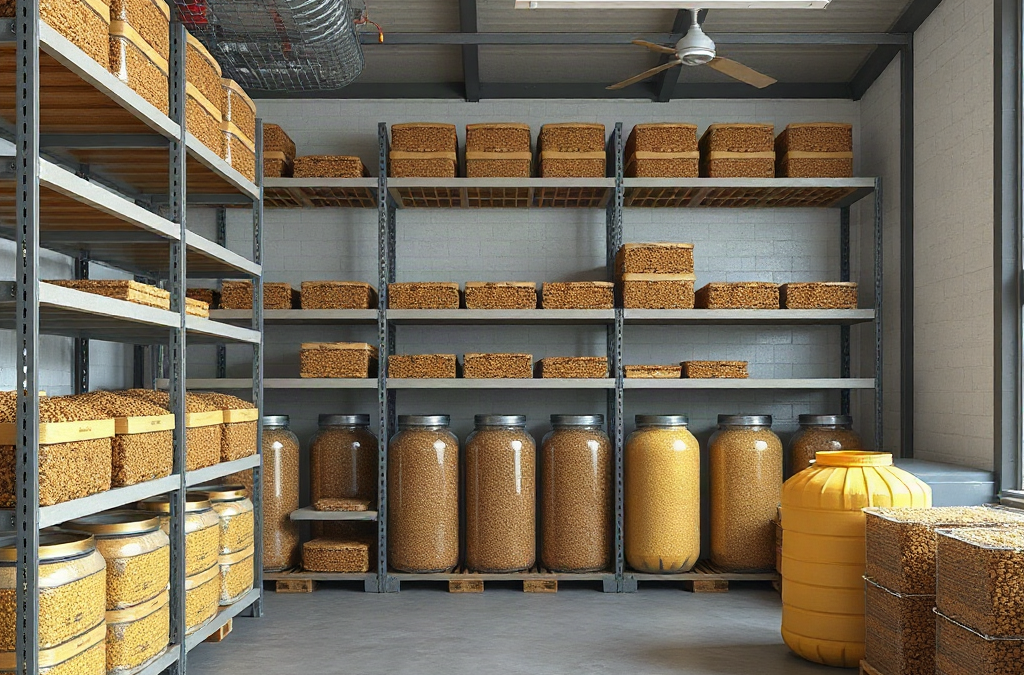
Grain storage shelves should keep sealed containers off the floor, provide enough clearance for cleaning and inspection, and support the full weight of densely packed grain without sagging or tipping. Choose moisture-resistant shelving, place the heaviest containers on lower levels, and leave visible space around bins so leaks, condensation, insects, and rodent activity are easier to detect. Floor clearance also limits exposure to minor spills and damp concrete, though elevation cannot compensate for a wet room or poorly sealed packaging. The safest setup combines stable shelves, intact food-grade containers, accessible aisles, controlled room conditions, and a rotation system that prevents old stock from disappearing behind new purchases.
Why Does Floor Clearance Matter for Stored Grain?
Floor clearance creates an inspection and cleaning zone beneath stored grain rather than serving as a substitute for moisture control. A raised container is easier to examine from several sides, and dust, spilled kernels, droppings, webbing, or water can be seen before the problem spreads through a larger stock. Containers sitting directly on a floor hide their bottom surfaces and make routine sweeping or vacuuming difficult.
Concrete deserves particular attention because it can feel dry while remaining cooler than the surrounding air. When a grain container rests against that cool surface, the container base may experience different temperature conditions from its upper portion. Elevation allows air to move around the package and makes dampness easier to notice. This does not mean that every concrete floor will damage grain, nor does it guarantee that raising a bucket will stop condensation. Room humidity, temperature swings, container temperature, and the moisture condition of the grain still govern the actual risk.
Clearance also protects against small plumbing leaks, seepage, and routine cleaning water. A shallow incident may reach a sack or cardboard package on the floor long before it reaches a container supported on a shelf. Rigid food-grade buckets resist brief exterior contact better than paper sacks, but wet labels, dirty lids, and trapped moisture under bucket rims can still complicate inspection. Elevation buys visibility and response time; it does not make packaging waterproof.
A common mistake is to treat any improvised platform as adequate. Cardboard sheets absorb moisture, conceal insects, and compress under heavy buckets. Loose boards laid across unstable blocks may bow or shift when containers are moved. Even pallets can create deep recesses that are hard to clean and may introduce splinters, dirt, or pest shelter if their history and condition are unknown.
Choose a clearance that lets you see and clean beneath the lowest shelf with the tools used in that room. A low platform may be sufficient for a few sealed pails in a dry pantry, while a larger storeroom benefits from enough open space for a vacuum nozzle, mop, inspection light, or pest-monitoring device. The useful measurement is therefore practical access, not a universal number detached from the shelf design and room conditions.
Which Shelves Work Best for Grain Containers?
Grain shelving must be selected by loaded weight, resistance to the room environment, and structural stability. Dry grain is dense, and several full buckets concentrated on one shelf can impose far more load than boxes of lightweight pantry goods. The shelf manufacturer’s stated capacity should apply to the assembled unit and should not be exceeded. Capacity can also depend on distributing weight across the shelf rather than placing every heavy container in the center.
Steel shelving is often practical for larger stocks because it provides high capacity without excessively thick shelf panels. Coated steel is easier to wipe than unfinished wood, but chipped coatings and humid rooms can permit corrosion. Wire decking encourages airflow and reveals spills, although narrow bucket bases may sit unevenly unless the shelf is designed for them. A rigid, cleanable shelf liner can improve support, provided it does not create hidden pockets where grain dust or moisture accumulates.
Wood shelves can work in a dry, controlled room when the framing and panels are sized for the load. Their limitations are absorption, warping, and joints that may harbor dust or insects. Thin particleboard is particularly vulnerable if a leak wets an edge; swelling can reduce strength before the damage looks severe. Smooth sealed surfaces are easier to inspect than rough lumber, but finishes should be fully cured and containers should remain closed so grain does not contact the shelving material.
Plastic shelving resists rust and is easy to wash, yet some units flex under concentrated bucket loads. Visible bowing, spreading legs, loose connectors, or shelves that no longer sit level are failure signs rather than cosmetic issues. Adding more containers because unused surface area remains is unsafe when the rated load has already been reached.
Stability matters as much as nominal capacity. Place heavier grain containers on the lowest usable levels and lighter packages above them. Tall units should stand on a level surface and be secured according to their manufacturer’s instructions where tipping is a concern. Do not improvise wall attachment through weak trim, plumbing chases, or unknown wall material. In rented spaces or rooms where anchoring is impractical, a shorter, wider shelving unit may offer a better tradeoff than a tall rack with more theoretical capacity.
Before buying shelves, total the expected container weights rather than counting containers alone. Compare that load with the rating for each shelf and the entire unit, then leave room for ordinary handling rather than designing to the absolute limit. The right shelf is one that remains level, accessible, and stable after the grain is loaded—not merely one that fits the empty containers.
How Much Spacing and Access Should Shelves Provide?
Shelf spacing should permit containers to be lifted, opened, labeled, and inspected without scraping the shelf above. A bucket that technically fits but must be tilted sharply to remove is poorly placed, especially when it is heavy. Leave hand clearance above lids and enough front space to pull each container forward without first unloading an entire row.
Deep shelves increase capacity but can undermine rotation. When two or three rows of identical buckets are packed front to back, the oldest grain tends to disappear behind newer stock. Deep storage also hides leaks and pest evidence along the wall. If deep racks are unavoidable, assign each position, mark purchase or packing dates prominently, and keep a simple map or inventory record. Containers should not be stacked so tightly that their sides and lids cannot be checked.
A compact planning table helps translate room conditions into usable clearance:
| Layout Area | What Clearance Must Allow | Warning Sign |
|---|---|---|
| Below the lowest shelf | Visual inspection and access for the chosen cleaning tool | Dust or spills cannot be removed without unloading the rack |
| Above containers | Safe gripping, lid checks, and removal without severe tilting | Knuckles strike the shelf or lids scrape during removal |
| In front of shelving | Lifting with stable footing and room to turn | Containers must be carried sideways through a narrow gap |
| Beside walls or corners | Inspection for dampness, insects, and rodent evidence | The wall surface is completely hidden |
Aisle planning should reflect the heaviest item that will be handled. A narrow pantry may accommodate small jars, but a full grain pail needs space for a balanced two-handed lift. Frequently used grain belongs between roughly knee and chest height when possible, while bulk reserve containers can occupy lower levels. Avoid storing dense containers overhead, where retrieval increases the chance of dropping them or losing balance.
Clearance from walls also has a practical purpose. Shelves pressed tightly against an exterior wall can hide condensation, seepage, mold growth on the building surface, or pest pathways. Some shelving must be anchored or installed in a specific position, so manufacturer directions take priority. Even then, avoid filling every gap with loose bags. Preserve a visible inspection line wherever the design permits.
The weak assumption is that maximum container density equals maximum storage efficiency. A slightly lower capacity can produce a more usable storehouse when every lot can be dated, reached, and examined. If retrieving one bucket requires moving six others, inspections will become less frequent and rotation errors more likely.
Building a Safe, Inspectable Storage Layout
A sound layout begins with the room rather than the shelving. Check the floor for standing moisture, cracks that admit water, uneven areas, and signs of previous leaks. Examine nearby pipes, water heaters, drains, windows, and exterior walls. Moving grain a short distance away from a recurring moisture source is more valuable than adding a taller platform under it.
Get Whole Wheat Flour, Grains and Milling Supplies – CLICK HERE 
Plan the rack locations before loading them. Doors, electrical panels, vents, utility controls, and emergency exits must remain accessible. Shelves should not block airflow needed by appliances or place containers where direct sun repeatedly heats them. Follow applicable building requirements and equipment instructions when clearance around utilities is involved; food-storage convenience does not override safe access.
A practical setup sequence keeps the heaviest work controlled:
- Inspect and clean the room. Resolve active water entry and remove old spills before installing racks.
- Confirm shelf ratings and dimensions. Account for the total loaded weight, container width, lid clearance, and unit capacity.
- Assemble and level the shelving. Use all specified braces and connectors, and secure the unit as directed by its manufacturer.
- Load from the bottom upward. Center heavy containers, distribute weight, and avoid concentrated loads on unsupported shelf edges.
- Label every container. Record the grain type and packing or purchase date in a location visible from the aisle.
- Test access. Remove representative containers and clean beneath the rack before considering the layout finished.
Consider a small storeroom containing wheat in rigid buckets and oats in lighter commercial packages. The buckets belong on lower rated shelves, while vulnerable bags are better placed inside appropriate sealed containers rather than left exposed above them. Frequently opened stock should be easy to reach without disturbing reserve containers. If all products are packed into one tightly filled rack, a single spill can contaminate labels and make the entire unit difficult to inspect.
Keep chemicals, fuel, paint, pesticides, and strongly scented products out of the grain area. A sealed grain bucket does not justify sharing a shelf with substances that could spill, emit odors, or complicate cleanup. Likewise, do not place open grain scoops directly on dusty shelf surfaces. Store handling tools clean and protected so they do not carry debris from the floor or rack into an opened container.
The layout is working when shelves stay level, labels remain visible, individual containers can be removed safely, and all floor edges can be examined. It is failing when racks rock during handling, shelf panels bow, dampness reappears, or routine access requires climbing, reaching overhead, or unloading multiple levels.
Maintaining Shelves, Containers, and Floor Clearance
Maintenance should focus on changes rather than waiting for obvious grain spoilage. Inspect after plumbing problems, severe weather, unusual humidity, pest activity, or any time a container is found open or damaged. Between those events, use a repeatable schedule suited to the room and stock turnover. A frequently accessed pantry warrants more frequent visual checks than a stable reserve area, but neither should be ignored simply because the containers are sealed.
Look beneath shelves before sweeping away evidence. A few kernels may indicate a careless transfer, while repeated fresh kernels beneath the same container can point to a damaged seam, loose lid, or gnawing. Fine powder, webbing, insects, droppings, unusual odors, rust, swelling wood, and persistent damp spots deserve investigation. Determine where the material originated, isolate the affected package, and clean the area so new evidence is distinguishable from old residue.
Inspect the rack while it is loaded, without crawling beneath an unstable structure. Check whether uprights remain vertical, braces are connected, feet sit firmly, and shelf surfaces remain level. Rust concentrated near the floor may indicate repeated wetting. Wood that feels soft or has swollen around fasteners may have lost strength. Plastic shelves that retain a bowed shape after weight is reduced should not be assumed to recover their original capacity.
Rotation is part of shelf maintenance because repeated handling reveals hidden damage. Use older suitable grain before newer stock and move new containers into assigned positions rather than pushing them into the nearest opening. Record dates consistently; color alone is unreliable when several grain types use similar buckets. If a container has no date or its history is uncertain, mark it for prompt evaluation instead of allowing it to remain indefinitely at the rear.
Cleaning methods should match the shelving and packaging. Dry removal of grain dust and kernels is generally easier to control than saturating the floor beneath loaded racks. If wet cleaning is necessary, protect containers from splashes, follow the shelf manufacturer’s cleaning directions, and let surfaces dry before restoring the storage arrangement. Never use household pest-control chemicals directly on grain containers or food-contact tools contrary to their labels.
A common maintenance failure is preserving floor clearance but filling it with spare bags, flattened boxes, or loose equipment. That turns the inspection zone into pest shelter and blocks airflow and cleaning access. Keep the space beneath the lowest shelf intentionally open. If capacity is insufficient, add suitable shelving or reduce stock rather than sacrificing the very clearance meant to expose problems.
Frequently Asked Questions
Can sealed grain buckets sit directly on concrete?
They may tolerate brief placement, but direct contact hides moisture and prevents inspection beneath the base. A stable rated shelf or clean platform is preferable for ongoing storage.
Is a wooden pallet suitable for storing grain?
A clean, sound pallet can provide temporary elevation, but it may be difficult to clean and can shelter pests. Confirm its condition and history, and never rely on a damaged or contaminated pallet.
Should heavy grain buckets go on the top shelf?
No. Dense containers are safer on lower rated shelves, where they improve rack stability and can be lifted without overhead handling.
Do wire shelves need a liner under buckets?
Only if the bucket bases do not sit securely. Use a rigid, cleanable liner compatible with the rack, and inspect beneath it so dust and moisture do not remain hidden.
What indicates that a grain shelf is overloaded?
Bowing surfaces, leaning uprights, spreading legs, loose connectors, rocking, or difficult container removal are warning signs. Reduce the load and compare it with the manufacturer's limits.
Conclusion
Effective grain shelving preserves visibility, safe handling, and access rather than merely fitting the largest possible number of containers into a room. Start by correcting leaks and unstable flooring, then select racks whose per-shelf and total-unit ratings match the expected load. Keep dense containers low, leave enough room to grip and remove them, and maintain an open cleaning zone beneath the lowest level.
After loading, test the arrangement under real conditions: retrieve a full container, read every date label, inspect the wall and floor edges, and reach the area beneath the rack with the intended cleaning tool. Rework any layout that requires overhead lifting, hides damp surfaces, or causes shelves to flex. Regular checks for spills, pests, corrosion, warping, and loose connections will reveal whether the setup remains dependable as inventory changes.
Get Whole Wheat Flour, Grains and Milling Supplies – CLICK HERE
Auto Amazon Links: No products found.