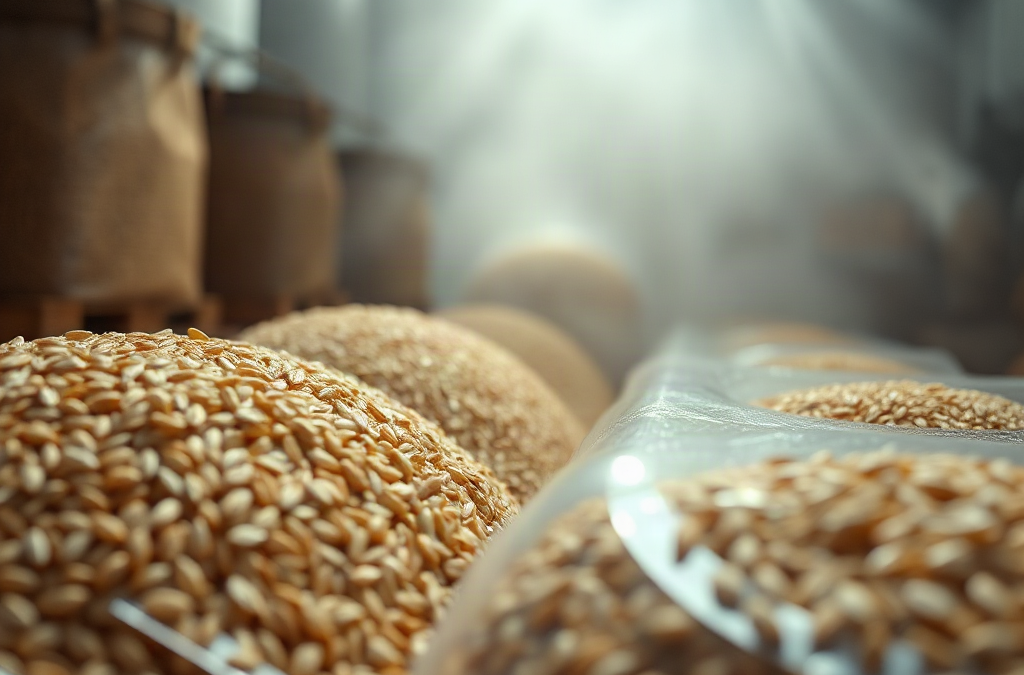
Stored grain temperature changes create condensation risks when warm, moisture-bearing air reaches colder grain, bin walls, lids, or package surfaces and cools below its dew point. The resulting water can wet kernels, encourage mold growth, support insect activity, cause crusting, and corrode metal containers even when the grain entered storage at an acceptable moisture level. Reduce the risk by storing dry grain, limiting abrupt temperature differences, inspecting the top and perimeter of the grain mass, and using controlled aeration where the storage system permits it. Visible droplets, damp odors, clumped kernels, or localized heating call for prompt investigation rather than routine ventilation without checking outdoor conditions.
Why Do Temperature Differences Create Condensation?
Condensation begins with a surface-temperature problem, not necessarily with grain that was uniformly too wet at loading. Air within the spaces between kernels contains water vapor. When that air touches a surface cold enough to bring it to the dew point, some vapor becomes liquid water. The cold surface may be an exterior bin wall, an uninsulated roof, a metal pail lid, or a cool layer of grain.
Seasonal temperature changes make this mechanism especially relevant in bulk storage. During cold weather, grain near the outside wall cools before grain at the center. The difference in temperature can establish slow air movement within the grain mass. Air cooled along the wall becomes denser and moves downward, while relatively warm air moves upward through the center. When the warmer air reaches the cold grain and roof area near the top, moisture may condense there. The exact airflow pattern can reverse as outdoor conditions and grain temperatures change, shifting the vulnerable area rather than removing the risk.
For example, a bin filled with dry grain during mild autumn weather may retain warmth in its center after the outside air turns cold. Moist air carried upward from the warmer center can meet a chilled underside of the roof. Droplets may then fall onto the upper grain layer, producing a damp patch even though most of the bin remains dry. Treating the average grain moisture as proof that every location is safe misses this localized failure.
Small sealed containers behave differently but follow the same physical rule. A warm bucket moved into a cold room may develop moisture on the lid or upper interior if humid air was trapped during packing. Conversely, bringing a cold container into a warm, humid room can wet its exterior. Opening it before the contents warm may also admit humid air that condenses on cold grain or packaging.
The practical priority is to reduce sharp temperature gradients while keeping outside moisture from entering. Temperature management cannot correct grain that began storage too wet, and drying cannot be inferred from cooling alone. Grain may feel cool while retaining enough moisture for deterioration. Measure moisture before storage when possible, then evaluate temperature patterns as a separate control.
Where Do Moisture Problems Develop in Stored Grain?
Condensation damage is usually concentrated at interfaces: the roof and headspace, the top grain surface, exterior walls, container lids, and boundaries between warmer and colder grain. These locations deserve more attention than a single reading taken from an accessible opening. A normal temperature near the hatch does not rule out a warm or damp pocket deeper in the mass.
In a metal bin during cold weather, the upper center commonly warrants close inspection because natural air movement may carry warmth and moisture upward. Look for a crust over the grain, kernels adhering to one another, damp material under the roof, discoloration, or a musty odor. Along the wall, inspect for frozen or matted grain where cold metal has created a sharply chilled boundary. Roof leaks can resemble condensation, so note whether wetness follows seams, fasteners, or a particular side exposed to wind-driven rain.
Bagged and containerized grain has its own weak points. Bags placed directly on a concrete floor can encounter a cold, occasionally damp surface and limited airflow beneath the stack. Pails stored against an exterior wall may experience stronger temperature swings than containers positioned away from it. A tightly closed liner helps isolate grain from room humidity, but it does not remove moisture that was sealed inside with warm grain.
A useful inspection order is:
- Check overhead surfaces. Look beneath roofs and lids for droplets, staining, frost, or rust.
- Examine the grain surface. Note crusting, clumps, webbing, unusual color, or damp patches.
- Compare locations. Check the center, perimeter, and different depths when the system allows safe sampling.
- Follow changes over time. Record temperatures and observations so a developing hot spot is not mistaken for normal variation.
Do not enter a grain bin to investigate a suspected problem. Flowing grain, hidden voids, crusted surfaces, and poor air quality can create fatal hazards. Use exterior access points and suitable sampling or monitoring equipment, and obtain qualified assistance when the condition cannot be assessed safely.
The common mistake is to respond only to visible water. By the time droplets are obvious, the affected grain may already be clumping or heating. Odor changes, rising temperature at one location, insect activity, and resistance when probing can provide earlier warning. None is conclusive alone, but several appearing together justify immediate inspection and a plan to remove, dry, cool, or use the affected grain as appropriate.
How Can You Detect Condensation Early?
Early detection depends on comparing readings across locations and dates rather than relying on one temperature. Stored grain naturally follows seasonal conditions slowly, so a gradual, broadly similar change is less concerning than a localized rise or a widening difference between the center and perimeter. A persistent warm area may indicate biological activity, restricted airflow, or a pocket that was not cooled with the rest of the mass.
Temperature cables can reveal trends in large storage structures, but they sample only the grain near each sensor. Handheld probes and representative samples can add context where safe access is available. For household containers, inspection is simpler: check seals, the underside of lids, liners, and a sample from the upper and lower portions. Avoid leaving a container open in humid air longer than necessary, especially when its contents are colder than the room.
Use a log that identifies the date, outdoor conditions, grain location, measured temperature, odor, appearance, and any fan operation. The value of the record lies in the trend. If one zone warms while nearby zones cool, investigate that difference instead of averaging it away. After aeration, readings should move toward a more uniform target without new dampness appearing at the exhaust side or beneath the roof.
Get Whole Wheat Flour, Grains and Milling Supplies – CLICK HERE 
| Observation | Likely Interpretation | Next Check |
|---|---|---|
| Droplets under a roof or lid | Warm humid air met a cold surface | Inspect the grain directly below and check temperature differences |
| Crusted or clumped top layer | Localized wetting or deterioration may be present | Sample beneath the crust without entering the bin |
| One area remains warmer | Uneven cooling or biological heating is possible | Compare nearby readings and inspect odor and condition |
| Wetness follows a seam | Rain entry may be more likely than condensation | Examine the roof, wall joint, or lid seal |
| Moisture appears after opening cold grain | Humid room air may be condensing on the contents | Close the package and allow sealed contents to temper |
Smell is useful but limited. A musty, sour, or unusually sweet odor can indicate deterioration, yet the absence of odor does not prove that grain is sound. Likewise, a surface moisture meter reading cannot describe an entire bin unless sampling represents multiple locations. When grain condition is uncertain, combine temperature history, moisture testing, physical inspection, and safe sampling.
A weak response is to run a fan automatically whenever a warm reading appears. Warm, humid air can add moisture, while very cold air can create unnecessary stress or freezing around equipment. First determine whether the reading reflects normal seasonal lag, an isolated hot spot, or a broader cooling need. Then choose outdoor conditions and fan duration suited to the storage design and grain condition.
Controlling Temperature Without Adding Moisture
Temperature control works best when it creates a reasonably uniform grain mass without exposing it to unsuitable air. In aerated bins, fans move a cooling or warming front through the grain. Stopping before that front passes through the entire mass may leave sharply different layers, preserving the temperature gradient that drives moisture movement. Fan operation therefore needs to account for grain depth, airflow, outside temperature, humidity, and the system’s design rather than a fixed number of hours.
Cooling grain for seasonal storage is different from drying it. Aeration generally uses modest airflow to manage temperature, while drying requires conditions and equipment capable of removing substantial moisture. Assuming that any fan operation will dry wet grain can allow spoilage to continue. If testing shows that grain exceeds the appropriate storage moisture for its type and intended duration, it may need dedicated drying, faster use, or movement to suitable facilities.
Outdoor air conditions matter because grain exchanges heat and moisture with the air passing through it. Cool air may be useful for reducing temperature, but foggy, rainy, or persistently humid conditions can be a poor choice for some situations. Short fan cycles that repeatedly move a front only partway through the mass can also produce uneven layers. Automated controls may improve consistency, but sensors must be maintained and their readings still need interpretation.
For pails, jars, and sealed liners, the practical method is gentler. Package grain only after it is dry and near the temperature of the packing area. Keep containers away from direct sun, heaters, uninsulated exterior walls, and bare concrete. If a cold package must be brought into a warmer room, leave it sealed until the grain and trapped air warm gradually. This limits contact between cold kernels and humid room air.
When condensation or heating is confirmed, prioritize the affected material rather than repeatedly adjusting the whole storage environment. Separate visibly damp grain where this can be done safely, determine how far the condition extends, and evaluate whether prompt drying or use is feasible. Grain with mold, objectionable odor, extensive insect contamination, or uncertain safety should not be treated as sound merely because it is later dried. Suitability for food or feed may require assessment by an appropriate grain-handling or food-safety professional.
Signs that the control approach is working include narrowing temperature differences, no new roof moisture, stable grain odor, free-flowing kernels, and the absence of expanding warm zones. Continued crusting, recurrent droplets, rising localized temperatures, or worsening odor indicate that ventilation alone is not resolving the cause. Recheck for leaks, inadequate airflow, excessive initial moisture, blocked ducts, or a deteriorating pocket before continuing the same response.
Frequently Asked Questions
Can dry grain still develop condensation?
Yes. Dry grain can be locally wetted when moisture-bearing air contacts a cold roof, wall, lid, or grain layer. Acceptable average moisture does not eliminate temperature gradients or trapped humid air.
Where should stored grain be checked first?
Inspect the underside of the roof or lid, the top center, exterior-wall areas, and any location with an unusual temperature. These interfaces commonly show condensation before the entire grain mass changes.
Should fans run whenever condensation appears?
Not automatically. Confirm outdoor temperature and humidity, the location of the wet area, and whether the system is designed for aeration. Unsuitable air or incomplete fan cycles can worsen uneven conditions.
How can condensation be distinguished from a leak?
Condensation often appears broadly on cold surfaces during temperature changes. Water concentrated along seams, fasteners, cracks, or one weather-facing side is more consistent with rain entry, though both problems can occur together.
Is grain safe after it has been dampened by condensation?
Safety cannot be judged from dampness alone. Check the extent and duration of wetting, odor, mold, insects, heating, and intended use. Questionable grain may require professional evaluation rather than simple redrying.
Conclusion
Effective condensation control starts with dry grain, representative monitoring, and fewer temperature differences across the stored mass. Give special attention to roofs, lids, upper grain layers, exterior walls, and containers near cold surfaces. Record readings by location so a developing warm or damp pocket is not hidden by an acceptable average.
Use aeration as a temperature-management tool only when the equipment and outdoor conditions are suitable; do not assume it will correct excessively wet grain. For sealed household packages, reduce abrupt transitions and allow cold containers to warm before opening. If clumping, mold, persistent odor, insects, or localized heating appears, identify the affected area promptly and address leaks, airflow restrictions, or excess moisture. Avoid entering bins, and seek qualified help when safe inspection or the grain’s suitability cannot be determined from outside.
Get Whole Wheat Flour, Grains and Milling Supplies – CLICK HERE
Auto Amazon Links: No products found.