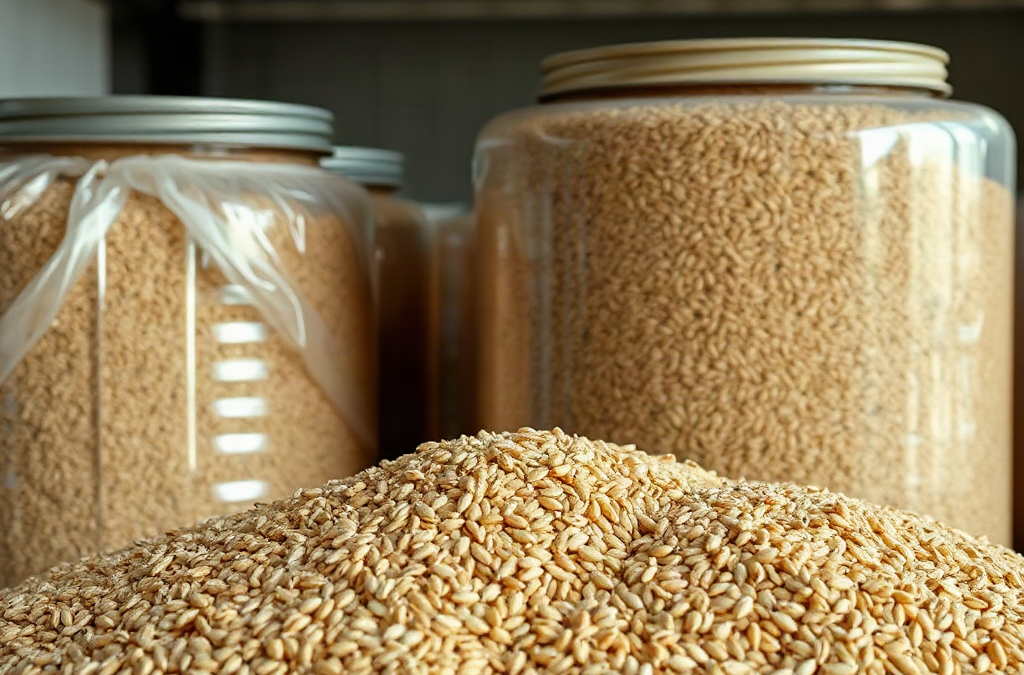
Stored grain needs repackaging when its container is punctured, cracked, no longer airtight, chemically unsuitable, or exposed to moisture, insects, or repeated temperature swings. Transfer only grain that remains dry, normally colored, free-flowing, and free of musty, sour, rancid, or chemical odors. Inspect the entire batch under good light, discard unsafe material rather than mixing it with sound kernels, and place acceptable grain in a clean food-grade container with a dependable seal. Repackaging corrects packaging failure but cannot reverse mold growth, insect contamination, rancidity, or moisture damage already present in the grain.
Packaging Failures That Require Action
A storage package should continue blocking moisture, pests, odors, and physical damage throughout its intended service life. Repackaging becomes appropriate when that barrier is visibly compromised or can no longer be trusted. A split seam, loose lid, failed gasket, punctured liner, cracked bucket, rodent damage, or corroded metal container calls for prompt inspection rather than another layer of tape and continued storage.
Less obvious failures deserve equal attention. A flexible bag that has lost its vacuum may have a pinhole or imperfect seal, although vacuum loss alone does not prove that the grain is spoiled. A bucket lid that lifts without normal resistance may be warped or incorrectly seated. Condensation, dampness beneath a lid, clumped kernels, or droplets inside a liner indicate moisture movement or entry. Replacing the package is only part of the response because wet grain must be evaluated separately.
Container location can also force a transfer even when no hole is visible. Grain held in a non-food-grade vessel may absorb unwanted odors or contact residues from the container’s former contents. Never assume that washing makes a bucket suitable if it previously held paint, cleaners, pool chemicals, lubricants, or other nonfood products. Likewise, an unknown trash bag or ordinary utility tote is not a dependable long-term food barrier.
A practical example is a sealed liner inside a bucket that has been gnawed at the rim. The outer bucket may appear repairable, but the liner could have tiny tooth punctures and contamination around the damaged area. Moving apparently sound grain into a fresh liner and intact food-grade bucket is more defensible than relying on an uncertain patch. By contrast, a dusty exterior or faded label does not by itself justify disturbing a sound internal seal.
The common mistake is treating age as the sole trigger. Calendar time does not reveal whether a package failed; seal condition, storage environment, and grain condition provide better evidence. Unnecessary opening introduces fresh air, humidity, and handling risk. Readers deciding when stored grain needs repackaging should prioritize actual barrier failure, unsuitable materials, and signs of moisture or pests over an arbitrary anniversary.
Deciding Whether the Grain Is Safe to Transfer
Repackaging is suitable only for grain that still appears wholesome. Moving questionable kernels into a new vessel can hide an existing problem and contaminate other food. Inspect the contents before combining lots, adding oxygen absorbers, or sealing anything for another long interval.
Open a suspect package away from the main storage supply and examine the grain under bright light. Normal characteristics vary by crop, but intact grain should generally be dry, loose, and consistent with its expected color and aroma. Look through more than the top layer. Pouring a small amount onto a light-colored tray can reveal webbing, larvae, adult insects, frass, unusual dust, discolored kernels, or damp clumps that remain hidden in a deep container.
Odor is a decisive screening tool, though not a laboratory test. Musty or moldy odors suggest moisture damage. Sour, fermented, or rancid notes can indicate deterioration. A solvent-like, fuel-like, or perfumed smell may reflect chemical or odor exposure. Do not taste grain to resolve uncertainty, and do not expect cooking, drying, freezing, or a new package to make visibly moldy or chemically tainted grain acceptable.
Use a compact decision check before transfer:
- Transfer: The package is damaged, but the grain is dry, clean-smelling, free-flowing, and without visible pest or mold evidence.
- Isolate for closer evaluation: The seal failed and the history of humidity, pests, or chemical exposure is uncertain.
- Discard rather than repackage: The grain has mold, persistent off-odors, wet clumps, rodent contamination, or suspected contact with floodwater or chemicals.
Sorting out a few visibly damaged kernels is not a reliable remedy for a batch with widespread mold odor or moisture exposure. Mold growth and contaminants may extend beyond what the eye can identify. Similarly, live insects do not automatically establish that every kernel is spoiled, but simply resealing an active infestation transfers the problem. Keep that lot apart from unaffected supplies and follow appropriate pest-control and food-safety guidance before deciding on use.
Uncertainty should not be diluted by mixing suspect grain with a clean lot. Combining ten pounds of questionable wheat with forty pounds of sound wheat produces one larger uncertain batch, not a rescued supply. The safest practical boundary is to preserve lot identity until inspection is complete and discard material when contamination cannot reasonably be ruled out.
How to Repackage Grain Without Spreading Damage
A controlled transfer protects clean grain from the very hazards that caused the first package to fail. Prepare the replacement container, work surface, scoop, labels, and any intended barrier materials before opening the old package. Choose a dry indoor area away from pets, open windows, cleaning products, and unaffected grain.
Begin by cleaning the work surface and confirming that every tool is completely dry. A container can look clean while retaining water around its rim, handle fittings, or gasket. Moisture introduced during transfer may be trapped after sealing, so air-drying is preferable to wiping a recently washed vessel and filling it immediately.
Keep the damaged package inside a secondary tub while opening it if insects or seam failure are possible. This catches escaped kernels and makes activity easier to see. Pour slowly or use a dedicated food scoop; do not drag the old bag across the rim of the replacement vessel. If the outside of the original package contacted rodent droppings, standing water, or chemicals, prevent that exterior from touching the grain or clean equipment.
The transfer itself provides another inspection opportunity. Check grain from the top, center, and bottom rather than approving the lot from one handful. Stop if deeper layers reveal moisture, heat, webbing, unexpected dust, or a stronger odor. A dry upper layer can conceal a damp zone near the base where condensation or floor moisture entered.
Do not top off a partly used container with a different lot merely to save space. Separate lots may have different moisture histories, ages, and pest exposure. Keeping them apart makes later troubleshooting and rotation much easier. Record the grain type, original purchase or packing date if known, transfer date, and reason for transfer. Labeling the event “repacked after cracked lid” is more useful than writing only a new date.
For long-term dry storage, oxygen absorbers may be appropriate in a properly sized high-barrier package, but they are not substitutes for dry grain or a sound seal. Use them according to the packaging system and supplier instructions, and do not improvise quantities for damp or questionable grain. Vacuum sealing also reduces package bulk and confirms initial closure, yet a hard vacuum cannot compensate for sharp kernels that puncture a thin bag.
A frequent failure is pouring good grain into an unverified replacement and considering the job finished. Test the lid, seal, and liner before returning the batch to storage. The transfer described in when stored grain needs repackaging should end with a stronger barrier and clearer lot history than the package it replaced.
Choosing a Better Replacement Container
The replacement package should address the original failure rather than merely look sturdier. For dry whole grains, a food-grade bucket with a secure lid provides physical protection, while a high-barrier food-storage liner can improve resistance to oxygen and moisture transmission. These components perform different jobs: the liner supplies the primary environmental barrier, and the bucket protects it from puncture, crushing, and light.
Rigid food-grade containers are practical for grain used regularly because they tolerate repeated opening better than thin flexible packages. A gasketed lid can improve closure, but every opening exchanges the protected air for room air. Storing one large supply in several smaller packages reduces repeated exposure and limits the amount affected if one seal fails. The tradeoff is greater packaging cost and more labels to manage.
Get Whole Wheat Flour, Grains and Milling Supplies – CLICK HERE 
Glass jars offer an excellent visible, odor-resistant barrier for modest quantities. They are easy to inspect and do not hide insect activity, but they are heavy, breakable, and inefficient for large stores. They also need protection from light and impact. Metal cans can provide strong barriers when designed for food, though rust, damaged seams, and dented closures require attention. Ordinary paper sacks remain useful for short turnover in a dry, pest-controlled pantry but are poor barriers against humidity and insects.
Flexible packages need enough thickness and durability for the kernel shape and handling conditions. Pointed grains or rough movement can create tiny punctures, especially where a bag folds against a hard bucket wall. Smooth the liner into place, avoid overfilling, and leave enough material to make the specified seal. A household zipper bag may organize small portions, but it should not be treated as equivalent to a purpose-made long-term barrier.
Container size should match use. If grain is milled weekly, several working-size containers allow one to be opened while the remainder stays sealed. If the grain is an emergency reserve, smaller independent packages reduce single-point loss from a cracked lid, pest entry, or accidental spill. No package makes a hot shed, damp basement, or chemical-storage area suitable; environmental control remains part of the system.
The weak assumption is that “airtight” printed on a product description guarantees long-term performance. Closure design, gasket condition, wall permeability, food-contact suitability, and resistance to puncture all matter. Select a documented food-storage product, follow its closure method, and protect it from temperature extremes, moisture, rodents, and sharp surfaces.
Checking the Grain After Repackaging
Post-transfer monitoring confirms whether the new package solved the problem or merely postponed discovery. Inspect it soon after sealing and again during routine pantry checks. Look for a lifted lid, relaxed vacuum, swelling, condensation, new insect activity, leaking kernels, or renewed odor around the container.
A package that loses its vacuum shortly after transfer may have an incomplete seal, contaminated sealing surface, crease, or pinhole. Inspect the closure rather than automatically adding a second bag around it. An outer bag can catch spills, but it does not restore the inner oxygen and moisture barrier. If resealing is necessary, limit the grain’s exposure to humid room air and use a new package when the defect cannot be located confidently.
Placement affects whether the repair lasts. Keep containers off bare concrete where possible, because floor-level locations are vulnerable to condensation, cleaning water, and unnoticed leaks. Leave enough clearance to inspect behind and beneath the supply. Avoid stacking beyond the container’s load tolerance; a lid that appears secure can distort under excessive weight.
Rotation should account for the grain’s original history, not restart the clock on transfer day. Repackaging does not make old grain newly harvested, restore flavor, or reverse oxidation. Marking both the original date and the repackaging date prevents this misconception. Use the affected lot earlier when it passed inspection but experienced a short period of uncertain sealing, rather than placing it behind newer, continuously protected stock.
Signs that the approach is working include a stable seal, a dry interior, no increase in grain dust or insects, and unchanged aroma when the package is eventually opened. Warning signs include repeated seal loss, clumping, warm or damp grain, larvae, webbing, or a developing off-odor. Isolate the package immediately if those appear.
Routine inspection should be visual and external whenever possible. Opening a sound package repeatedly to “check freshness” exposes it to the room and defeats part of the protective system. A clear label, visible container condition, clean storage area, and documented transfer reason make noninvasive checks more meaningful. That distinction—monitoring the package without continually disturbing the grain—is central to deciding when stored grain needs repackaging again.
Frequently Asked Questions
Does a broken vacuum mean stored grain must be discarded?
No. It means the barrier should be investigated. If the grain remains dry, normally colored, clean-smelling, and free of pest evidence, it may be transferred to a sound package; uncertainty about moisture or contamination warrants isolation.
Can a punctured grain bag be repaired with tape?
Tape may temporarily contain a spill, but it is not a dependable long-term moisture or oxygen barrier. Move acceptable grain into a new high-barrier food-storage package.
Should grain be washed before it is repackaged?
No. Washing adds moisture that can make sealed storage hazardous. Grain intended for dry storage should remain dry; clean the replacement equipment instead and allow it to dry fully.
Can old grain be mixed with a newly purchased batch?
Keeping lots separate is safer and easier to manage. Mixing obscures differences in age, moisture exposure, pest history, and quality while making rotation and later diagnosis more difficult.
Does repackaging restart the grain's storage life?
No. A new container improves protection from the transfer date forward, but it does not reverse prior aging or exposure. Preserve the original date on the new label and record why the transfer occurred.
Conclusion
Base a repackaging decision on barrier integrity and grain condition, not age alone. A damaged seam, unreliable lid, unsuitable vessel, moisture evidence, or pest access justifies opening the lot in a controlled area and inspecting it from top to bottom. Transfer only dry, normal-smelling grain into clean, fully dry food-grade packaging, and keep questionable material away from unaffected supplies.
The replacement should correct the original weakness: pair a durable outer container with an appropriate barrier liner when long-term protection is needed, divide frequently used supplies into manageable portions, and preserve both the original and transfer dates. After sealing, monitor the package externally for leakage, condensation, pests, or closure failure. If mold, chemical odor, rodent contamination, or persistent dampness is present, a fresh container is not a remedy; protecting the rest of the supply becomes the priority.
Get Whole Wheat Flour, Grains and Milling Supplies – CLICK HERE
Auto Amazon Links: No products found.