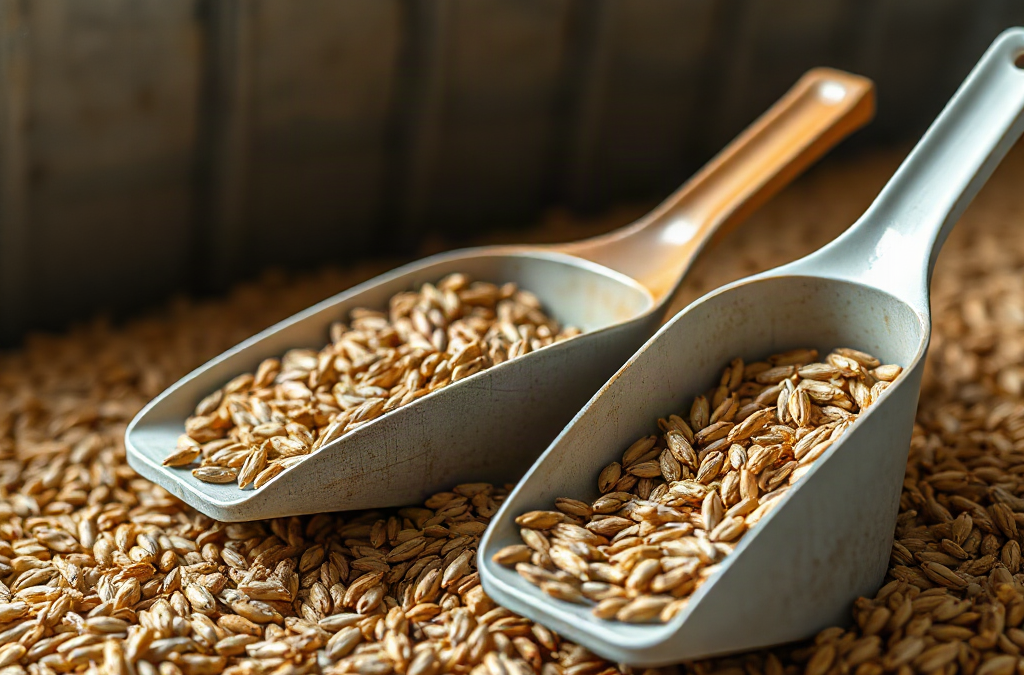
Grain scoops that reduce cross-batch contamination are smooth, nonporous, easy to inspect, and assigned to a single grain or clearly defined batch group. Stainless steel and food-contact-grade molded plastic work well when they have seamless bowls, minimal joints, and handles that keep hands away from the product. Color coding, durable labels, covered storage, and a documented cleaning routine matter as much as scoop material because a clean scoop can be recontaminated on a dusty shelf. Avoid wood, cracked plastic, hollow handles with open ends, and any scoop shared between allergen-containing and allergen-free products without a validated sanitation process.
How Do Scoops Transfer Residue Between Batches?
A scoop transfers more than the kernels visible in its bowl. Grain dust settles along the handle junction, beneath molded lips, inside scratches, and around rivets or fasteners. When that scoop enters another container, loose particles can fall into the new batch. The transfer may affect batch identity, purity, allergen controls, seed-variety separation, or quality investigations even when the amount is too small to notice casually.
Fine material creates the greatest practical challenge. Whole corn may leave several obvious pieces that are easy to remove, while wheat flour, barley dust, or powdered grain treatments can remain as a thin film. Static can make dry particles cling to some plastics. Moisture makes the problem harder by turning dust into residue that adheres to seams and textured surfaces. A quick shake or dry wipe therefore cannot be treated as proof that the scoop is clean.
Consider a storeroom handling plain oats and a grain blend containing wheat. A shared scoop may look empty after the blend is dispensed, yet particles trapped near its handle can enter the oat bin during the next use. For a household merely separating grain varieties, that transfer may be an inventory nuisance. Where allergen declarations, customer specifications, seed identity, organic status, or formal food-safety controls apply, it can carry much greater consequences. Equipment selection must follow the strictest separation need associated with the products, not simply the appearance of the grain.
Hand contact and storage surfaces create secondary transfer routes. A worker may touch one product, grasp a clean handle, and then return the scoop to another bin. A sanitized scoop placed bowl-down on a dusty ledge is no longer controlled. Leaving a scoop buried in grain avoids contact with the ledge but introduces other concerns: the handle may become coated, users may reach into the product to find it, and the scoop may migrate when bins are rearranged.
The weak assumption is that purchasing a food-contact scoop solves contamination by itself. A well-designed utensil only makes cleaning and control easier. The operating system must also specify which scoop belongs where, how its status is recognized, where it rests between uses, and what happens after it is dropped, borrowed, or used with the wrong batch. If staff routinely improvise because the assigned scoop is missing, the control is failing regardless of material quality.
Which Scoop Materials and Designs Clean Reliably?
Stainless steel and food-contact-grade molded plastic are the most practical choices because both can provide smooth, nonabsorbent surfaces. Construction details usually matter more than appearance. Favor a one-piece or smoothly welded utensil with rounded internal corners, an easily inspected handle connection, and no recesses where grain dust can pack tightly. Capacity should suit the container opening so the bowl does not scrape dirty rims or force the user’s hand into the grain.
Stainless steel tolerates frequent washing, resists gouging during ordinary use, and makes dark residue relatively easy to see. It is useful for high-use stations and for operations that want a long service life. Its tradeoffs are weight, noise, cost, and the possibility of damaging softer bins if it is thrown or dragged. Welds must be smooth; a poorly finished metal scoop with crevices is not automatically more hygienic than molded plastic.
Molded plastic is lightweight, economical, and available in distinct colors that support visual assignment. It can be a sound choice for separate grain families or low-volume bins. Plastic should be retired when it develops deep scratches, cloudy wear patches, cracks, rough edges, or heat distortion. Color alone is not a sanitation feature, and a green scoop does not remain dedicated if workers carry it to whichever bin is nearest.
| Feature | Useful Choice | Concern to Check |
|---|---|---|
| Body material | Smooth stainless steel or food-contact-grade plastic | Scratches, corrosion, cracks, or unknown material |
| Construction | One piece or smoothly sealed joints | Rivets, open tubes, deep seams, or loose fittings |
| Handle | Long enough to keep hands out of product | Hollow open ends or textured grips that retain dust |
| Bowl shape | Rounded corners and visible surfaces | Sharp internal angles and rolled edges |
| Identification | Permanent color or durable external marking | Peeling tape or labels positioned over the product |
Wood is a poor default where rigorous batch separation is expected because it is porous, can split, and is difficult to inspect consistently. Disposable scoops may be appropriate for sampling, incident response, or a short run involving a difficult-to-clean material, but they create recurring waste and require controls against accidental reuse. Measuring cups and improvised containers also deserve scrutiny: handles can be too short, printed markings can abrade, and folded seams may retain residue.
Choose the scoop after examining the cleaning process and the bin, not from a catalog image alone. Confirm that the utensil fits the wash area, tolerates the intended cleaning chemistry and temperature, drains without trapping water, and can be visually checked under good light. A small trial often reveals whether labels detach, handles flex, or the bowl is too wide for the container mouth.
How Should a Dedicated-Scoop System Be Organized?
Dedicated scoops provide the clearest control when products must remain separated. Each utensil should be linked to one named product, one bin, or a carefully defined compatibility group. Product-specific assignment offers stronger control than broad categories. A scoop marked only “grain” is ambiguous if the area contains wheat, oats, rye, treated seed, and identity-preserved lots.
Use at least two identification methods where a mix-up would matter. Color can provide fast recognition, while text, a bin number, or a simple symbol confirms the assignment. Permanent molding, engraving, or a durable label placed where it cannot shed into the grain is preferable to masking tape. The storage hook or holder should carry the same identifier. That pairing lets a user notice immediately when a scoop has been returned to the wrong station.
Physical location strengthens visual controls. Keep the scoop beside its assigned container in a protected holder rather than on a shared table. Separate allergen categories, treated seed, animal feed, and food grain according to the risks present in the facility. Color schemes must also be explained; staff cannot infer whether red means wheat, restricted use, or “not cleaned.” A posted key near the work area is more dependable than relying on memory.
A practical priority order is:
Get Whole Wheat Flour, Grains and Milling Supplies – CLICK HERE 
- Separate the highest-consequence products first. Give distinct scoops to allergen categories, treated materials, and batches with contractual identity requirements.
- Match every scoop to a labeled home. Pair the utensil marking with the bin and its holder.
- Keep a controlled spare. Store clean replacements in a covered location so a dropped scoop does not encourage borrowing.
- Define exceptions. State what users must do when a scoop is missing, damaged, or found at the wrong station.
For example, a small storeroom may assign blue scoops to oats and yellow scoops to corn, with the product name engraved on each handle. If wheat is also present as an allergen concern, it should receive a uniquely marked utensil and physically separate storage point rather than merely another shade that looks similar under poor lighting. Workers should place a misplaced scoop in a designated hold area, not guess whether it is safe.
Sharing may be reasonable when batches are demonstrably compatible and the documented process permits it, but convenience is not evidence of compatibility. Cleaning between every use also demands more labor and introduces delays, drying needs, and opportunities for incomplete sanitation. Dedicated utensils are often simpler, yet they still require periodic cleaning because dust, pests, spills, and handling can contaminate a scoop without cross-use.
Cleaning, Storage, and Inspection Checklist
Cleaning must remove retained grain and leave the scoop dry, identifiable, and protected before its next use. The exact method should match the product hazards, facility program, scoop material, and manufacturer instructions. Dry cleaning may suit some low-moisture grain environments because unnecessary water can create clumped residue and prolong drying. Where wet cleaning is required, the utensil needs enough time and airflow to dry completely before it returns to service.
Begin by removing bulk particles into the correct waste or rework stream. Inspect seams, the underside of the handle, embossed markings, and the bowl edge under adequate light. Use cleaning tools reserved for the appropriate area; a brush used across incompatible products can undo the benefit of dedicated scoops. If washing is part of the approved procedure, apply the specified cleaner, rinse as required by its directions, and allow the scoop to drain without contact with an unclean surface.
Sanitizing is not a substitute for cleaning. Grain particles and films must first be removed so the surface can be treated effectively. Nor should an operation improvise chemical concentration, contact time, or material compatibility. Those details belong in the facility’s established sanitation program and product directions. Household users should likewise avoid returning a damp scoop to dry grain, where moisture can create localized caking and obscure whether the container remains in acceptable condition.
Use this compact release check before a scoop goes back to its station:
- The bowl, rim, handle junction, and identification marks are visibly free of residue.
- No cracks, deep gouges, loose joints, corrosion, or rough patches are present.
- The scoop is fully dry when the process requires dry return to service.
- Its label is readable and matches the assigned holder and bin.
- The protected storage point is clean, intact, and positioned away from splash or floor contact.
Inspection frequency should reflect use rather than an arbitrary calendar. A scoop used throughout a shift warrants checks during changeovers and whenever it is dropped or misplaced. A rarely used utensil still needs examination before use because dust, insects, leaks, or storage damage may have occurred. Signs that the program is working include scoops consistently found in their assigned holders, labels remaining legible, and no visible residue at pre-use checks.
Repeated missing utensils, improvised cups, mixed colors, wet scoops beside dry bins, or residue returning after cleaning indicate a system problem. Investigate whether holders are inconvenient, replacements are unavailable, the wash method cannot reach a seam, or production pressure encourages shortcuts. Replacing a flawed scoop may be more reliable than repeatedly trying to clean damage that cannot be inspected with confidence.
Frequently Asked Questions
Is stainless steel always better than plastic for grain scoops?
No. Stainless steel is durable and easy to inspect, while food-contact-grade plastic is lighter and easier to color-code. Smooth construction, condition, cleaning compatibility, and dedicated use matter more than material alone.
Can one scoop be used for several grains?
Only when the products are compatible under the applicable storage and safety controls. Separate scoops are preferable for different allergen categories, treated materials, identity-preserved lots, or batches subject to strict purity requirements.
Should a scoop be stored inside the grain bin?
A protected external holder is usually easier to inspect and keeps users from reaching into the grain. If an internal storage arrangement is used, it should prevent the handle from becoming buried or contaminated by hands.
How often should grain scoops be replaced?
Replace them based on condition rather than age. Cracks, deep scratches, rough welds, corrosion, distorted plastic, loose joints, or unreadable identification are practical reasons to remove a scoop from service.
Does color coding prevent cross-batch contamination?
Color coding reduces selection errors only when each color has a documented meaning and matching storage location. It does not compensate for sharing, poor cleaning, damaged surfaces, or inconsistent handling.
Conclusion
A dependable scoop program combines cleanable construction with unambiguous ownership. Select smooth stainless steel or food-contact-grade plastic, reject joints and surface damage that trap dust, and size each utensil for its actual container. Assign separate scoops wherever allergen status, treatment, variety, batch identity, or customer requirements make residue transfer consequential.
Next, pair every scoop with a labeled bin and protected holder, provide controlled spares, and define what happens when equipment is misplaced. Check the handle junction, rim, markings, and storage point rather than inspecting only the bowl. If residue repeatedly survives cleaning or workers keep borrowing utensils, correct the design or workflow instead of relying on reminders. The strongest control is one that remains obvious and practical during a busy transfer, not merely one that looks complete on a written procedure.
Get Whole Wheat Flour, Grains and Milling Supplies – CLICK HERE
Auto Amazon Links: No products found.