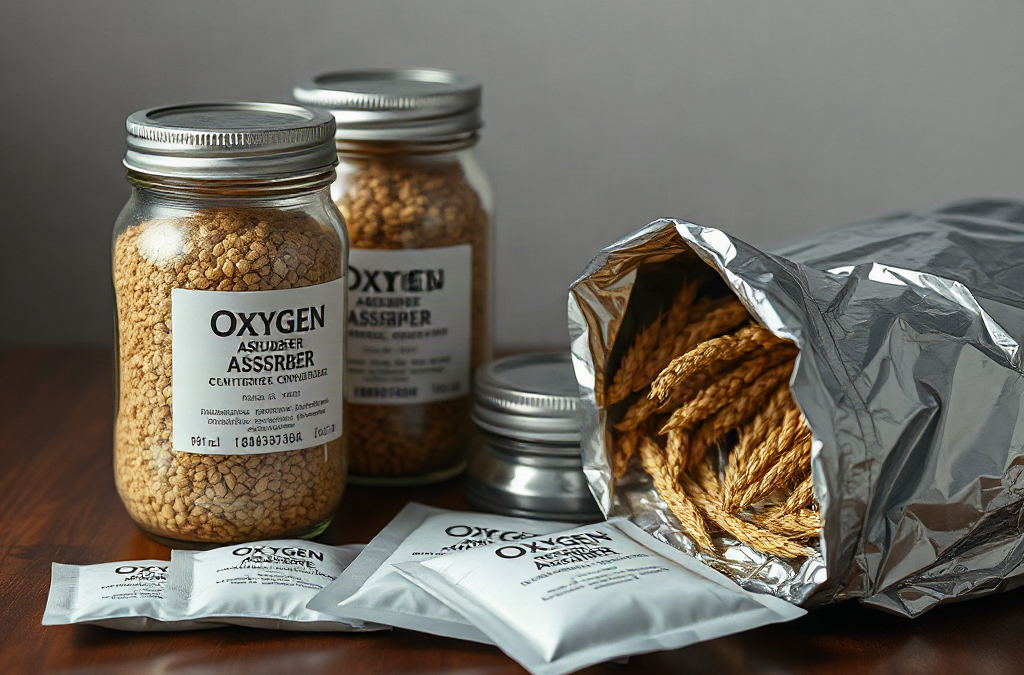
Oxygen absorber size for grain containers is rated in cubic centimeters (cc) of oxygen capacity, with about 500 cc an illustrative choice for a nearly full 1-gallon grain package. Sizing must account for both headspace and air between kernels, not merely the empty space above the grain. Estimate that air volume, multiply by 0.21, convert liters to cc, and round up to an available packet capacity. Follow the packet manufacturer’s grain-specific sizing chart when available, because fill level and packing density change demand. Fresh absorbers also need suitable dry grain and sealed oxygen-barrier packaging; extra capacity cannot compensate for an ongoing leak.
What you’ll learn
This guide covers the following practical points:
- Calculate Oxygen in Headspace and Kernel Gaps — The cc number printed on an absorber describes how much oxygen it can take up, not how much grain it can protect.
- Oxygen Absorber Capacity Chart for Grain Packages — The chart below applies the same calculation to three household package sizes.
- Check Grain, Packaging, and Packet Handling — Correct sizing only works when the grain, package, and absorbers are suitable for reduced-oxygen storage.
Calculate Oxygen in Headspace and Kernel Gaps
The cc number printed on an absorber describes how much oxygen it can take up, not how much grain it can protect. A 500 cc packet is rated for approximately 500 cubic centimeters of oxygen. Its physical dimensions are not a reliable sizing measure.
Air occupies two places in a grain container: the headspace above the fill line and the small gaps throughout the grain. Counting only headspace misses much of the oxygen load. Wheat kernels, rice, and rolled grains do not pack identically, so one assumed air fraction cannot describe every fill.
For an estimate, use this calculation, with all volumes measured in liters:
Required oxygen capacity in cc = [headspace + (bulk grain volume × estimated air-gap fraction)] × 0.21 × 1,000.
The factor 0.21 represents oxygen’s approximate share of ordinary air. Multiplying by 1,000 converts liters to cubic centimeters. This estimates the initial oxygen load; it does not account for later leakage or establish a food’s storage life.
Illustrative example: A roughly 3.8-liter, 1-gallon package has 0.38 liter of headspace and 3.42 liters occupied by bulk grain. Assume air gaps make up 40% of that grain volume. The calculation is [0.38 + (3.42 × 0.40)] × 0.21 × 1,000, or about 370 cc of oxygen. Choosing 500 cc provides some allowance for estimation error. The 40% figure is an example assumption, not a measured property of your grain.
Oxygen Absorber Capacity Chart for Grain Packages
The chart below applies the same calculation to three household package sizes. It assumes approximately 10% headspace and 40% air gaps within the remaining bulk grain volume. These are illustrative estimates, not universal packing instructions; use the absorber manufacturer’s chart for your grain and packaging when available.
| US Package Capacity | Approximate Volume | Estimated Initial Oxygen | Illustrative Absorber Capacity |
|---|---|---|---|
| 1 quart | 0.95 liter | 90 cc | 200 cc |
| 1 gallon | 3.8 liters | 370 cc | 500 cc |
| 5 gallons | 18.9 liters | 1,830 cc | 2,500 cc |
A partly empty container needs a fresh calculation. If the same 1-gallon package is only half full, the assumed air volume becomes 1.9 liters of headspace plus 0.76 liter between kernels. That produces an estimated oxygen load of about 560 cc—already beyond a 500 cc packet before adding any allowance.
Use a smaller package when you have less grain, rather than paying to treat a large empty space. Size a flexible liner by its filled, sealed volume, not automatically by the bucket holding it.
Packet capacities can be added: one fresh 2,000 cc packet plus one fresh 500 cc packet provides 2,500 cc of rated capacity. Choose the next suitable available combination rather than rounding below the estimate. Extra capacity costs more, however, and cannot make a poor seal reliable.
Get Whole Wheat Flour, Grains and Milling Supplies – CLICK HERE 
Check Grain, Packaging, and Packet Handling
Correct sizing only works when the grain, package, and absorbers are suitable for reduced-oxygen storage. A large packet in an unsuitable container may spend its capacity absorbing incoming oxygen rather than maintaining the intended conditions.
Confirm grain suitability before packing. Absorbers remove oxygen, not moisture. If moisture content is unknown, or the grain may have become damp, consult a university extension service or grain-storage specialist about grain-specific limits before sealing it with absorbers. A capacity calculation is not a food-safety assessment, and removing oxygen does not make questionable grain suitable for storage.
For long-term household reserves, use packaging specified as an oxygen barrier, such as an appropriate foil-laminate food-storage bag or a sound glass jar with a suitable airtight closure. A plastic bucket can protect a liner from punctures, but its lid and walls should not automatically be treated as a long-term oxygen barrier.
Keep the packing sequence simple:
- Prepare first: Fill containers, clear grain and dust from sealing surfaces, and have closures or the heat sealer ready.
- Check the packet specification: Choose food-grade absorbers rated for dry foods, and follow their exposure-time instructions.
- Open only what you can use promptly: Keep unused packets protected according to the manufacturer’s directions.
- Seal and inspect: Check closures, seal continuity, and possible punctures, then label the package with its contents and packing date.
A bag pulling inward may show a pressure change, but it does not prove that the remaining oxygen level is low enough. Nitrogen remains after oxygen is absorbed, so a properly packed bag may never look vacuum-tight. If a seal is visibly damaged, correct the packaging problem and use fresh absorbers when repacking rather than simply adding another packet.
Frequently Asked Questions
Can I use several small oxygen absorbers instead of one large packet?
Yes. Add the labeled oxygen capacities of fresh, suitable packets to reach your chosen total. For example, five 100 cc packets provide 500 cc of rated capacity. Each separately sealed jar or bag needs its own allocation.
Do oxygen absorbers need replacing after I open a grain container?
Opening introduces a new oxygen load, while the packet’s remaining capacity is usually unknown. For grain being resealed for long-term storage, use fresh absorbers. Smaller reserve packages can reduce repeated opening and repacking.
Can I convert an oxygen absorber’s weight in grams into its cc capacity?
Not reliably. Packet weight includes the wrapper and materials whose formulation varies by product. Use the manufacturer’s stated oxygen capacity in cc rather than estimating from weight or packet dimensions.
Are oxygen absorbers interchangeable with desiccant packets?
No. Oxygen absorbers target oxygen, while desiccants take up moisture. One does not replace the other, and adding a desiccant does not establish that damp grain is suitable for reduced-oxygen storage.
Can I recharge a used oxygen absorber for another grain container?
Treat ordinary single-use absorbers as spent once their capacity has been used. Do not assume heating, drying, or freezing restores them. Follow the product instructions and use fresh packets when remaining capacity is uncertain.
Conclusion
Choose absorber capacity after checking the grain’s suitability, the package’s barrier properties, and its actual fill level. Account for air between kernels as well as headspace, then round upward from the estimated oxygen load. Before buying packets for a whole batch, settle on your container size and packing method; that avoids both undersizing and unnecessary expense.
Get Whole Wheat Flour, Grains and Milling Supplies – CLICK HERE
Auto Amazon Links: No products found.