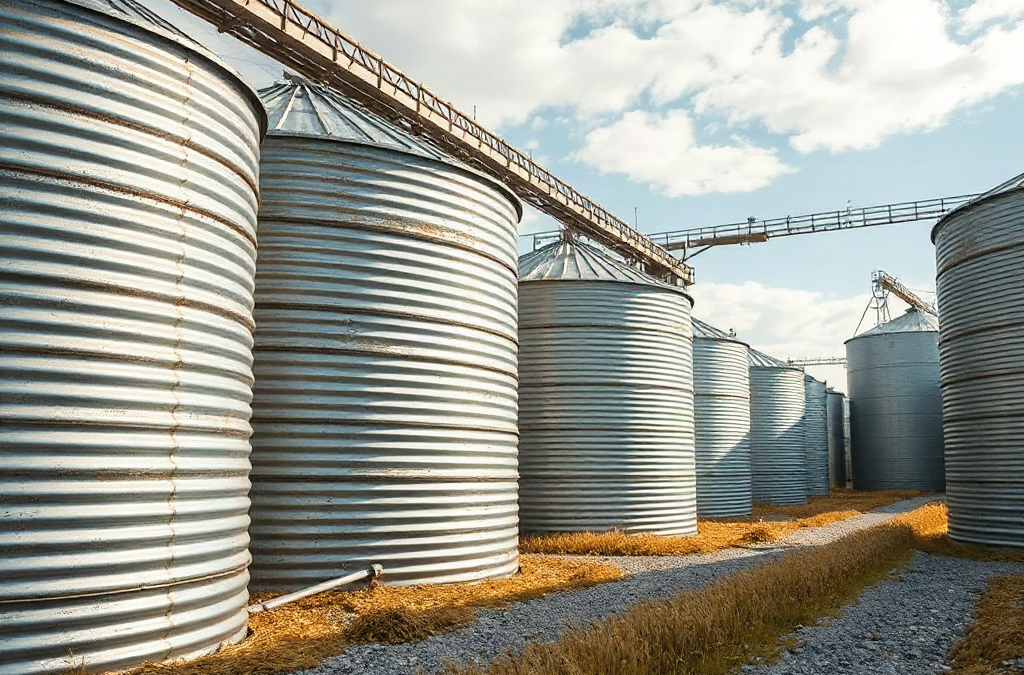
Before seasonal filling, grain bin inspection points should cover structural integrity, water exclusion, unloading equipment, aeration performance, electrical condition, and sanitation. Examine the roof, wall sheets, foundation joint, doors, hatches, fasteners, and seals for damage or openings that could admit rain or pests. Test fans, vents, augers, sumps, and temperature-monitoring equipment while the bin is empty, using lockout procedures and qualified help where needed. Remove old grain and fines because they can harbor insects, restrict airflow, and contaminate the incoming crop.
Which Structural and Weather-Tightness Points Need Inspection?
An empty bin provides the clearest opportunity to find deformation, corrosion, failed seals, and loose hardware before stored grain hides the evidence. Begin outside in good daylight and walk the full circumference. Look along the wall rather than only straight at it; a low viewing angle makes buckled sheets, uneven vertical seams, and distorted stiffeners easier to recognize. Changes from the previous season deserve more attention than uniform cosmetic weathering.
Inspect the roof sheets, peak opening, eaves, vents, access hatch, sidewall door, and transitions around fan housings. Water often enters at joints and penetrations rather than through the middle of an intact panel. Rust trails below a fastener, discolored sealant, daylight visible around a hatch, or compacted residue beneath a roof seam can identify a leak path. A hose test may help confirm a suspected exterior leak, but it should be controlled so water does not enter electrical equipment or create a false wet area elsewhere.
The foundation-to-wall connection deserves close attention. Check for cracked concrete, settlement, gaps beneath the bottom ring, failed caulk, standing-water marks, and vegetation that holds moisture against the base. Minor surface cracking and a gap that extends beneath the bin do not carry the same implication. Movement, spreading cracks, displaced anchors, or distorted wall sheets call for assessment by a qualified bin contractor or structural professional rather than a cosmetic patch.
Inside, use exterior light or fixed lighting where possible and follow the site’s confined-space and energy-isolation procedures. Do not enter merely because the bin is empty; residual grain, mechanical equipment, poor air, or an unguarded opening can still create hazards. Inspect the underside of the roof, interior wall seams, floor supports visible from safe access points, and door-panel hardware. Corrosion that flakes, perforation, torn bolt holes, or a door that no longer seats evenly is more consequential than superficial oxidation.
A common mistake is treating sealant as a universal repair. Sealant can close a sound, stationary joint, but it does not restore a weakened sheet, correct foundation movement, or replace missing fasteners. Mark each defect, photograph its location, and distinguish weatherproofing work from structural work. That separation prevents a quick leak repair from concealing a condition that should be professionally evaluated before the bin carries load.
What Do Residue, Pests, and Moisture Marks Reveal?
Old kernels, fines, dust, and crusted material are both contamination sources and diagnostic evidence. Their location can reveal where grain leaked, where condensation formed, or where airflow was weak during the prior storage cycle. Examine ledges, floor edges, wall seams, under-floor access areas, sumps, door frames, fan transitions, and any pocket where residue can remain undisturbed.
Remove residual grain with methods appropriate to the facility while controlling dust and ignition hazards. Cleaning should extend beyond the visible center of the floor. A thin layer of fines near a wall can support insects and absorb moisture even when the bin otherwise appears empty. Material packed into a sump or perforated floor also restricts air movement and may break loose later, contributing to an unloading blockage.
Look for live or dead insects, webbing, larvae, rodent droppings, feathers, gnawing, nests, and tracks through dust. Finding evidence does not automatically identify the active route. Follow signs toward roof vents, damaged screens, unsealed conduits, door gaps, or openings around unload components. Repairing access points is generally more durable than repeatedly cleaning the same contaminated pocket. If a pesticide treatment is considered, use only a product labeled for the intended structure and application, and follow the label rather than relying on an improvised concentration or timing.
Moisture evidence requires interpretation. A stain beneath one roof bolt suggests a localized leak, while widespread rust or streaking near the upper wall may indicate condensation associated with temperature differences and inadequate headspace ventilation. Dark residue at the bottom ring may instead point to exterior drainage or a failed foundation seal. Record whether staining is dry, damp, powdery, or accompanied by corrosion; that detail helps separate an old event from an active problem.
Odor can provide another warning, but it should not be used as proof that the bin is clean. Musty air may indicate retained damp material, while an apparently neutral odor does not rule out insects or hidden residue. Similarly, sweeping only the exposed floor is not equivalent to inspecting beneath a perforated floor. Where safe access is unavailable, a trained service provider can inspect and clean concealed spaces without bypassing guards or entering hazardous areas.
The practical goal is a dry, residue-free interior with pest entry points closed and the source of every significant moisture mark explained. If a stain cannot be linked to a repaired leak or a known past event, verify weather tightness before filling. Once grain covers the location, confirming the source becomes slower, riskier, and more expensive.
How Should Aeration and Monitoring Systems Be Tested?
Aeration should be evaluated as a complete airflow path, not simply by confirming that a fan motor runs. The path begins at the fan intake, continues through transitions and under-floor ducts, passes through floor perforations and stored grain, and exits through roof vents. A restriction at either end can reduce useful airflow even when the fan sounds normal.
With the bin empty and equipment operated under an approved procedure, listen for bearing noise, belt slap, vibration, scraping, or slow startup. Confirm that shutters move freely and that fan guards, housings, transitions, and fasteners are secure. Check belts for wear and proper tension according to the equipment documentation. Rotation matters as well: electrical work, motor replacement, or wiring changes can leave a fan turning in the wrong direction. A qualified person should verify rotation and correct electrical faults.
Inspect roof vents and exhaust openings for nests, corrosion, damaged screens, and stuck closures. More fan capacity does not compensate for inadequate exhaust area; restricted outlets can create unwanted pressure and may stress roof components. Conversely, open or damaged vents may admit precipitation and pests. The useful comparison is not “fan on” versus “fan off,” but whether the designed intake, distribution, and exhaust route is unobstructed and intact.
Perforated floors require a close visual check for plugged holes, bent panels, open seams, missing fasteners, and unsupported areas. Where the under-floor plenum can be examined under the facility’s safety procedure, look for grain accumulations, water, pest activity, collapsed supports, and objects that could block ducts. Never crawl beneath a floor or remove panels without isolating augers and other energy sources and confirming that the structure is safe to access.
Temperature cables, moisture sensors, fan controls, and alarms should be checked before loading because replacement becomes difficult after filling. Confirm that each cable is anchored and positioned as designed, connections are protected, and readings are plausible relative to ambient conditions. A display that powers up is not necessarily giving reliable data; compare channels and investigate a sensor that remains fixed or differs sharply without a physical reason. Follow the manufacturer’s test or calibration instructions rather than forcing agreement through an arbitrary software adjustment.
Document the test date, observed direction of rotation, unusual noise, sensor status, and repairs completed. The common failure is postponing a questionable bearing, blocked vent, or erratic cable because the system technically operates. Those marginal defects tend to become urgent only after warm grain, poor airflow, or inaccessible equipment has raised the cost of correction.
Get Whole Wheat Flour, Grains and Milling Supplies – CLICK HERE 
Are Unloading, Electrical, and Safety Controls Ready?
Unloading equipment needs a dry run or other manufacturer-approved functional check before grain reaches the sump. Inspect exposed auger flighting, bearings, gearboxes, belts, chains, gates, sweep components, and guards. Confirm that center and intermediate sump gates move through their expected range without binding. A gate that is stiff while empty is unlikely to improve under grain pressure.
Remove accumulated material around sumps and verify that covers, grates, and floor components are correctly installed. Do not reach into an auger, gate, or sweep mechanism to clear debris unless every relevant energy source has been isolated and secured against restart. Turning off a switch is not the same as controlling stored, electrical, hydraulic, pneumatic, or mechanical energy. Site procedures and equipment manuals should define who may perform the work.
Electrical inspection should cover visible conduit, junction boxes, disconnects, cords, motor leads, switches, controls, and bonding or grounding components. Look for cracked insulation, loose covers, corrosion, heat discoloration, rodent damage, moisture intrusion, and makeshift repairs. Dust and damaged electrical components are a serious combination. Electrical enclosures should not be opened or repaired by an unqualified person, and testing should respect the installation’s required protective practices.
Access equipment is part of pre-fill readiness. Examine fixed ladders, platforms, handrails, cages where present, roof steps, hatch hardware, and anchor points for corrosion, looseness, missing components, or unauthorized alterations. An anchor point should never be assumed suitable merely because it appears sturdy. Its intended use and condition need confirmation under the facility’s fall-protection program.
Check warning signs, emergency communication arrangements, lockout devices, and rescue planning before work begins—not after someone is at the hatch. No worker should walk on grain, enter beneath bridged material, or enter while filling or unloading equipment can operate. Flowing grain and hidden voids can engulf a person rapidly, and an unplanned rescue attempt can expose additional people.
A useful readiness test is to ask whether a fault discovered on filling day could be corrected without opening a guard, climbing onto an unsuitable surface, or entering the bin. If the answer is no, correct it while the structure is empty and accessible. Production pressure is a poor substitute for a verified control, intact guard, or serviceable gate.
Pre-Fill Release Checklist and Repair Priorities
A pre-fill release should convert observations into clear decisions: ready, repair before filling, or refer for qualified evaluation. Cosmetic defects can be recorded for later maintenance, but active leaks, structural distortion, unsafe access, failed guards, electrical damage, blocked airflow, and unreliable unloading controls should not be deferred simply to preserve the filling schedule.
| Inspection Area | Acceptable Pre-Fill Condition | Reason to Stop and Correct |
|---|---|---|
| Shell, roof, and foundation | Stable, closed, and weather-tight | Buckling, movement, perforation, open seams, or active leakage |
| Interior cleanliness | Dry and free of old grain accumulations | Damp residue, pest evidence, crusting, or blocked sumps |
| Aeration path | Fan, floor, ducts, and vents operate as designed | Abnormal vibration, wrong rotation, damaged floor, or restricted vents |
| Unload system | Guards secure and gates move correctly | Binding gates, exposed drives, damaged flighting, or unresolved noise |
| Electrical and controls | Enclosures intact and devices function normally | Heat damage, moisture, exposed conductors, or erratic controls |
| Access and safety | Ladders, rails, signage, and isolation devices are serviceable | Loose access components, missing protection, or no safe work procedure |
Prioritize by consequence rather than repair convenience. A bead of failed exterior sealant may be quick to fix, but a distorted wall, damaged anchor, or questionable foundation connection deserves a higher-level decision even if evaluation delays filling. Likewise, replacing a worn belt should not distract from a blocked roof vent or missing drive guard that changes the system’s operating risk.
Use a dated inspection record with photographs, component locations, corrective actions, and the person responsible for verification. Marking “repaired” is weaker than recording what was replaced, adjusted, sealed, cleaned, or tested. For recurring defects, compare this season’s image with the prior record. Growth in a crack, corrosion area, or sheet deformation is more informative than a stand-alone observation.
The final walk-around should occur after repairs and cleaning, not before them. Confirm that tools, fasteners, cleaning equipment, and loose material have been removed; doors and hatches are correctly secured; drains and grading direct water away; and controls are returned to their intended operating state. The bin is ready only when corrective work has been verified, not merely assigned.
Frequently Asked Questions
When should a grain bin be inspected before filling?
Inspect early enough to obtain parts and qualified repairs, then perform a final verification after cleaning and maintenance but before grain delivery begins.
Can a bin be filled if a small roof leak is suspected?
Confirm and repair the leak first. Even limited water entry can wet a concentrated area of grain, while the covered leak point becomes difficult to diagnose after filling.
Does running the aeration fan prove the system is ready?
No. Readiness also depends on correct rotation, stable operation, clear ducts, open floor perforations, adequate exhaust paths, and functional controls.
Should old grain be removed from beneath a perforated floor?
Accumulated grain should be removed through a safe, planned process because it can harbor pests and obstruct airflow. Access must follow energy-isolation and structural safety procedures.
Which defects require professional evaluation?
Structural distortion, foundation movement, damaged anchors, severe corrosion, electrical faults, and uncertain fall-protection components should be referred to appropriately qualified specialists.
Conclusion
Seasonal readiness depends on resolving defects while the bin is empty, visible, and serviceable. Give first priority to structural movement, water entry, unsafe access, exposed or damaged electrical components, missing guards, and airflow restrictions. Cleaning matters, but it should be paired with investigation of the leak, pest route, or operating condition that produced the residue.
Complete functional checks under approved safety procedures, document what was observed, and verify every repair before releasing the bin for filling. Conditions that involve shell deformation, foundation movement, electrical work, confined-space entry, or fall protection warrant qualified assistance rather than an improvised fix. A dated record and final walk-around provide a defensible handoff from maintenance to loading and reduce the chance that a known defect becomes inaccessible beneath the new crop.
For additional technical and safety detail, consult current grain-storage publications from land-grant university extension programs, grain-bin operation manuals from the equipment manufacturer, and official occupational-safety guidance covering grain handling, hazardous energy control, confined spaces, and fall protection. Match all procedures to the installed bin and local requirements.
Get Whole Wheat Flour, Grains and Milling Supplies – CLICK HERE
Auto Amazon Links: No products found.