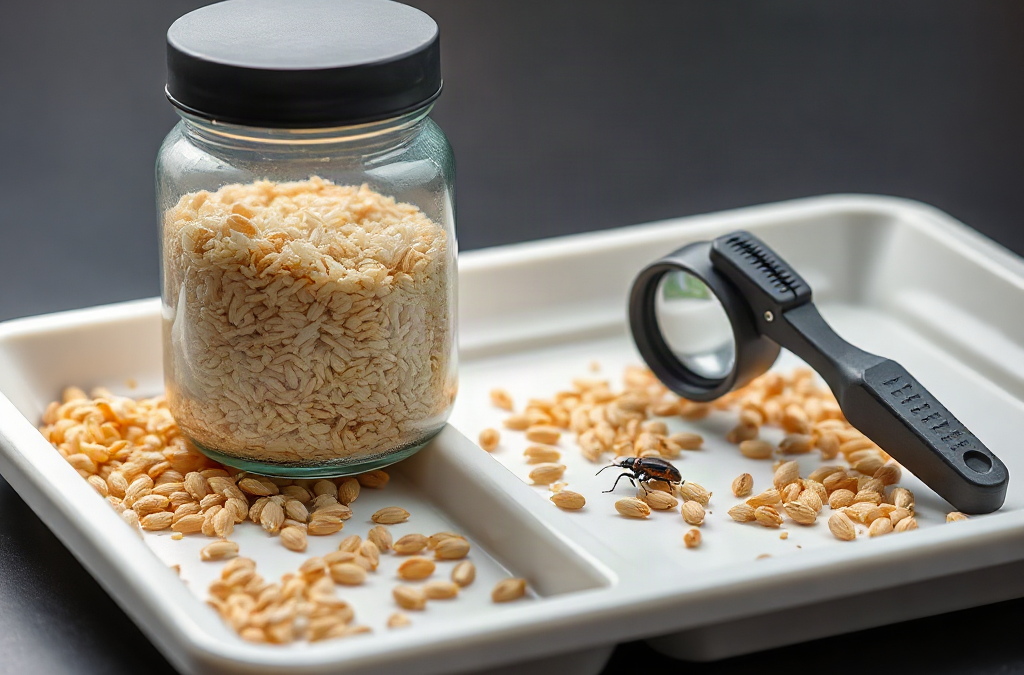
Detecting insects inside sealed grain means checking package signs and, when needed, examining samples because eggs and larvae can remain hidden inside kernels despite an intact seal. With clear packaging, look for moving beetles, silk webbing, shed skins, and round exit holes, while recognizing that damage alone does not show whether insects are still alive. Opaque buckets and foil liners prevent a reliable visual check of their contents, so an undamaged exterior cannot establish that the grain is pest-free. Isolate suspect packages before opening them, inspect grain from more than one location, and seek insect identification when the evidence is uncertain.
What you’ll learn
This guide covers the following practical points:
- What an Intact Seal Can Tell You — An intact seal tells you about the package closure, not everything that happened before filling.
- Inspect Packaging for Insect Evidence — Inspect the unopened package over a light-colored tray, away from other dry foods.
- Sample Suspect Grain Without Spreading Insects — Controlled sampling gives better evidence than repeatedly opening a suspect package near the rest of your food.
What an Intact Seal Can Tell You
An intact seal tells you about the package closure, not everything that happened before filling. Some stored-grain insects develop within individual kernels. Grain can therefore contain concealed insects before it enters a bucket, jar, or heat-sealed bag.
Weevils are a useful example: immature stages can develop inside kernels, leaving little obvious evidence until adults emerge. Other pests feed among kernels or on broken grain and may leave silk, shed skins, or fine feeding debris. A quick look at the upper surface can miss either kind.
Sealed does not necessarily mean airtight, and airtight does not mean insect-free. A snap-on lid may look secure without providing the same barrier as an intact, properly sealed liner. Even genuinely airtight packaging does not reveal the starting oxygen level or demonstrate that a pest-control process worked.
Separate two questions: are insects present, and are any still alive? An old exit hole supports the first possibility but cannot answer the second. Likewise, a motionless beetle may be dead, while a clear-looking sample may simply have missed hidden larvae. Record the packing date, grain lot, package type, and any earlier treatment before interpreting what you find.
Inspect Packaging for Insect Evidence
Inspect the unopened package over a light-colored tray, away from other dry foods. Use a flashlight to examine seams, folds, lid edges, and the bottom. With transparent packaging, tilt the contents gently and watch the grain against the wall; do not shake fragile packaging or damage its seal.
Look for actual insects as well as damage. A beetle crawling inside a clear bag is much stronger evidence than dust near its outside edge. A moth on a nearby wall may have come from another food, so its presence should prompt a wider inspection rather than an automatic verdict on one sealed container.
| Observation | What It Suggests | Main Limitation |
|---|---|---|
| Live insect visible inside | Active insect presence in that package | Does not reveal the full extent |
| Round holes in kernels | Possible emergence damage | May reflect an earlier infestation |
| Silk binding grain or debris | Possible moth larval activity | Does not establish whether larvae remain alive |
| Fine powder without visible insects | Possible feeding debris or ordinary grain dust | Not diagnostic by itself |
Opaque packaging sets a firm limit: you cannot visually inspect grain through a bucket or foil liner. Inspecting the closure can reveal damage, but it cannot clear the contents. Specialized acoustic or X-ray examination may help in professional settings; neither listening against a bucket nor using an ordinary phone provides a dependable household test for concealed insects.
Sample Suspect Grain Without Spreading Insects
Controlled sampling gives better evidence than repeatedly opening a suspect package near the rest of your food. First place the package inside a larger, closable container that can contain escaping insects. For a purchased product, photograph visible evidence and contact the supplier before opening if a return or replacement is possible.
If you choose to inspect the contents, prepare a clean, dry workspace away from pantry shelves. Keep the original label and lot details with the package. A small hand lens, white tray, clean scoop, and suitable sieve are usually more useful than elaborate gadgets.
Get Whole Wheat Flour, Grains and Milling Supplies – CLICK HERE 
- Examine several portions. Check material from different accessible locations rather than relying on one scoop from the top.
- Spread grain thinly. Look between kernels for movement, larvae, shed skins, silk, and damaged kernels.
- Sift over the tray. Inspect the separated fines for small insects; remember that a sieve cannot expose every insect concealed inside a kernel.
- Contain the evidence. Keep suspect grain and any specimens closed and labeled while deciding on identification, return, or disposal.
For example, suppose a clear bag of rice has several round kernel holes but no visible movement. Checking only the damaged kernels might miss adult insects elsewhere. Examining separate portions and the sifted debris gives a better picture, yet finding nothing still does not certify the whole bag as insect-free.
There is no universal household sample size that clears a bucket. Insects may be clustered, and early infestations are easier to miss. Inspecting a few kernels under magnification may reveal damage, but destructive examination is slow and cannot establish that all remaining kernels are clear.
If live insects appear, stop handling the grain near other supplies and keep it contained. If results remain ambiguous, seek identification rather than repeatedly reopening the package. Do not add water to the main supply or deliberately warm it to encourage insects to emerge; those changes complicate storage without providing a reliable clearance test.
Frequently Asked Questions
Can insect eggs already be in grain when it is sealed?
Yes. Grain can carry eggs or immature insects before packaging, and some species develop inside kernels. Closing a clean container keeps out new insects only if the barrier remains effective; it does not remove insects already in the grain.
Can I hear insects moving inside a sealed grain bucket?
Ordinary listening is not a reliable test. Quiet insects, concealed larvae, background noise, and the bucket wall can make activity undetectable. Specialized acoustic equipment may detect feeding activity under suitable conditions, but household silence does not establish that grain is insect-free.
Does floating grain in water reveal infested kernels?
A float test cannot reliably identify infestation. Trapped air, natural kernel differences, and other damage can affect floating, while some infested kernels may sink. Avoid wetting the stored supply; use dry inspection and seek identification when damage is unclear.
Do dead insects mean an oxygen absorber failed?
No. Dead insects do not establish when they died or what oxygen conditions existed. Their presence alone cannot confirm either absorber failure or successful treatment. Review the packaging and absorber instructions, and keep any package containing live insects isolated.
Should I open every grain container after finding one infested package?
Not automatically. Start with packages from the same purchase or packing batch and inspect nearby foods and shelving. Check intact containers externally before breaking seals. A shared source or repeated evidence justifies closer investigation, but opening everything can compromise otherwise sound packaging.
Conclusion
Treat the package, the pest evidence, and the sample as separate pieces of information. A sound closure cannot rule out insects packed with the grain, and old damage cannot establish current activity. Begin with an unopened inspection, contain suspicious packages, and sample only when the result will guide a decision. When concealed insects remain a concern, identification is more useful than treating a clean-looking scoop as proof.
Your state university’s Cooperative Extension service is a useful contact for stored-product insect identification. Ask whether it accepts close-up photographs or contained specimens, and explain whether the evidence came from inside the package, its exterior, or nearby shelving.
Get Whole Wheat Flour, Grains and Milling Supplies – CLICK HERE
Auto Amazon Links: No products found.