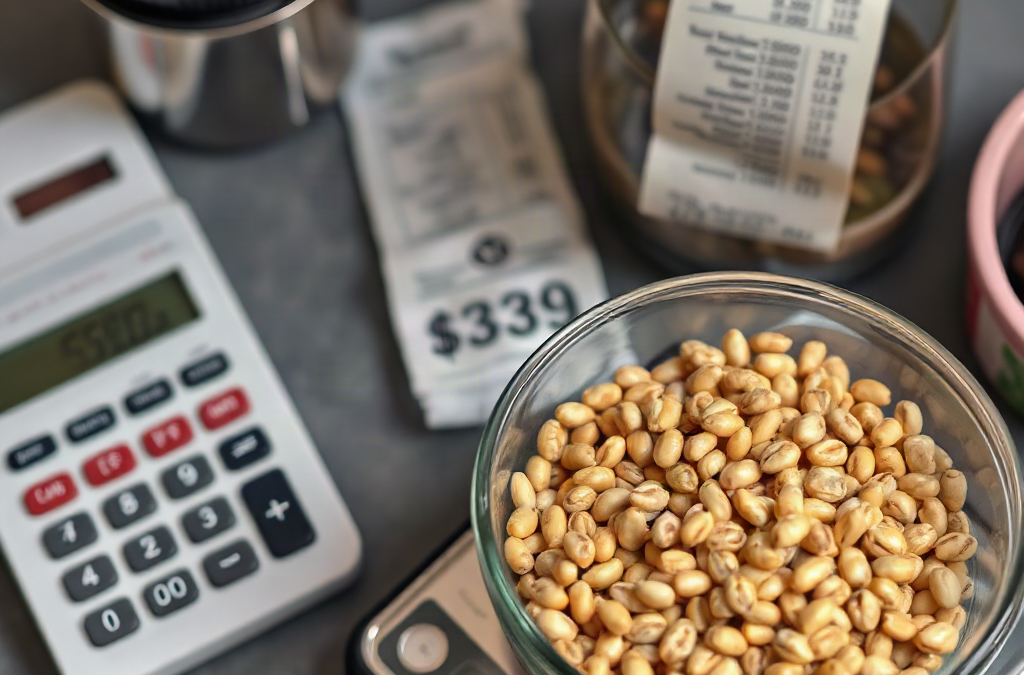
The cost per serving of stored wheat is about $0.23 for an illustrative 2-ounce dry portion when a 25-pound batch costs $44 including shipping and packaging, with 5% loss assumed. That batch provides 190 portions, so the price reflects wheat available to use rather than the bag’s original weight. Choose a fixed dry weight before comparing suppliers, since cooking water increases serving weight without adding wheat. Count milling, cooking fuel, and other recipe ingredients separately when estimating bread, cereal, or an entire meal. Replacing these sample prices and the loss allowance with your own receipts and measured yield gives your household a useful spending benchmark.
What you’ll learn
This guide covers the following practical points:
- Define a Dry-Wheat Serving — Dry wheat weight gives you a consistent basis for comparing serving costs.
- Calculate a 25-Pound Batch — A batch calculation needs three inputs: the cost assigned to the batch, its usable dry weight, and your chosen portion weight.
- Add Milling, Cooking, and Recipe Costs — Wheat-only cost and finished-food cost answer different questions.
Define a Dry-Wheat Serving
Dry wheat weight gives you a consistent basis for comparing serving costs. A bowl of cooked wheat, a bread slice, and a scoop of flour contain different amounts of the original grain. Comparing those finished portions without checking their wheat content can make one purchase look cheaper than it is.
For household budgeting, you might define one portion as 2 ounces of dry wheat, or about 56.7 grams. This is an accounting choice, not an official dietary serving or a claim about how much anyone should eat. Use the amount that fits your recipes, then keep that unit unchanged when comparing purchases.
Water changes cooked weight and volume, but it does not create more wheat. If a batch uses 8 ounces of dry berries and produces four bowls, each bowl contains the equivalent of 2 ounces dry, regardless of how much water remains after cooking.
For flour, weigh the output you actually keep. Sifting out bran or leaving flour behind in the mill reduces usable yield. Counting the original grain weight as finished flour would understate the cost of recipes made from that flour.
Calculate a 25-Pound Batch
A batch calculation needs three inputs: the cost assigned to the batch, its usable dry weight, and your chosen portion weight. Keep the weight units consistent throughout. Pounds work for buying wheat; ounces or grams are usually easier for dividing it into portions.
The following figures are illustrative, not current market prices. The $6 packaging charge represents supplies assigned to this batch. The 5% loss allowance is a planning assumption, not an expected or normal loss rate; replace it with measured results when available.
| Budget Item | Illustrative Amount |
|---|---|
| Purchased wheat | 25 pounds = 400 ounces |
| Wheat purchase price | $30.00 |
| Shipping | $8.00 |
| Packaging supplies | $6.00 |
| Total batch cost | $44.00 |
| Usable wheat after assumed 5% loss | 23.75 pounds = 380 ounces |
| Number of 2-ounce portions | 380 ÷ 2 = 190 |
| Cost per dry portion | $44 ÷ 190 ≈ $0.23 |
Formula: batch cost ÷ (usable dry weight ÷ dry portion weight) = cost per portion. Keep extra decimal places during the calculation and round the final dollar amount.
Portion size changes the result even when the wheat does not change. From this same usable batch, a 1.5-ounce portion costs about $0.17, while a 3-ounce portion costs about $0.35. Neither is a better bargain; they contain different amounts of wheat.
Without any loss, the batch would supply 200 two-ounce portions at $0.22 each. Do not automatically subtract a loss allowance and then subtract the same discarded wheat again when you measure actual yield.
Add Milling, Cooking, and Recipe Costs
Wheat-only cost and finished-food cost answer different questions. The first helps compare grain purchases. The second tells you what homemade rolls, cereal, or bread actually cost to put on the table. Keep those totals separate so a low grain price does not stand in for the price of a whole meal.
Get Whole Wheat Flour, Grains and Milling Supplies – CLICK HERE 
Using the unrounded batch calculation above, 16 ounces of usable wheat costs about $1.85. Suppose an illustrative recipe adds $1.20 in other ingredients and $0.30 in milling and baking energy, then produces 12 rolls. Its total is about $3.35, or $0.28 per roll, before labor and equipment ownership. Dividing only the wheat cost by 12 would miss almost half the recipe expense.
Reusable containers and mills need a consistent accounting choice. For an upfront cash budget, include the full purchase when you buy it. For an ongoing serving estimate, spread the cost over a realistic amount of wheat you expect to use. Do not assume years of refills merely to make a large purchase look inexpensive.
Check one actual batch before expanding your reserve:
- Record the delivered price and the packaging expense assigned to that batch.
- Weigh usable grain or retained flour, without subtracting the same loss twice.
- Track a familiar recipe’s ingredients, energy estimate, and finished portion count.
Then compare like with like: whole-wheat flour against usable whole-wheat flour, or homemade rolls against a similar purchased product. A cheaper bag can lose its advantage through delivery charges, discarded material, or low equipment use. If your household rarely cooks with wheat, a smaller purchase may cost more per pound but less in wasted food and unused supplies.
Frequently Asked Questions
How many 2-ounce servings are in a 25-pound bag of wheat?
A 25-pound bag contains 400 ounces, enough for 200 portions weighing 2 ounces dry before losses. If usable yield is 95% of the original weight, the count falls to 190.
Can I calculate wheat cost by the cup instead of by weight?
Yes, but weigh several cups of your own wheat first and find the average. Cup measurements can vary with the grain and how the cup is filled, so weight makes supplier and batch comparisons more consistent.
Does keeping wheat longer automatically increase its cost per serving?
Time alone does not change the original purchase cost per portion. Ongoing storage expenses or discarded wheat can raise it. Keep the historical cost separate from replacement cost, which uses the price you would pay to buy wheat now.
Should I include a grain mill I already own?
For an operating-cost comparison, you can exclude its original purchase price and clearly label that choice. For a full ownership estimate, assign an equipment cost across a realistic volume of use, while keeping electricity and maintenance separate.
Is stored wheat always cheaper than buying whole-wheat flour?
No. Compare delivered wheat cost, retained flour yield, packaging, milling expense, and equipment use against the price of the flour you would otherwise buy. Small flour purchases may be more economical when wheat turnover is low.
Conclusion
Choose a dry portion that matches how your household uses wheat, then price one batch from receipt to usable yield. Keep grain cost separate from recipe and equipment expenses. Before buying more, test the numbers with a meal you already make. That gives you a sounder budget than either a cheap bag price or an optimistic serving count.
Get Whole Wheat Flour, Grains and Milling Supplies – CLICK HERE
Auto Amazon Links: No products found.