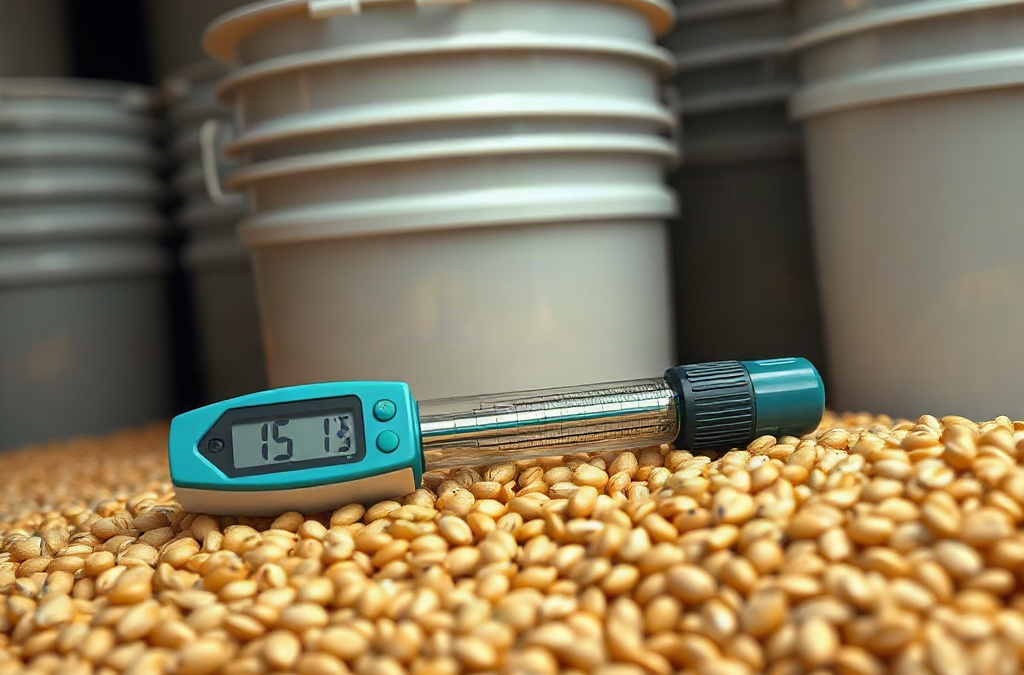
The ideal temperature for stored wheat is generally below 50°F (10°C), with about 35–40°F (2–4°C) a useful winter target for dry wheat in aerated bins where weather permits. Cooler kernels slow insect activity and grain respiration, but cooling does not replace drying or correct existing spoilage. During seasonal changes, aim for an even temperature throughout the grain rather than a cold surface over a warm center. Check moisture with a wheat-calibrated meter, and use suitable cooling air long enough to move the cooling front through the full grain depth. In warm climates or household containers, prioritize the coolest stable location available and inspect more often.
What you’ll learn
This guide covers the following practical points:
- Match Cooling to Moisture and Storage Time — Moisture content sets the limits of any temperature target.
- Adjust Wheat Temperature Through the Seasons — Seasonal cooling works best when the whole grain mass changes temperature together.
- Check for Uneven Cooling and Warming Pockets — Temperature trends reveal more than a single reading.
Match Cooling to Moisture and Storage Time
Moisture content sets the limits of any temperature target. Dry kernels and damp kernels can have the same thermometer reading but very different storage risks. Cooling slows biological activity; it does not remove enough water to make damp wheat suitable for an extended hold.
For longer storage, around 13% moisture or less is a common planning benchmark for wheat, not a universal safe-storage limit. Wheat held through hot weather or for a particularly long period may need a lower moisture content. Confirm the target with local grain-storage guidance for your climate, wheat type, and intended holding time.
Use a moisture meter set for wheat, following its instructions for sample temperature and calibration. Take representative samples rather than testing only the easiest handful to reach. A dry surface sample can miss wetter material elsewhere in the lot.
The distinction matters for household reserves, too. These recommendations concern intact wheat kernels, not whole-wheat flour. Choose a cool interior storage space over an attic or sun-heated garage, and use clean, food-grade containers that limit moisture entry. A sealed lid preserves the condition of the wheat placed inside; it does not dry it.
If wheat is damp, visibly moldy, or developing an unusual odor, seek advice from a grain-storage specialist or extension service. Do not treat a lower thermometer reading as evidence that damaged wheat is suitable for food.
Adjust Wheat Temperature Through the Seasons
Seasonal cooling works best when the whole grain mass changes temperature together. Large differences between the center and outer layers can drive air movement within the wheat, carrying moisture toward colder areas where it may accumulate.
Practical seasonal targets for dry, whole-kernel wheat:
| Storage period | Temperature objective | Main operating priority |
|---|---|---|
| After filling and during fall | Work below 50°F (10°C) as suitable weather becomes available | Remove retained heat and reduce temperature differences |
| Winter in a cold climate | About 35–40°F (2–4°C) | Finish cooling through the full grain depth |
| Spring and summer | Retain cool conditions where practical | Watch for warming, moisture movement, and insect activity |
In an aerated bin, use an appropriate stretch of cooler outside air and keep the fan operating long enough for the cooling front—the boundary between cooled and warmer wheat—to pass through the grain. Required operating time varies with airflow, grain depth, and weather. A few chilly hours may cool only part of the load.
For an illustrative example, suppose wheat begins at 65°F (18°C). After a cooling cycle, several readings are near 40°F (4°C), but one upper area remains at 55°F (13°C). That remaining warm zone deserves attention; averaging all readings would hide incomplete cooling. Which area cools last depends on airflow direction and the storage arrangement.
Do not automatically warm the wheat when spring arrives. Keeping dry wheat cool can be useful, provided moisture conditions remain controlled. Extended fan operation with unsuitable warm or humid air can work against that goal. Use local aeration guidance or a properly configured controller rather than outside temperature alone.
Get Whole Wheat Flour, Grains and Milling Supplies – CLICK HERE 
Check for Uneven Cooling and Warming Pockets
Temperature trends reveal more than a single reading. A location that becomes steadily warmer while surrounding wheat remains stable may indicate insect activity, moisture-related deterioration, or another localized problem. First check whether sunlight, changing weather, or sensor error could explain the difference.
Measure the wheat itself at several accessible locations and depths. A room thermometer or bin-headspace reading cannot show what is happening in the center. Fixed temperature cables and suitable grain probes are useful, but neither guarantees that every small trouble spot will be detected. Use externally accessible monitoring equipment rather than entering a loaded bin.
A practical monitoring routine is:
- Record a baseline: note grain temperatures, moisture readings, filling date, and recent fan operation.
- Repeat comparable readings: check the same locations at least weekly during warm weather or after filling, and more often if conditions are changing.
- Investigate departures: compare a warming area with nearby readings and check for condensation, caking, or insects.
- Confirm the response: after corrective work, look for temperatures that settle rather than quickly rise again.
Uniform readings that remain stable after cooling are encouraging. A persistent warm pocket, visible dampness, or crusting calls for further assessment, not simply another short fan run. Depending on the cause, the next step may involve drying, correcting airflow, moving the wheat, or separating a suspect lot under specialist guidance.
Frequently Asked Questions
Is 60°F too warm for stored wheat?
A reading of 60°F (16°C) does not by itself mean wheat is spoiled, but it offers less protection against insect activity than cooler conditions. Check moisture and temperature trends, shorten the planned holding period if necessary, and cool the wheat when suitable conditions become available.
Does cold storage kill insects in wheat?
Ordinary cool storage mainly suppresses insect movement and development; it should not be treated as a reliable disinfestation treatment. Existing insects may survive and become active again as the wheat warms. Ask a grain-storage specialist about an appropriate treatment for a confirmed infestation.
Will an aeration fan dry wet wheat?
An aeration system designed for temperature control should not be assumed to provide adequate drying. Drying needs suitable airflow, air conditions, and operating time. Test the moisture content and check the system's drying capability before relying on it to handle wet wheat.
Can I keep wheat kernels in a refrigerator?
Refrigeration can provide a cool location for small quantities if the wheat is already dry and enclosed in a moisture-resistant, food-grade container. Keep the container sealed while it warms to room temperature before opening, which reduces contact between cold kernels and humid room air.
How long will wheat last at 40°F?
Temperature alone cannot establish a storage life. Moisture content, initial grain condition, insects, packaging, and the intended use all matter. Treat 40°F (4°C) as a favorable storage condition, not an expiration-date calculator, and continue checking the wheat.
Conclusion
Manage wheat temperature as a changing condition, not a number reached once and forgotten. Confirm moisture first, cool evenly when the weather allows, and keep records that make unusual warming easy to spot. For household reserves, a stable indoor location and moisture-resistant packaging are practical priorities. For bulk wheat, verify that cooling reaches the entire load. Investigate changes early rather than assuming cold weather has taken care of the wheat.
Your state university extension service is a useful next stop for wheat-specific moisture limits, aeration schedules, and seasonal storage guidance. For a particular bin, also consult the fan and controller documentation: airflow direction, grain depth, and equipment capacity affect how long a cooling cycle takes.
Get Whole Wheat Flour, Grains and Milling Supplies – CLICK HERE
Auto Amazon Links: No products found.