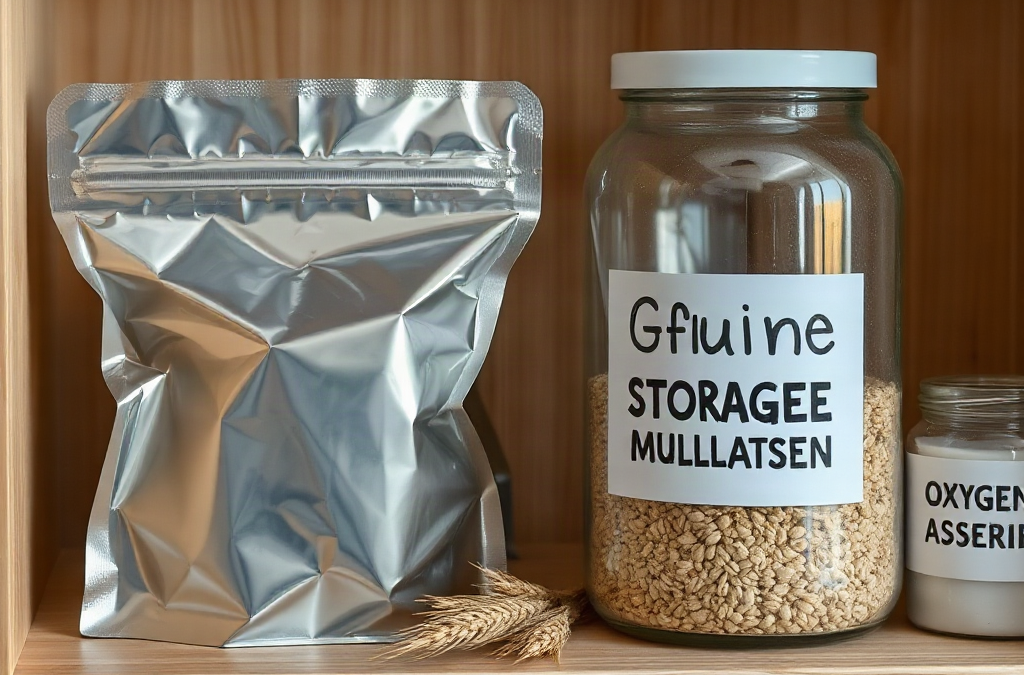
Oxygen-free grain storage uses oxygen absorbers or a managed low-oxygen atmosphere inside sealed packaging to slow oxidation and suppress stored-grain insects, but each method has limits. The term usually means very low oxygen, not a verified absence of every trace of gas. Dry grain, a dependable oxygen barrier, and an intact seal matter more than whether a bag looks vacuum-tight. Absorber capacity must account for air between kernels as well as the empty space above them, and insect control takes time under suitable conditions. Moist grain, existing spoilage, and frequent reopening call for a different storage approach or advice from a grain-storage specialist.
What you’ll learn
This guide covers the following practical points:
- What Low Oxygen Changes Inside Stored Grain — Ordinary air contains about 21% oxygen, including the air tucked between kernels in a full container.
- Dry Grain and Oxygen Barriers Come First — Dryness and packaging integrity determine whether oxygen removal is an appropriate next step.
- Comparing Oxygen-Removal Methods — The main methods differ in how they change the atmosphere and how much control the user has over the result.
- Packing and Checking a Small Grain Reserve — Pack grain in units you can use without repeatedly exposing the reserve to fresh air.
What Low Oxygen Changes Inside Stored Grain
Ordinary air contains about 21% oxygen, including the air tucked between kernels in a full container. Removing oxygen changes that storage environment; simply closing a lid traps the existing air unless something removes or consumes its oxygen.
Lower oxygen can slow oxidative deterioration, including some changes in grain oils and flavor. It can also suppress stored-grain insects when the oxygen level remains low enough for long enough. Results depend on the insect, its life stage, temperature, and the atmosphere actually reached. A sealed package is not proof that an insect-control treatment has succeeded.
Low oxygen does not sterilize grain. It does not remove dirt, reverse rancidity, or make an already damaged batch sound. Treat grain condition as a separate decision from packaging. If a lot has moisture damage, mold, heating, or an unusual odor, set it aside and seek qualified advice rather than sealing it and hoping the atmosphere will fix it. Normal appearance and smell alone do not establish safety, either.
For a household reserve, the practical benefit is protecting sound grain while it waits to be used. Start with a suitable batch and a manageable package size. Trying to rescue questionable grain adds uncertainty before the storage method has even begun.
Dry Grain and Oxygen Barriers Come First
Dryness and packaging integrity determine whether oxygen removal is an appropriate next step. An oxygen absorber is not a drying treatment, and reduced oxygen should not be assumed to make damp grain safe.
For purchased grain, check whether the supplier identifies it as suitable for long-term, reduced-oxygen storage. For grain you harvested or dried yourself, use a calibrated moisture meter intended for that crop and ask a grain-storage specialist about the result. A moisture recommendation for an aerated farm bin is not automatically a packing instruction for a sealed household reserve. Storage temperature, duration, crop, and the proposed container still matter.
The package must resist oxygen entering over time. Food-contact glass jars with suitable closures and foil-laminate pouches designed for long-term food storage are common small-scale choices. A product described only as a plastic bag, a vacuum bag, or a metallic-looking pouch does not tell you enough about its barrier performance. Check its intended use and sealing instructions.
A rigid bucket can protect a liner from punctures and make handling easier, but do not assume every bucket-and-lid combination provides a lasting oxygen barrier. Keep grain out of the sealing area, inspect jar rims and gaskets, and protect pouches from sharp edges. A generous absorber cannot compensate indefinitely for a poor closure.
Comparing Oxygen-Removal Methods
The main methods differ in how they change the atmosphere and how much control the user has over the result. Choose a complete storage system, not just a packet, pump, or bag.
| Method | How It Works | Main Limitation |
|---|---|---|
| Oxygen absorber | A food-packaging sachet chemically binds oxygen inside a sealed barrier package. | Capacity must cover the enclosed oxygen; leaks can exhaust the packet. |
| Vacuum sealing | A pump removes some air before the package is closed. | Residual air and oxygen entering through the package remain concerns. |
| Hermetic storage without added absorbers | A gas-tight enclosure retains atmospheric changes caused by respiration within the grain mass. | Oxygen depletion may be slow or insufficient; sealing alone does not verify the atmosphere. |
| Nitrogen flushing | A controlled gas flow displaces oxygen-containing air before closure. | Results require suitable equipment, process control, and atmosphere checks. |
For small dry-grain reserves, food-grade absorbers in suitable barrier packaging offer a practical approach when the supplier provides clear sizing and handling instructions. Vacuum sealing can make packages compact, but a tightly drawn bag does not establish a particular oxygen concentration. The pump removes air rather than selectively removing its oxygen.
Hermetic systems need to be used as designed. Clean, very dry grain may change the enclosed atmosphere slowly, so do not add moisture or leave an infestation untreated just to encourage oxygen consumption. Follow the system’s crop-specific instructions.
Gas flushing becomes more relevant in controlled packing operations. Large-scale nitrogen use and low-oxygen bins call for trained operators and professional safety procedures, not improvised household methods.
Get Whole Wheat Flour, Grains and Milling Supplies – CLICK HERE 
Packing and Checking a Small Grain Reserve
Pack grain in units you can use without repeatedly exposing the reserve to fresh air. Several smaller pouches inside a protective container often suit a family better than one large liner opened for every baking day.
- Confirm the grain is suitable. Establish dryness and condition before choosing an oxygen-removal method.
- Check the packaging system. Use food-contact materials, compatible closures, and the specified sealing settings.
- Match absorber capacity to the package. Follow the supplier’s sizing guidance for the grain and container, including air between kernels.
- Limit packet exposure. Have packages ready before opening the absorber supply, and follow its handling instructions.
- Seal, label, and protect. Record the grain, packing date, and batch; store packages in a cool, dry place away from damage.
Absorber ratings describe a volume of oxygen, not a weight of grain. As an illustrative calculation, suppose a container holds 200 milliliters of air above the grain and another 300 milliliters between kernels. Its estimated air volume is 500 milliliters. At roughly 21% oxygen, that represents about 105 milliliters, or 105 cubic centimeters, of oxygen.
That calculation explains why headspace alone is not enough for sizing; it is not a packet recommendation. The example assumes those air volumes are known and ignores later oxygen entry. Real sizing needs the supplier’s allowance for uncertainty and the package’s barrier performance.
After packing, inspect the closure for wrinkles, trapped kernels, punctures, or incomplete sealing. A foil pouch may tighten somewhat as oxygen is absorbed, but it need not become brick-hard because other gases remain. Packet warmth, packet hardness, and bag appearance are not reliable oxygen measurements. Where verification matters, use a monitoring method intended for that packaging system.
If a seal fails, treat the package as exposed: assess the grain, replace damaged packaging, and use fresh absorbers if repacking remains appropriate. Repeated package failures are a reason to review the material and sealing process, not simply add more packets.
Frequently Asked Questions
Can a food-grade bucket provide oxygen-free grain storage by itself?
Food-grade identifies suitability for food contact, not oxygen-barrier performance. The bucket walls, lid, gasket, and closure all affect air entry. Check the manufacturer's storage specifications; a suitable sealed liner inside the bucket may provide the barrier while the bucket protects it.
Can oxygen absorbers be reused after opening a grain package?
Do not count on a used packet having enough capacity for another storage cycle. Its remaining capacity is difficult to judge at home. When resealing for extended storage, follow the supplier's instructions and use a fresh, correctly sized absorber.
How long does low oxygen take to control grain insects?
There is no dependable household countdown based on sealing alone. Exposure time varies with oxygen concentration, temperature, insect species, and life stage. For an infested lot, get a validated treatment recommendation rather than assuming a few days in a sealed bag is enough.
Will oxygen-free packaging make brown rice last as long as wheat?
Do not assume the two will have the same storage life. Brown rice retains an oil-rich bran layer, and oxygen removal does not stop every cause of quality loss. Use product-specific storage guidance and a rotation schedule suited to the grain.
Is an oxygen absorber the same as a desiccant?
No. An oxygen absorber removes oxygen, while a desiccant takes up moisture. Neither replaces proper drying of a grain batch. Use only products intended for the food and packaging system, and do not add a desiccant as a way to make damp grain suitable for sealed storage.
Conclusion
Put the grain’s condition ahead of the oxygen-removal method. Confirm that it is dry enough for the proposed system, select packaging with a dependable barrier, and size absorbers for all the enclosed air. Use smaller units if you expect frequent access, and inspect seals without treating a tight-looking bag as proof of success. If moisture suitability or grain condition is uncertain, resolve that question with a grain-storage specialist before sealing the batch.
For grain you have harvested or dried, your state Cooperative Extension grain-storage service can help interpret crop-specific moisture measurements and storage options. For a particular pouch, hermetic bag, or absorber, consult the manufacturer’s technical instructions for barrier properties, compatible grain uses, capacity, sealing, and verification rather than relying on a general retail description.
Get Whole Wheat Flour, Grains and Milling Supplies – CLICK HERE
Auto Amazon Links: No products found.