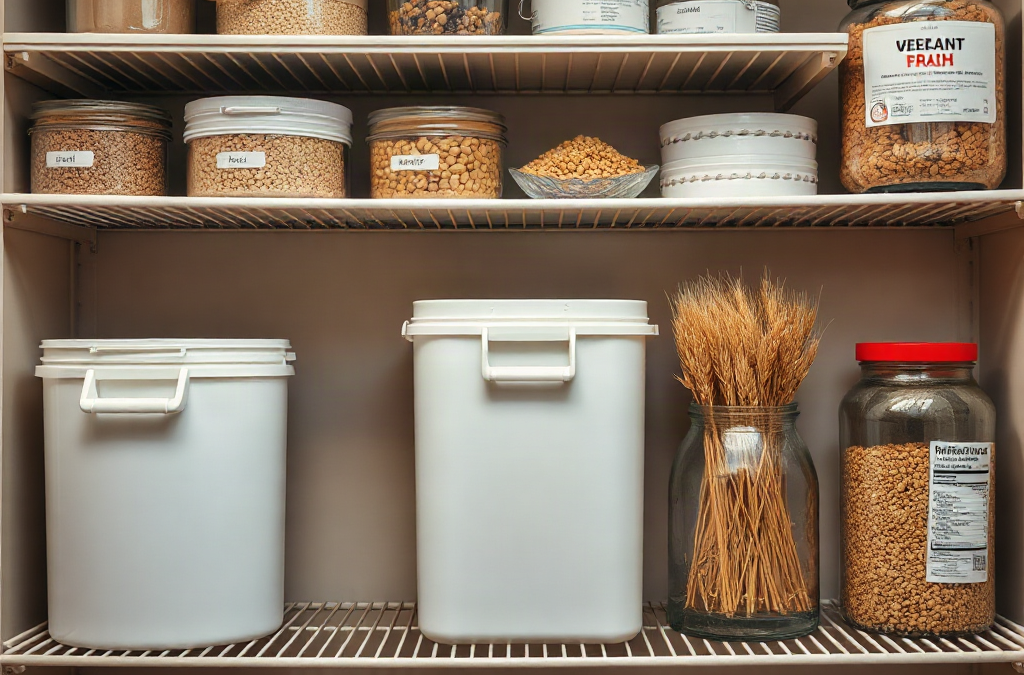
Moth prevention around grain reserves without sprays relies on clean shelving, sound food-grade containers, and early inspection to reduce the chance that a small infested lot spreads through the reserve. Eggs and larvae may arrive in purchased grain, while spilled flour and broken kernels can sustain insects outside the main packages. Inspect new supplies for webbing or live insects, keep lots separate, and protect dry grain with intact, tightly fitted lids. Use species-matched pheromone traps to monitor adult activity, not as proof that every container is pest-free. If moths appear, isolate suspect packages and trace the breeding source before adding fresh grain.
What you’ll learn
This guide covers the following practical points:
- Trace Moths to Their Feeding Source — A moth resting above a grain shelf does not tell you where the infestation began.
- Protect Dry Grain With Sound Packaging — Protective packaging needs both a durable wall and a dependable closure.
- Remove Residues and Track Moth Activity — Food dust and spilled kernels can keep moth activity going after an obvious infested package is removed.
- Contain a Suspect Lot Before It Spreads — Contain suspicious packages before moving or opening them elsewhere.
Trace Moths to Their Feeding Source
A moth resting above a grain shelf does not tell you where the infestation began. With common stored-food moths, larvae do the feeding, and mature larvae may leave their food to find a sheltered place to develop into adults. Ceiling corners and shelf joints can therefore hold evidence even when the nearest package looks clean.
Examine recently opened grain first, then nearby supplies. Look for silk threads, webbed clusters of kernels, small caterpillar-like larvae, and debris caught around package folds. Inspect the upper grain surface, bag seams, and spaces beneath lids without pouring suspect contents across a shared work area. Clumping alone is not proof of moths; moisture can also cause grain to stick together.
Check more than the reserve itself. Birdseed, pet food, nuts, flour, and forgotten cereal can provide a feeding source beside otherwise well-protected grain. A partly used sack tucked behind the main supply may matter more than the moths you can see.
A clean-looking surface is only a screening result. Small infestations can be hard to see, and some grain moths develop inside kernels. Keep the supplier, purchase date, and batch identity available so you can trace related packages if further evidence appears. These steps suit household and small storeroom reserves; bulk bins need a different inspection approach.
Protect Dry Grain With Sound Packaging
Protective packaging needs both a durable wall and a dependable closure. Glass jars, suitable metal containers, and sturdy food-grade pails can provide a stronger barrier than paper sacks or thin bags, provided their lids fit properly. A strong container with a cracked rim or worn gasket still leaves a weak point.
Inspect the entire closure before filling. Remove kernels trapped in lid grooves, check that seals are seated, and look for splits around handles or rims. Flexible liners need attention too: a punctured liner inside a pail should not be treated as an intact inner barrier.
Keep separate purchases identifiable rather than continually topping off one large vessel. Emptying a working container before refilling gives you a chance to inspect the bottom, remove flour dust, and clean the closure. Let washed containers dry completely before adding dry grain.
Dividing a large purchase into smaller sealed portions can make later inspection and containment easier. The tradeoff is more lids to maintain and more packages to label. For a family opening grain regularly, a small working jar plus separately closed reserve portions is often easier to manage than repeatedly opening the whole supply.
Sealing is not the same as treating an infestation already inside. A well-closed pail may contain insects rather than stop their development. Likewise, cooler conditions can slow insect activity, but a cool room should not be treated as proof that grain is insect-free.
Remove Residues and Track Moth Activity
Food dust and spilled kernels can keep moth activity going after an obvious infested package is removed. Concentrate cleaning on places that collect food but escape ordinary wiping: shelf supports, floor edges, pallet gaps, container rims, and the space beneath scoops or small mills.
Vacuum accessible cracks and loose residues, then promptly empty the collected material outside the storage area. Wipe washable surfaces and allow them to dry. Avoid leaving damp grain dust in corners or putting clean supplies back onto wet shelving. Cleaning removes food and some insects; it does not prove that every hidden life stage is gone.
Pheromone traps are useful for tracking certain moth species, but they are not a stand-alone control method. Many attract males of a particular species or group. They do not directly measure eggs or feeding larvae, and the wrong lure may tell you little about the insects present.
Follow the trap instructions for placement and replacement. Keep a simple record of its location, inspection date, and catches. Moving traps repeatedly makes changes harder to interpret. A practical inspection route can be short:
Get Whole Wheat Flour, Grains and Milling Supplies – CLICK HERE 
- Check recent deliveries and opened packages for fresh silk or larvae.
- Look around closures, beneath shelves, and beside nearby animal feed.
- Record trap activity and clean any new spills before leaving.
Fewer catches are encouraging only when package inspections also remain clear. Fresh webbing or larvae in another food lot matters more than a quiet trap.
Contain a Suspect Lot Before It Spreads
Contain suspicious packages before moving or opening them elsewhere. Put the package inside a sound secondary container or securely closed bag, and keep it apart from unaffected supplies. Carrying an open sack through the storeroom can scatter grain, dust, and insects along the way.
For a household package with confirmed insect activity, removing the affected food is generally more dependable for pest control than sifting and returning it to the shelf. Place discarded material in a closed bag and move it out of the building promptly. Do not blend suspect grain into a clean batch to dilute the problem.
Consider this illustrative situation: moths appear beside a newly opened sack of rolled oats, while two nearby wheat pails have intact lids and no visible damage. Isolate the oats, examine the pail closures, and check the birdseed stored below them. There is no reason to combine or empty all three grain lots merely because adults appeared nearby. However, intact lids cannot rule out insects that entered before packing.
After removal and cleaning, watch for new feeding evidence rather than judging success from one moth-free day. Adults may still emerge from sheltered stages left nearby. Continued larvae or fresh webbing in food suggest that a feeding source remains.
For repeated problems, uncertain identification, or a large bulk lot, ask a Cooperative Extension office or qualified stored-product pest professional for a plan matched to the grain and storage system. Household package advice should not be stretched into a treatment plan for a farm bin.
Frequently Asked Questions
Can moths arrive in an unopened bag of grain?
Yes. Insects may be present before packaging, and some packaging can be damaged during transport or storage. An unopened bag is not proof that its contents are pest-free; inspect the seams and visible grain before adding it to the reserve.
Does one moth mean I should discard every grain package?
No. A single adult does not identify the feeding source or show that every package is affected. Inspect nearby foods, isolate packages with evidence, and keep apparently unaffected lots separate while you investigate.
Can I reuse a food-grade pail after removing infested grain?
A sound pail can usually be cleaned and reused. Pay particular attention to lid grooves and removable gaskets, inspect for damage, and let all parts dry fully. Replace closures that no longer fit securely.
Should a moth trap go inside a sealed grain container?
Use monitoring traps in the storage area according to their instructions, rather than placing them in direct contact with grain. A trap outside a pail tracks adult activity in the room; it cannot certify the contents of that pail.
Will freezing a large sack reliably clear an infestation?
Do not assume that a cold sack surface means the center received an effective treatment. Package size, freezer conditions, and treatment duration matter. Ask a university extension office for a suitable protocol rather than applying small-package advice to a large sack.
Conclusion
Protect the separation between grain lots before spending money on more traps or replacing every container. Inspect the newest and most exposed foods, repair weak closures, and remove the dust and forgotten packages that can sustain moths nearby. If activity appears, contain the suspect source and keep records of what you find. Sound packages plus repeated checks offer a more useful picture than either a spotless shelf or an empty trap alone.
For identification help, contact your local Cooperative Extension office with clear photos of adults, larvae, webbing, and package damage. Include the grain type, package size, and whether the reserve is in household containers or a bulk bin. Ask for stored-product moth guidance specific to that setting before attempting any treatment of a large or valuable lot.
Get Whole Wheat Flour, Grains and Milling Supplies – CLICK HERE
Auto Amazon Links: No products found.