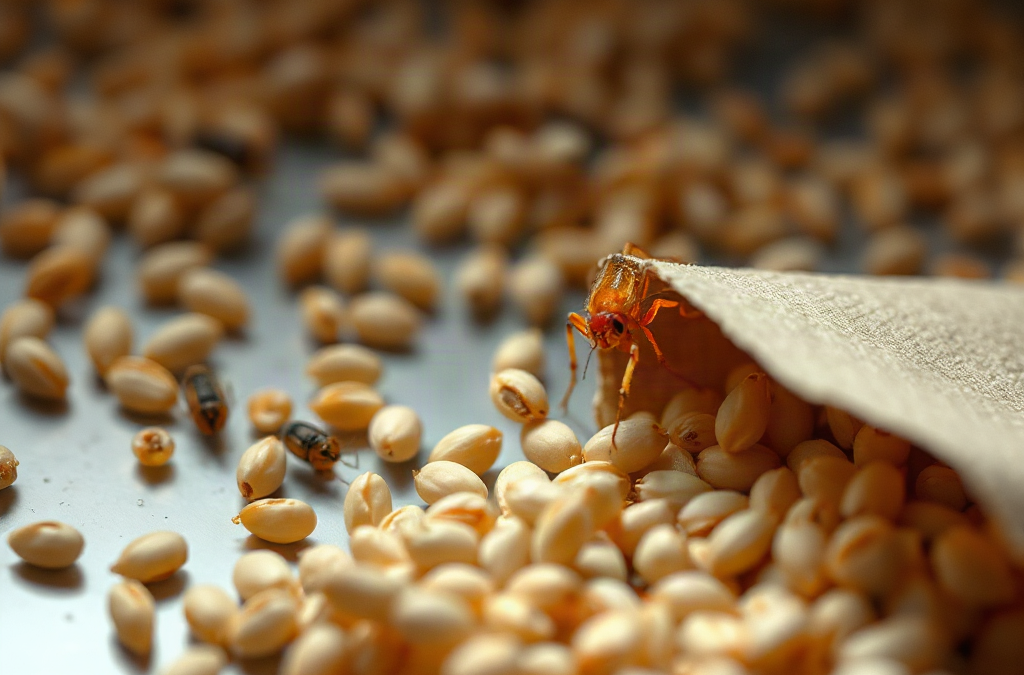
Grain storage pests attracted by spilled kernels are responding to an accessible food source that can sustain insects and rodents outside otherwise secure containers. Remove whole kernels, cracked grain, flour dust, and debris from floors, shelf joints, equipment, and gaps, then inspect nearby packages for holes, webbing, larvae, beetles, droppings, or gnaw marks. Use a vacuum for crevices, empty it outdoors, and correct leaking bags or poorly sealed bins before returning cleaned containers. Sanitation reduces pest pressure, but an active infestation may also require isolating affected grain, monitoring with appropriate traps, and using a licensed pest professional when rodents or persistent insects remain.
Why Do Spilled Kernels Attract Storage Pests?
A small spill can become a persistent feeding site because kernels remain edible long after they roll beneath a shelf or settle behind a container. Cracked grain and flour-like dust are especially accessible to insects, while whole kernels can feed mice and other grain-eating rodents. The storage container may be sound, yet food left around it gives pests a reason to remain in the room and search for additional openings.
Stored-product insects do not all enter in the same way. Some may already be present within an infested package, while others can move from one food source to another through shelf joints, wall gaps, or loosely closed bags. Adult moths may be conspicuous, but larvae, cast skins, webbing, and fine debris near seams often reveal where feeding is occurring. Small beetles may be mistaken for random household insects until repeated sightings appear near grain, flour, cereal, feed, or seed.
Rodent evidence has a different pattern. Missing kernels alone do not prove rodent activity, because grain can scatter during scooping or pouring. Droppings, gnawing, rub marks, shredded material, tracks in dust, or repeated disturbance of the same spill make rodent involvement more plausible. A few kernels found beside a recently used bucket call for cleanup; fresh droppings or a chewed bag call for isolation of exposed food and a broader inspection.
The common weak assumption is that closing the main bin solves the problem. A tight lid protects the grain inside only if pests have not already entered and if food is not available elsewhere. Sweepings left in a corner, dust inside a scoop drawer, and grain caught beneath a pallet can maintain activity independently of the bin. Spraying the visible floor without removing that material leaves the food source in place and may introduce an unsuitable chemical near stored food.
Treat the spill as both food and evidence. Note where it originated, whether the kernels are intact or chewed, and whether insects are concentrated nearby. That distinction guides the next move: repair a torn package, improve pouring practices, inspect for an internal infestation, or investigate rodent entry points. Sanitation is the first control pressure, but it works best when paired with diagnosis rather than performed as an isolated cosmetic cleanup.
Where Does Hidden Grain Debris Collect?
Hidden grain usually accumulates along movement paths rather than in the center of an open floor. Bags shed kernels while being carried, scoops drop fragments between a bin and work surface, and fine dust moves into cracks during sweeping. Inspect the route from the receiving door to the storage shelf, not merely the spot where grain is poured.
Shelf edges, caster wheels, pallet channels, floor-wall junctions, and the undersides of bins deserve close attention. Grain can also lodge beneath liners, inside folded bag tops, around lid gaskets, and in the seams of fabric or woven sacks. In a home pantry, the comparable hiding places include shelf-pin holes, drawer slides, appliance gaps, and the narrow space where shelving meets the wall. A bright flashlight held at a low angle makes kernels, webbing, skins, and dust trails easier to see.
Equipment can hold more residue than the room itself. Mills, grinders, augers, funnels, scales, and scoops may retain cracked grain in guards, joints, or housings. Clean only according to the equipment manufacturer’s safe shutdown and disassembly instructions; reaching into powered machinery or removing fixed guards creates a more serious hazard than the spill. If equipment cannot be accessed safely, arrange proper servicing rather than blowing debris deeper into it with compressed air.
Use a deliberate inspection sequence so that disturbed debris does not obscure the evidence:
- Look before cleaning: record package damage, insects, webbing, droppings, and the apparent spill path.
- Check above the spill: inspect bag seams, bin lids, transfer equipment, and shelf surfaces for the source.
- Check below and behind: move portable containers and accessible shelving where doing so is safe.
- Inspect adjacent foods: examine grain products, seed, dry pet food, and animal feed separately.
- Recheck after cleanup: fresh debris appearing later indicates a continuing leak or active pest source.
Moving every package at once is less useful than working in zones. It can spread insects, mix clean and suspect products, and erase clues about origin. Start with the heaviest activity, isolate questionable packages in durable closed containers, and then inspect outward. A warehouse, farm grain room, and kitchen pantry differ in scale, but the principle is the same: the distribution of debris often reveals whether the problem is a single leaking bag, careless transfer, infested stock, or an entry route.
How Should a Grain Storage Area Be Cleaned?
Effective cleanup removes kernels and fine residue without scattering them into new hiding places. Pick up large material first, then vacuum accessible cracks, shelf joints, and floor edges with equipment suitable for the setting. In commercial or agricultural facilities, grain dust can create respiratory and combustible-dust hazards, so facility procedures and appropriately rated equipment take priority over ordinary household methods.
A vacuum generally reaches crevices better than dry sweeping. Sweeping can push fine particles under shelving or suspend dust, although it remains useful for gathering large kernels on a smooth, open floor. Empty a household vacuum or sealed collection container outdoors promptly so insects do not emerge inside. If the vacuum has a reusable canister or attachment, inspect and clean it according to its instructions before storing it.
Wet washing is not automatically better. Water can turn flour dust into paste, drive residue into joints, and leave moisture around grain packaging. After dry material has been removed, washable surfaces may be cleaned with a method appropriate to the surface and allowed to dry fully. Never apply a pesticide, cleaner, or disinfectant directly to grain unless its label and intended food-use instructions explicitly permit that application. More chemical does not compensate for food debris that remains beneath fixtures.
Packages require individual decisions. An undamaged rigid container can be moved, cleaned externally, inspected, and returned after the area is dry. A paper or woven bag with insects, webbing, exit holes, gnawing, urine contamination, or an unreliable closure should not simply be placed inside another bag and forgotten. Isolate it from unaffected food while deciding whether the contents can be safely handled or should be discarded. Food contaminated by rodents should not be eaten, and cleanup of rodent-contaminated areas should follow current public-health guidance rather than dry sweeping or vacuuming droppings.
Get Whole Wheat Flour, Grains and Milling Supplies – CLICK HERE 
Close the source before restocking. Replace split sacks, repair transfer leaks, and use food-grade containers with lids that close consistently. Avoid filling bins so high that kernels lodge in lid threads or gasket channels. Leave enough clearance to inspect behind and beneath containers; a shelf packed tightly to the wall may save space but makes recurring spills and pest signs difficult to detect.
Cleanup is working when no fresh kernels appear, trap activity declines, and inspections find no new insects, webbing, gnawing, or droppings. Failure looks different: debris returns under the same bag, insects continue appearing near one package, or rodents disturb bait stations or monitoring devices repeatedly. Those signs mean the source, harborage, or entry route remains unresolved.
How Can You Monitor Activity and Prevent a Return?
Monitoring distinguishes a completed cleanup from a temporarily hidden infestation. Date the cleanup and inspect the area regularly at first, especially around the original spill, nearby packages, wall edges, and equipment. The goal is not to promise that every pest has disappeared immediately; it is to detect whether activity is declining, persisting, or shifting to another location.
Traps should match the suspected pest and be used as monitoring tools rather than substitutes for sanitation. Species-appropriate stored-product insect traps may help locate activity, but a trap does not make infested food usable or remove larvae inside packages. Rodent traps require careful placement away from children, pets, and food-handling surfaces. If the species is uncertain, capture or photograph a specimen without crushing key features and seek identification from a local extension service or qualified pest professional.
Container choice affects future risk. Thin retail bags are convenient for short-term handling but offer limited protection from punctures, imperfect closures, and rodents. Rigid food-grade containers make spills easier to contain and reveal, although even a strong plastic bin should not be considered rodent-proof under every condition. Metal containers may resist gnawing better, but lids and seams still need inspection. Transferring grain into a new container also does not remove insects already present in the product.
Prevention should focus on the points where grain is handled. Use a tray or cleanable mat beneath the filling area, choose a scoop that fits fully inside the container opening, and avoid pouring from shoulder height. Label containers so older stock can be used first, but examine it before combining it with a newer lot. Mixing an unnoticed infestation into fresh grain expands the amount that must be isolated and assessed.
A practical monitoring record can be simple: date, location, pest sign, affected product, cleanup performed, and result at the next check. Repeated sightings in different rooms, fresh rodent evidence, inaccessible nesting areas, or activity that continues after food removal justify professional evaluation. Pest-control work around food requires correct identification, lawful product use, and attention to contamination risks; indiscriminate indoor spraying is neither a diagnostic method nor a durable correction.
Long-term success is visible in routine handling. Staff or household members clean spills when they occur, damaged packages are isolated before entering the main storage area, and inspection space remains around containers. By contrast, relying on scent repellents, occasional surface sweeping, or sealed bins alone leaves the underlying food trail and access routes unaddressed.
Frequently Asked Questions
Can a few spilled kernels really cause a pest problem?
Yes. A few kernels may be enough to keep existing insects or rodents searching the area, especially when additional dust and fragments are hidden beneath shelving.
Should spilled grain be returned to its container?
No. Floor debris may contain dirt, pest material, moisture, or cleaning residues. Discard it in a closed waste container rather than mixing it with stored food.
Does seeing one moth mean all stored grain is infested?
Not necessarily, but it warrants inspection. Check package seams and nearby dry foods for larvae, webbing, holes, cast skins, or repeated adult activity.
Will airtight containers stop grain pests?
They limit movement and contain spills, but they do not remove insects already inside grain. Inspect products before transfer and keep containers externally clean.
When should a pest-control professional be called?
Seek qualified help when rodent signs persist, entry points are inaccessible, insects continue after source removal, or control near food-handling areas requires specialized treatment.
Conclusion
Spill control works when it goes beyond the visible pile. Inspect the package or transfer point that released the grain, follow the debris into cracks and equipment, and separate suspect products before cleaning. Dry removal is usually the practical starting point, while moisture, pesticides, and machinery access require added caution.
Afterward, watch the original location for fresh kernels and renewed pest signs. Reappearing debris points to a leak or handling problem; continuing insects or rodent evidence suggests an infestation, harborage, or access route that remains active. Store sound grain in clean, durable containers, preserve room for inspection, and record where activity occurs. If contamination, persistent rodents, or widespread insect activity makes the situation uncertain, protect unaffected food and obtain species-specific assistance rather than relying on repeated surface treatments.
Get Whole Wheat Flour, Grains and Milling Supplies – CLICK HERE
Auto Amazon Links: No products found.