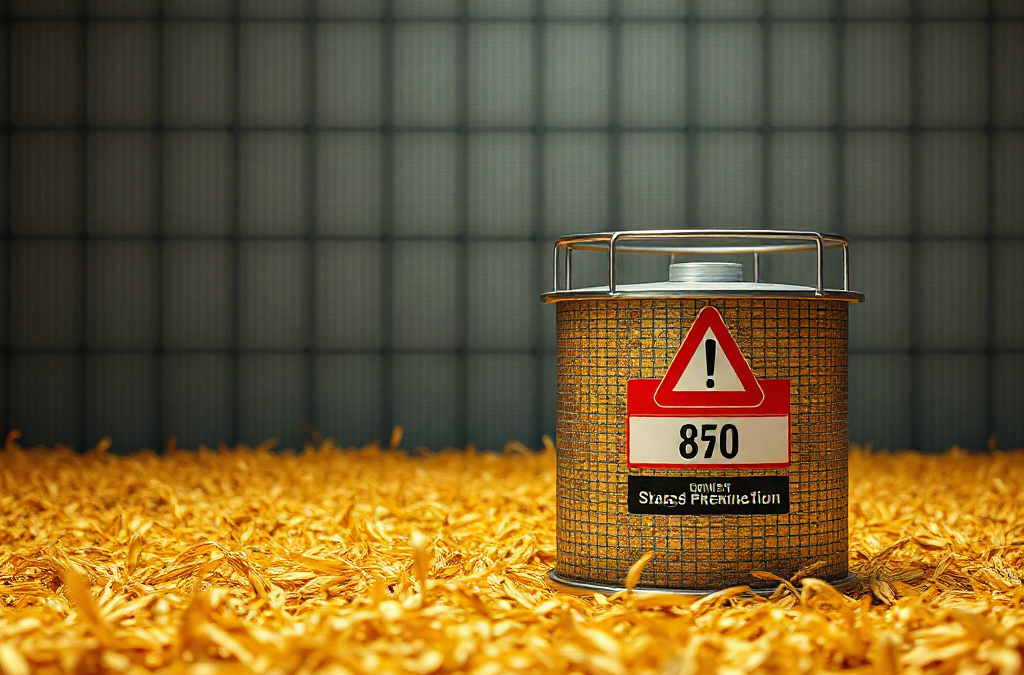
Grain storage pest traps and monitoring points work best as a mapped detection network placed beside walls, near doors, beneath handling equipment, and around bins or bag stacks where insects travel or grain debris accumulates. Use suitable pitfall or probe traps within bulk grain and pheromone or sticky traps around the storage structure, then identify, count, and record catches by location and date. Inspect points on a consistent schedule and compare trends rather than treating one empty trap as proof that grain is pest-free. Rising catches, repeated activity at one location, damaged kernels, webbing, or heating should trigger closer grain inspection and corrective action.
What Can Pest Traps Reveal About Stored Grain?
Trap catches reveal insect activity at a particular place and time; they do not certify the condition of every kernel in a bin, sack, or room. Their strongest value is early detection and comparison. A trap that repeatedly captures insects near a bucket elevator, for example, points toward a different inspection priority than a single insect found beside an exterior door after warm weather.
Stored-product insects behave differently according to species, temperature, food availability, and life stage. Some move across floors and along wall edges. Others fly through the building, while larvae or adults may remain within a grain mass. A monitoring network therefore needs to sample more than one route. Floor traps can intercept crawling insects, pheromone traps can indicate activity by particular target species, and probes inserted into bulk grain can reveal insects moving between kernels.
The distinction between detection and measurement matters. A pheromone lure may be highly attractive to a target insect, so its catch cannot be read as a direct count of insects in the grain. Conversely, an empty trap can reflect poor placement, an expired or inappropriate lure, dust-covered adhesive, low insect movement, or temperatures that suppress activity. It is weak evidence when considered alone.
Useful interpretation combines trap results with direct observations. Check for live insects in grain samples, cast skins, webbing, damaged kernels, unusual odors, caking, localized warmth, and grain dust accumulating beneath equipment. A small household grain room might use numbered traps beside shelving and containers, while a larger facility may need points around receiving, conveying, cleaning, storage, and dispatch areas. The scale changes, but the principle does not: catches become meaningful only when each point has a stable identity and surrounding conditions are documented.
A common failure is buying several traps and moving them whenever a location looks suspicious. Moving a trap destroys the location history needed to identify a trend. Establish fixed points first, record temporary investigative traps separately, and retain zero-catch entries. A sequence of recorded zeros is valuable context; a blank log is not.
Where Should Monitoring Points Be Placed?
Monitoring points belong where insects are likely to enter, travel, feed, hide, or emerge from equipment—not in an evenly spaced pattern chosen only for visual neatness. Begin with a simple floor plan showing bins, bag stacks, doors, wall junctions, conveyors, mills, cleaners, floor drains, utility penetrations, and areas where grain dust or broken kernels collect.
Wall-floor junctions are useful locations for traps targeting crawling insects because many pests follow edges rather than crossing exposed floor space. Other high-value points include both sides of frequently opened doors, beneath spouts, near seams or gaps in equipment, behind pallets, around sack-storage racks, and close to returned or older grain. Keep traps where they can be inspected without being crushed, washed away, buried by sweepings, or exposed to heavy dust that compromises them.
Bulk grain requires a different spatial view. Activity may vary between the surface, central core, and perimeter because grain temperature, moisture migration, fines, and airflow are not uniform. Probe or pitfall traps intended for grain can be distributed across accessible surface zones, with their positions mapped. Safe access takes priority: nobody should enter a grain bin or walk on bridged grain to place or retrieve a trap. Monitoring must be designed around approved access points and site safety procedures.
A practical placement survey can follow four priorities:
- Entry points: doors, windows, vents, pipe penetrations, and incoming-grain routes.
- Food and residue: spills, dust ledges, floor cracks, bag seams, and equipment interiors.
- Movement corridors: walls, pallet edges, conveyor lines, and transitions between rooms.
- Stored commodity: representative locations in or immediately around bins, totes, or bag stacks.
Consider a room with sealed grain containers on two shelving rows. Placing every trap near the doorway may detect entry but miss insects emerging from a damaged package at the rear wall. A better plan includes the doorway, each wall line, the oldest stock area, and the space beneath shelving where spilled kernels settle. More traps are not automatically better; a smaller number of inspectable, mapped points usually produces cleaner records than numerous traps that are forgotten or shifted.
Matching Trap Types to Storage Conditions
Trap selection should match the insect’s movement and the physical storage system. No single design adequately samples flying moths, crawling beetles, and insects living inside a grain mass. Before choosing equipment, identify the commodities present, likely pest groups, whether grain is bulk or packaged, and whether the goal is broad surveillance or follow-up on a known target.
Floor, probe, and pheromone-based traps
Floor traps and pitfall-style devices are suited to insects moving over surfaces. They are often most informative along edges, beneath machinery, or near residues. Grain probe traps are perforated devices inserted into accessible bulk grain so moving insects enter and are retained. Their results are influenced by local conditions, which means several mapped grain positions are more informative than one probe near a convenient hatch.
Pheromone traps use a species-specific or group-targeted chemical lure and are particularly useful when the suspected pest is known. A lure for one pest should not be expected to provide broad surveillance for all beetles and moths. Sticky traps may catch flying insects even without a specialized lure, but dust can quickly cover the adhesive in active grain-handling areas. Trap labels and manufacturer directions should govern lure compatibility, replacement, placement orientation, and disposal.
| Monitoring tool | Best-suited location | Primary limitation |
|---|---|---|
| Floor or pitfall trap | Wall edges, shelving, machinery, and spill zones | Samples mobile insects near that surface |
| Grain probe trap | Accessible zones within bulk grain | Represents local movement, not the entire grain mass |
| Pheromone sticky trap | Storage rooms and processing spaces | Targets only pests responsive to the selected lure |
| Direct grain sample | Selected depths or suspect lots | Requires representative sampling and careful examination |
Trap choice also involves a maintenance tradeoff. A sensitive adhesive trap may provide clear specimens in a clean room but fail rapidly beside a dusty conveyor. A sheltered floor trap may remain usable longer but miss moths flying above it. In a mixed facility, combining complementary devices is preferable to forcing one trap type into every location.
The common misconception is that a branded lure identifies every captured insect. The lure explains what the trap is intended to attract, not necessarily every organism stuck to it. Preserve or photograph uncertain specimens and seek identification through a qualified pest professional, diagnostic laboratory, or agricultural extension service when available. Treatment decisions made from a misidentified insect can waste effort and leave the actual source untouched.
How Should Traps Be Inspected and Recorded?
A consistent inspection interval is more useful than irregular checks prompted by visible insects. The appropriate frequency varies with grain temperature, storage duration, previous activity, trap instructions, and the consequences of delayed detection. Inspect more frequently during warm conditions, after receiving grain, following a prior catch, or while verifying corrective work. Longer intervals may be reasonable during stable cool storage, but lure and adhesive service limits still apply.
Get Whole Wheat Flour, Grains and Milling Supplies – CLICK HERE 
Assign every point a durable code tied to the map, such as R1-W03 for room one, west wall, point three. At each check, record the date, trap condition, number and apparent type of insects, grain or room observations, and any action taken. Include zero catches. Replace a trap when it is full, contaminated, damaged, or due under its product instructions, while preserving the same point code in the record.
Counts should be compared point by point rather than pooled into one building total. Five insects caught at one machine on consecutive inspections may indicate a localized source; five insects spread across a large site may suggest a different pattern. Note operational changes that can distort comparisons, including deep cleaning, grain movement, open doors, unusually heavy dust, a changed lure, or a trap relocated by staff.
A workable inspection sequence is to examine the surroundings before touching the trap, photograph unusual conditions, collect or identify catches, clean nearby spills without erasing evidence prematurely, and update the log immediately. Delayed transcription encourages guessed counts and missing zero entries. Digital records can simplify trend charts, but a paper log stored at the inspection station is better than software nobody updates.
Monitoring is working when traps remain serviceable, point locations stay fixed, records show complete inspection dates, and catch patterns can be linked to grain lots or structural areas. It is failing when adhesive is buried in dust, traps disappear during cleaning, specimens are discarded before identification, or staff report only positive catches. A calendar alone cannot correct these failures; responsibility for checking, recording, and escalating results must be explicit.
What Should Happen After a Pest Is Caught?
A catch should trigger verification and source tracing before it triggers a broad treatment response. First confirm the specimen as closely as practical, check the condition of the trap, and inspect the immediate area. Then examine nearby grain, packaging, residues, cracks, equipment voids, and adjacent monitoring points. The aim is to determine whether the catch is isolated, repeated, spreading, or associated with a particular lot.
Response intensity should reflect evidence. One uncertain outdoor insect beside an open door is not equivalent to repeated captures of a stored-product beetle beneath a grain cleaner. Repeated catches at the same point, activity in neighboring traps, live insects in a representative grain sample, or commodity damage justify faster escalation. Separate suspect lots where this can be done safely and without spreading insects, and avoid blending questionable grain into unaffected stock.
Sanitation often removes the food and shelter sustaining peripheral populations. Vacuum grain residues from accessible cracks and equipment areas where appropriate, dispose of collected material securely, correct leaking packages, and improve stock rotation. Simply placing more traps over a spill monitors the symptom while leaving the food source intact. Likewise, discarding a trap after a positive catch without inspecting the surrounding zone loses the main benefit of detection.
Temperature management, aeration, grain movement, fumigation, or other pesticide use requires commodity-specific judgment, suitable equipment, and compliance with product labels and applicable rules. Traps do not determine whether grain is safe to consume, and they should not be used as the sole basis for pesticide selection. Significant activity, uncertain identification, inaccessible infestations, or evidence within a large bulk mass warrants advice from a qualified grain-storage or pest-management professional.
After corrective work, retain the original monitoring points and add temporary traps only if they answer a defined question, such as whether insects remain around one conveyor. Mark these additions separately so their catches do not distort the baseline. Falling counts across successive checks, clean grain samples, and the absence of fresh damage support the conclusion that action is helping. A single empty inspection immediately after cleaning is encouraging but insufficient to close the incident.
Frequently Asked Questions
Can an empty pest trap confirm that stored grain has no insects?
No. An empty trap may reflect low movement, cool conditions, poor placement, trap contamination, or the wrong lure. Combine catches with grain sampling and checks for damage, webbing, odors, and localized heating.
Should traps be placed in the center of a storage room?
Some flying-insect traps may be useful away from walls, but crawling-insect traps usually perform better along edges and near food residues, equipment, doors, or packaging. Placement should follow expected pest movement.
How often should grain pest traps be checked?
Use a consistent schedule based on trap instructions, temperature, storage risk, and prior catches. Increase inspection frequency during warm periods, after new grain arrives, or when catches begin rising.
Do pheromone traps attract pests into the building?
They are monitoring tools designed to attract particular target insects over a limited area. Avoid placing them immediately beside open exterior access unless that location serves a defined monitoring purpose.
What information belongs in a trap log?
Record the point code, date, catch count, suspected pest, trap condition, nearby grain observations, operational changes, and corrective actions. Zero-catch inspections should be recorded as well.
Conclusion
Effective pest monitoring depends less on owning numerous traps than on building a stable, interpretable network. Map likely entry routes, residue zones, equipment, and stored commodities; select devices that match crawling, flying, or grain-dwelling insects; and keep each point identifiable through cleaning and stock movement. Treat catches as evidence requiring context rather than an automatic diagnosis.
The next practical step is to draw the storage layout, number existing traps, and review whether each location answers a clear detection question. Establish who checks them, what gets recorded, and which findings require grain sampling or professional help. Consistent records will show whether activity is isolated, persistent, or spreading, while sanitation and follow-up inspections verify whether corrective action is changing the pattern.
For commodity-specific monitoring and identification guidance, consult current stored-grain publications from a local agricultural extension service, national agriculture department, or recognized grain-quality organization. Match any trap, lure, pesticide, or fumigation practice to its official instructions and the requirements governing the storage site.
Get Whole Wheat Flour, Grains and Milling Supplies – CLICK HERE
Auto Amazon Links: No products found.