
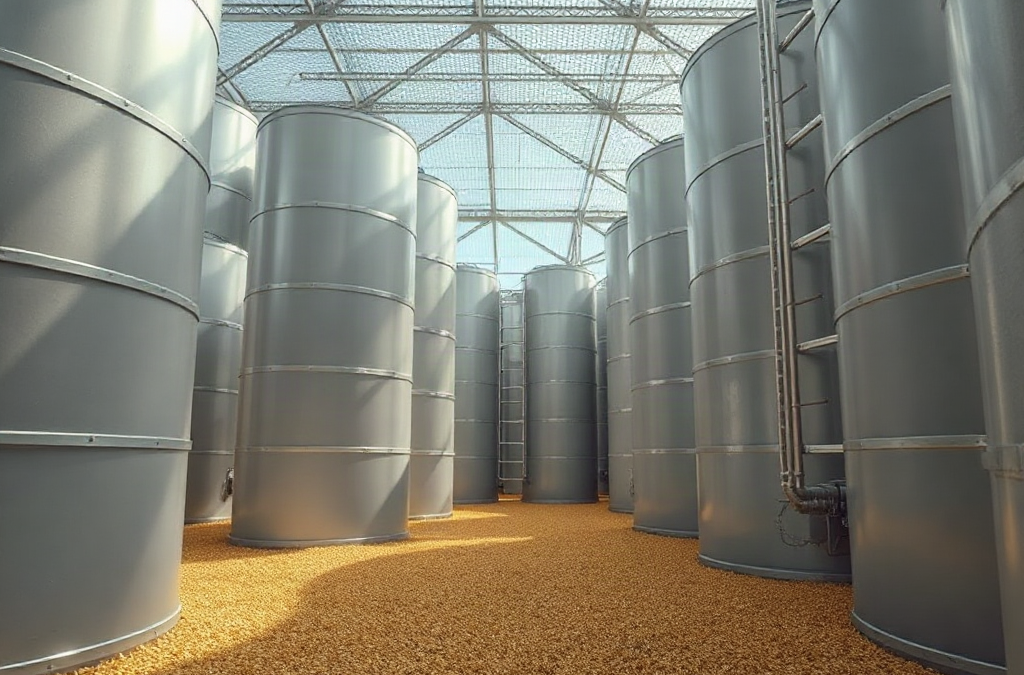
Grain storage ventilation without humidity gain depends on running fans only when incoming air can cool or equalize the grain without raising its equilibrium moisture content. Compare outside temperature and relative humidity with grain temperature, account for condensation at bin surfaces, and stop airflow when damp air would move the grain toward unsafe moisture levels. Short, monitored aeration cycles are safer than continuous ventilation during fog, rain, warm humid afternoons, or rapid weather changes. Temperature cables, a reliable hygrometer, exhaust-air observations, and regular grain inspection help confirm whether each cycle is cooling the mass or quietly adding moisture.
Why Can Ventilation Add Moisture to Stored Grain?
Ventilation changes grain condition through an exchange of heat and moisture between the kernels and the air moving around them. Air that feels cool or comfortable to a person is not necessarily safe for stored grain. Its effect depends on temperature, relative humidity, grain type, and the grain’s existing moisture content. When incoming air favors a higher equilibrium moisture content than the kernels currently have, prolonged airflow can gradually wet the grain.
Relative humidity alone is an incomplete operating signal because it changes as air temperature changes. Cool outside air at high relative humidity may contain less total water vapor than warmer air, yet it can still move a dry grain surface toward a higher moisture equilibrium. Conversely, warmer air with a lower relative humidity may have enough drying capacity to remove moisture, but it can also warm the grain and undermine a cooling objective. Fan decisions therefore need to reflect both moisture behavior and temperature control.
Moisture movement inside a bin adds another complication. Grain is a porous mass containing temperature differences, air spaces, dust, and uneven resistance to airflow. Natural convection can carry warmer air through the center and down along colder walls, where water may condense. Aeration changes these temperature patterns, but an incomplete cooling front can leave warm and cool zones within the same bin. Condensation may then appear under the roof, near the wall, or at the top surface even when the average grain moisture has barely changed.
For example, consider grain that was placed into storage warm and reasonably dry. Running a fan through several damp nights may cool the lower layers first, while the upper portion remains warm. If fan operation stops before the cooling front exits the grain, the bin contains a pronounced temperature gradient. Continuing through fog or rain may then expose the upper layer to damp exhaust air and condensation. The failure is not simply that the outside humidity was high; fan timing, incomplete front movement, and cold metal surfaces combined to concentrate moisture.
A common misconception is that aeration and drying are interchangeable. Aeration generally uses modest airflow to manage temperature and reduce temperature differences. Drying requires enough airflow and suitable air conditions to remove a meaningful quantity of water. Expecting a low-airflow aeration system to correct wet grain can allow spoilage to develop before moisture falls appreciably. If grain entered storage above the moisture level appropriate for its intended storage period, dedicated drying or prompt marketing may be more appropriate than waiting for ventilation to solve the problem.
When Should Aeration Fans Run?
Fans should run during a suitable weather window long enough to move a conditioning front through the grain, but not merely because the outside air is colder. The practical decision combines outside temperature and relative humidity with grain temperature, grain moisture, airflow rate, and the operator’s target condition. An equilibrium-moisture reference for the particular grain provides a better basis than a fixed relative-humidity cutoff applied to every crop and season.
A control system that measures temperature and humidity can estimate whether incoming air is likely to wet, dry, or leave the grain nearly unchanged. Manual operators can apply the same principle by checking reliable weather measurements at the bin rather than relying only on a distant forecast. Conditions at a sheltered farmstead, beside wet soil, or near standing vegetation may differ from an airport weather report. A sensor should be protected from direct rain and sun while remaining exposed to representative intake air.
| Observed Condition | Likely Decision | Reason to Verify |
|---|---|---|
| Cool air with acceptable moisture potential | Run a planned cooling cycle | Confirm that the cooling front can progress through the bin |
| Fog, rain, or saturated intake surfaces | Usually pause aeration | Liquid water and near-saturated air raise wetting and condensation risk |
| Warm, dry afternoon air | Use only if drying or equalization is intended | The air may remove moisture while also warming the grain |
| Rapid temperature drop after a warm day | Check roof and surface conditions | Cold metal can collect condensation before the grain mass equalizes |
Short cycles can be useful when weather windows are limited, but repeatedly starting and stopping without tracking the front creates uncertainty. Each run advances a temperature or moisture front from the air inlet toward the exhaust side. If later cycles use very different air conditions, the grain may develop layered conditions rather than uniform cooling. A planned sequence of acceptable hours is preferable to random operation whenever enough suitable weather is available.
Fan direction and bin design also affect the result. Upward airflow allows an operator to observe exhaust conditions at the top, but it can carry moisture toward the roof and upper grain surface. Downward airflow may reduce some roof-condensation concerns, yet it requires suitable ducting and safe exhaust management. Neither direction makes humid air harmless. The correct choice depends on the installed system, airflow resistance, grain depth, and whether the top surface can be inspected safely.
Do not use a household humidity rule as a universal trigger. Different grains reach different moisture equilibria under the same air conditions, and acceptable storage moisture also changes with storage duration and temperature. Establish limits for the actual crop, then revise fan operation when grain temperature, intended holding period, or weather pattern changes.
How Do You Monitor Airflow and Grain Condition?
Effective monitoring looks for trends across the bin rather than a single reassuring reading. Temperature cables, if properly placed and functioning, can reveal warming zones and show whether a cooling front is advancing. They do not sample every kernel, however. Grain near a wall, beneath crusted material, or between sensor lines can deteriorate without producing an immediate alarm. Cable data should be paired with surface inspection, odor checks, exhaust-air observations, and records of fan runtime and weather.
At the start of a cooling cycle, exhaust air may reflect the condition of grain near the outlet rather than the incoming air. As the front approaches, exhaust temperature typically changes toward the condition produced by the new airflow. That change can help indicate progress, but it should not be interpreted in isolation. Sun-warmed roofs, cold nights, fan heat, and uneven airflow can distort spot readings. Compare measurements taken at similar locations and operating stages.
Physical warning signs deserve prompt attention. Condensation beneath the roof, dampness on the upper grain surface, musty odor, crusting, localized heating, insect activity, or grain sticking together may indicate moisture concentration or biological activity. A fan should not automatically be started in response to every warm reading. If the outside air is unsuitable, ventilation may spread moisture or feed a deteriorating zone with oxygen without adequately cooling it. A qualified grain-storage or aeration professional can help assess persistent hot spots, severe crusting, or uncertainty about unloading safety.
A practical monitoring record should capture a small set of comparable observations:
Get Whole Wheat Flour, Grains and Milling Supplies – CLICK HERE 
- date, fan start and stop times, and total runtime;
- intake-air temperature and relative humidity;
- grain temperatures at consistent sensor locations;
- weather conditions such as rain, fog, or sharp temperature changes; and
- surface, roof, odor, and exhaust-air observations.
The record becomes useful when it supports a decision. If lower sensors cool while upper sensors remain unchanged, the front probably has not crossed the grain mass. If temperatures fall but roof condensation increases, operating hours or airflow direction may need review. If grain warms again after fans stop, investigate solar heating, insect activity, moisture migration, or an incompletely conditioned zone rather than assuming more fan hours are automatically the answer.
Safe access remains a firm constraint. Never enter a bin while grain is flowing, and do not walk on bridged or crusted grain. Inspection methods should favor exterior access points, fixed sensors, safely designed platforms, and established confined-space procedures. Grain condition matters, but it does not justify exposure to engulfment, entanglement, or hazardous air.
An Operating Plan for Changing Weather
A reliable operating plan defines acceptable intake conditions before the fan starts and identifies the evidence that will end the cycle. Begin with the crop, measured grain moisture, current grain temperature, storage objective, and expected holding period. Determine whether the immediate goal is cooling, temperature equalization, limited drying, or protection from a forecast temperature swing. Mixing those objectives produces inconsistent fan decisions.
Next, identify a suitable range of outdoor conditions using an equilibrium-moisture chart, calculator, or controller intended for that grain. A simple thermostat can support cooling but cannot identify moisture risk by itself. A humidistat adds information, although a fixed relative-humidity setting still ignores the effect of temperature and crop type. Controls based on both temperature and humidity are more selective, provided their sensors are calibrated, correctly located, and checked against actual grain condition.
Use this operating sequence as a compact field checklist:
- Confirm the objective. Record whether the cycle is intended to cool, equalize, or remove limited moisture.
- Check the grain. Review moisture, temperature differences, surface condition, and any previous warning signs.
- Evaluate intake air. Consider temperature, relative humidity, precipitation, fog, and the crop’s expected equilibrium response.
- Plan enough runtime. Estimate whether the available weather window can make meaningful progress through the grain mass.
- Verify the result. Compare sensor trends, exhaust conditions, roof moisture, and surface observations before scheduling another cycle.
Changing weather may force a tradeoff between completing a cooling front and avoiding a humid period. If a brief damp interval interrupts an otherwise suitable multi-day cooling window, pausing may be reasonable when the front can resume soon. If the grain is already heating or marginally wet, waiting for perfect weather may carry a greater spoilage risk. That situation calls for crop-specific judgment and may require drying, transfer, turning, or unloading rather than prolonged low-airflow aeration.
Suppose a bin is partly cooled when a warm, wet system arrives. Leaving the fan running continuously could add moisture and rewarm the cooled portion. Shutting it off preserves current conditions but leaves a temperature boundary inside the mass. The practical response is to document where the front appears to be, stop during unsuitable air, inspect for condensation, and resume with compatible air as soon as conditions permit. The weak alternative is forgetting the interrupted cycle and assuming the bin is uniformly cool.
Success is visible as a stable, narrowing temperature range, no new condensation, no musty odor, and a front that reaches the exhaust side. Failure appears as persistent warm pockets, rising moisture at the surface, repeated roof wetting, crust formation, or fan operation that changes readings near the inlet but never conditions the full depth. Those signals should prompt a change in method, not simply a longer repetition of the same schedule.
Frequently Asked Questions
Can grain fans run when outdoor relative humidity is high?
Sometimes, but relative humidity alone is not enough to decide. Evaluate air temperature and the grain’s equilibrium moisture response; fog, rain, and near-saturated conditions generally warrant greater caution.
Does cold air always keep stored grain dry?
No. Cold air can cool grain while still encouraging moisture gain at the kernel surface, and cold bin components can collect condensation when warm, moist air contacts them.
Should an aeration fan run continuously until the grain is cool?
Continuous operation is appropriate only while intake conditions remain suitable. Track the cooling front and pause when rain, fog, or changing temperature and humidity would create an unacceptable wetting risk.
Can a thermostat prevent humidity gain?
A thermostat controls for temperature, not moisture potential. Pair temperature information with relative-humidity measurements or a crop-specific equilibrium-moisture control method.
What is the first sign that ventilation is going wrong?
New roof condensation, surface dampness, musty odor, crusting, or a temperature front that stops progressing are early reasons to reassess the weather window, airflow, and grain condition.
Conclusion
Good aeration decisions come from treating the bin, crop, and weather as one changing system. Set a clear objective for each fan cycle, use temperature and humidity together, and judge incoming air by its likely effect on the specific grain rather than by a universal humidity cutoff. Track the conditioning front so that interrupted cycles do not leave hidden temperature layers.
Before the next run, verify grain moisture, sensor trends, intake conditions, roof dryness, and the available operating window. Stop and reassess if condensation, odor, crusting, or localized heating appears. When low-airflow ventilation cannot correct wet or deteriorating grain, shift to drying, transfer, unloading, or qualified technical assistance instead of extending an ineffective schedule. Consistent records and direct bin observations provide the clearest evidence that cooling is occurring without an accompanying humidity gain.
Get Whole Wheat Flour, Grains and Milling Supplies – CLICK HERE
Auto Amazon Links: No products found.





