
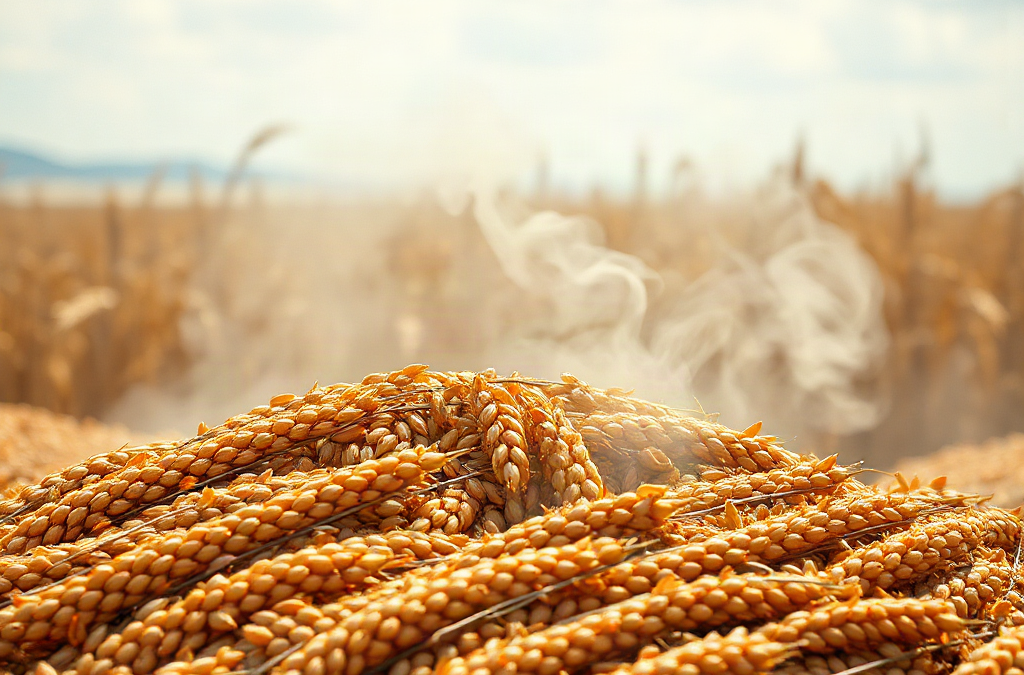
Handle grain exposed to smoke by isolating the lot, stopping its use, and assessing the fire source, packaging, heat, soot, water, and chemical exposure before deciding whether disposal or professional testing is appropriate. Grain in paper, cloth, woven plastic, or open containers should not be assumed safe because smoke odors and residues can enter porous packaging. Do not rinse, air out, blend, mill, eat, sell, or feed questionable grain to animals as a salvage method. Keep records and photographs, and ask local food-safety or agricultural authorities about commercial quantities.
Why Does Smoke Exposure Threaten Grain?
Smoke exposure is not limited to a visible layer of ash. A building fire can produce fine particles, gases, condensed residues, and strong odors, while firefighting may add water, foam, dust, or debris. The composition varies with what burned. Clean wood smoke presents a different contamination question from smoke involving plastics, treated lumber, fuel, pesticides, insulation, machinery, or household chemicals. Appearance alone cannot identify those residues or establish that food is suitable to eat.
Dry grain is particularly difficult to judge because kernels have a large collective surface area and remain in storage for extended periods. Smoke can travel through a room, enter bins through vents or imperfect lids, and settle into the spaces between kernels. Paper sacks, cloth bags, and many woven bulk bags are not gas-tight barriers. A sack can look undamaged while allowing smoke odor and airborne material to reach its contents.
Heat adds a separate concern. Grain close to a fire may be scorched, discolored, cracked, or affected by a melted liner even when flames never touched it. Fire-suppression water can raise grain moisture, creating conditions favorable to mold, heating, clumping, or spoilage during storage. A wet outer layer does not prove that the center stayed unaffected, especially in a large bin where water may follow channels that are hard to see.
For example, wheat stored in a folded paper sack across the room from a small appliance fire may have no visible soot, yet the bag offers little protection against smoke. By contrast, grain inside an undamaged, factory-sealed metal can may have been physically separated from smoke, although the container still needs inspection for heat distortion, seam damage, swelling, leakage, or contamination around the opening.
A common mistake is treating odor as the only safety test. A smoky smell is a clear reason to reject grain, but the absence of odor does not establish safety. Human smell varies, some residues have little detectable odor, and prolonged exposure to a smoky environment can dull perception. Base the initial decision on the event, contamination pathways, and packaging—not a taste test.
How Should You Isolate and Document the Grain?
Move decision-making ahead of cleanup by creating a controlled hold area for every potentially affected lot. Do not carry an open sack through clean storage rooms, pour questionable kernels into an uncontaminated bin, or run them through shared augers, mills, scoops, or grinders. Those actions can spread soot and make it impossible to distinguish exposed grain from unaffected inventory.
If the fire scene is still restricted, structurally unsafe, or affected by electrical, chemical, or air-quality hazards, wait for emergency personnel or the property authority to permit entry. Food recovery is not a reason to enter an unsafe building. Once access is allowed, wear protective equipment suited to the cleanup conditions and avoid stirring settled ash. Household cleanup needs may differ substantially from work in a commercial elevator, farm bin, warehouse, or food-processing facility.
Label the held material with the grain type, approximate amount, container, storage location, and date of the incident. Photograph the room before moving items, then record visible soot, water lines, melted packaging, open vents, failed lids, and distance from the fire. Note what burned and whether firefighting water or other suppression agents could have contacted the grain. Preserve purchase, lot, storage, insurance, and inventory records where available.
A compact first-response sequence keeps the evidence intact:
- Stop use and movement. Suspend eating, milling, sale, donation, planting, and animal feeding.
- Separate affected lots. Keep questionable containers away from clean grain and shared handling equipment.
- Record the incident. Photograph conditions and identify fire, smoke, heat, water, and chemical pathways.
- Protect clean inventory. Close unaffected containers and prevent cleanup dust from entering them.
- Seek case-specific direction. Contact the insurer and relevant food-safety, agricultural, environmental, or feed authority before disturbing a commercial lot.
Documentation matters most when a large quantity may require testing, an insurance claim, regulated disposal, or a formal release decision. The weak alternative is to clean first and investigate later. Washing containers, sweeping away soot, or combining partial lots may erase the evidence needed to determine the extent of exposure. A useful sign that containment is working is a clearly marked, physically separate lot with no shared tools or traffic carrying residue into clean areas.
Which Packaging and Exposure Conditions Matter?
Packaging should be evaluated as a barrier system rather than by whether it still looks closed. Open bins, vented silos, paper sacks, cardboard cartons, cloth bags, and woven polymer sacks allow air movement or have porous surfaces. Grain in these containers should be treated as exposed when smoke occupied the storage area, even if soot is not obvious on the kernels.
Ordinary lidded buckets require closer scrutiny. A lid that is merely snapped on is not necessarily airtight, and heat can deform plastic or weaken a gasket. Check for warping, softened areas, cracks, loose closures, soot around the rim, and smoke odor beneath the lid. Avoid opening a suspect container in a clean kitchen or grain room; opening can release residue and contaminate nearby surfaces.
Intact commercial cans, sealed glass jars, and genuinely hermetic packages provide a stronger physical barrier, but they are not automatically recoverable. Reject containers that are bulging, leaking, cracked, deeply rusted, heat-discolored, charred, or distorted at seams and closures. Glass exposed to intense heat or rapid cooling may have subtle damage. Flexible pouches can develop pinholes or seal failures that are difficult to see.
| Storage condition | Likely concern | Practical response |
|---|---|---|
| Open bin or vented silo | Direct smoke, ash, or suppression-water entry | Hold the entire potentially affected zone for official or professional assessment |
| Paper, cloth, or woven sack | Porous barrier permits smoke movement | Do not rely on an intact-looking sack as evidence of protection |
| Lidded household bucket | Possible gasket, lid, or heat failure | Inspect the closure and exposure history without opening it in a clean area |
| Undamaged hermetic container | Exterior contamination and possible heat damage | Consider case-specific evaluation; protect the contents while handling the exterior |
| Wet, warped, leaking, or sooty package | Barrier failure or direct contamination | Keep closed and segregated pending disposal instructions |
Location helps define exposure but does not replace a packaging assessment. Grain in an attached room may receive smoke through doors, ductwork, roof spaces, or ventilation. Grain farther away but downwind of a warehouse fire may receive more smoke than a closer container inside a sealed enclosure. Examine airflow, open vents, residue patterns, and the duration of smoke in the space.
The practical dividing line is whether there is credible evidence that an intact barrier prevented contact. “The lid was on” is weaker than documented hermetic packaging with no heat, water, seam, or closure damage. If that evidence is missing, do not convert uncertainty into a claim of safety.
Should the Grain Be Discarded or Professionally Tested?
Disposal is generally the prudent household decision for grain that was open, stored in porous packaging, visibly sooty, smoke-smelling, wet from firefighting, heat damaged, or near burning chemicals. The value of a bag of grain rarely justifies an uncertain food exposure or the cost and complexity of meaningful laboratory work. Keep suspect material contained while asking local waste authorities how fire-damaged food should be handled.
Get Whole Wheat Flour, Grains and Milling Supplies – CLICK HERE 
Professional evaluation becomes more relevant for a commercial bin, warehouse lot, seed inventory, or other high-value quantity. That process should begin with the appropriate food, feed, agricultural, environmental, or public-health authority—not with a laboratory test chosen at random. Testing needs a defined question based on the materials burned and the likely contamination route. A general grain-quality panel or moisture test cannot rule out every possible smoke-related contaminant.
Sampling quality also controls the usefulness of results. Smoke, water, and soot may be unevenly distributed, especially near bin tops, vents, walls, doors, and water channels. One clean sample from the center cannot represent a heterogeneous lot. A qualified sampler or authority can determine whether the lot should be divided into zones, how samples should be collected without spreading residue, and what chain-of-custody records are needed.
Do not assume that a satisfactory result for one analyte clears the grain for every use. Laboratory scope, detection limits, representativeness, applicable food or feed requirements, odor, and physical damage may all affect the decision. Human food, animal feed, seed, industrial use, and disposal are separate pathways with different questions. Downgrading grain to livestock feed is not a casual workaround; animals can also be harmed by contaminated feed, and feed distribution may be regulated.
A realistic commercial example is a metal silo exposed to smoke from a neighboring machinery fire. If the silo remained cool and closed but smoke entered a roof vent, the upper grain layer may have a different exposure profile from the lower mass. Removing or blending that layer before authorities define a sampling plan could spread contamination and destroy useful boundaries. Hold the lot, preserve its configuration, document the vent pathway, and obtain written direction before movement.
Which Salvage Methods Should You Avoid?
Home processing cannot reliably reverse an unknown smoke exposure. Airing grain outdoors may reduce odor, but odor reduction is not proof that deposited residues are gone. It can also expose the grain to moisture, pests, dust, and additional cross-contamination. Sunlight, freezing, or extended dry storage should likewise not be treated as decontamination methods.
Rinsing is a poor salvage test. Water may remove some loose surface material while leaving other residues, and wet kernels become harder to dry safely. Moisture trapped inside a dense container can lead to heating, mold growth, or spoilage. If the grain is later milled, surface material may still be incorporated into flour. A clear rinse-water appearance says little about compounds that cannot be seen.
Removing the top few inches from a bin is also unreliable without a professionally designed assessment. Smoke can enter through vents, but air currents, grain movement, cracks, and firefighting water may create irregular contamination patterns. Similarly, removing visibly black kernels does not address residues on normal-looking kernels. Visual sorting is useful for identifying damage, not for establishing the safety of the remainder.
Blending questionable grain with clean grain is especially harmful. Dilution does not make an unknown lot acceptable, and it turns a contained problem into a larger one. The same principle applies to mixing it into animal feed, compost, garden soil, or seed stock without guidance. Disposal routes may depend on what burned, how much material is involved, and local waste rules; open burning can create further smoke and should not be improvised.
Cooking, baking, pressure cooking, or distilling should not be assumed to solve the problem. Heat can destroy some biological hazards, but fire residues are not a single organism with a known kill step. Some contaminants may persist, and ordinary kitchen preparation offers no way to verify removal. A failed salvage attempt is signaled by persistent odor, oily dust, staining, clumping, condensation, heating, or mold—but the absence of those signs still does not prove the grain acceptable.
The safer objective is containment and a defensible disposition decision, not making the grain appear normal. For small household amounts, that usually points toward controlled disposal. For valuable or regulated lots, preserve the material unchanged until competent authorities define sampling, testing, release, diversion, or disposal requirements.
Frequently Asked Questions
Can grain be safe if it does not smell smoky?
Lack of odor does not confirm safety. Consider the fire materials, airflow, packaging barrier, heat, soot, and suppression water rather than relying on smell alone.
Can I wash smoke residue off whole kernels?
Washing is not a reliable decontamination method and introduces moisture that can encourage spoilage. Do not use rinsing as evidence that exposed grain is safe.
Is grain in a sealed bucket protected from smoke?
Only if the bucket provided a genuinely airtight, undamaged barrier. Inspect the lid, gasket, walls, and heat exposure; a snapped-on lid alone may not be sufficient.
Can smoke-exposed grain be fed to chickens or livestock?
Do not redirect questionable grain to animals without guidance from the relevant feed authority or veterinarian. Contamination concerns do not disappear when the intended consumer changes.
Who should assess a large commercial grain lot?
Contact the insurer and applicable food, feed, agricultural, public-health, or environmental authority. They can help define sampling, testing, handling, and disposal requirements.
Conclusion
A sound decision begins by preserving the boundary between questionable grain and clean inventory. Keep exposed lots stationary and labeled, prevent shared equipment from spreading residue, and document packaging, airflow, heat, water, soot, and the materials involved in the fire. Porous sacks, open bins, smoke odor, visible deposits, moisture, or heat damage weigh strongly against household salvage.
Small quantities with uncertain exposure are usually poor candidates for testing because a narrow test cannot answer every contamination question. Large commercial or farm lots deserve a structured response coordinated with insurers and the authorities responsible for food, feed, agriculture, or waste. Do not wash, air out, blend, cook, or feed the grain merely to avoid a loss. Preserve the evidence, obtain case-specific direction, and choose a disposal or evaluation pathway that matches the actual exposure.
Get Whole Wheat Flour, Grains and Milling Supplies – CLICK HERE
Auto Amazon Links: No products found.





