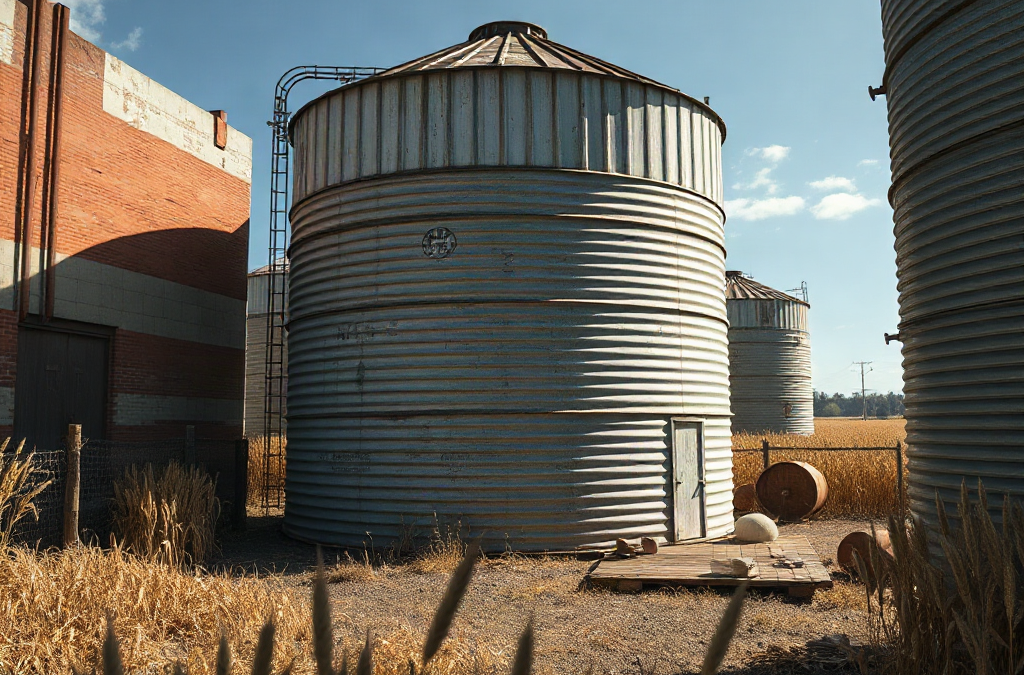
A grain bin home should be physically and operationally separated from food stocks, but no single setback distance is safe for every property. The plan should account for grain dust, pesticide or fumigant use, rodents, vehicle traffic, fire access, drainage, and whether nearby bins remain active. Use separate ventilation, entrances, utilities, waste routes, and pest-control zones so air and contaminants do not move between living space and stored food. Before selecting a distance, have local building and fire officials review the site plan, and use qualified structural, electrical, and grain-handling professionals for the conversion and any operating storage equipment.
How Much Separation Is Enough?
A suitable separation distance comes from the hazards and operations on the property, not from the circular shape of the proposed home. A vacant bin on a residential parcel presents a different problem from a converted bin beside dryers, augers, truck lanes, fumigation work, or regularly loaded grain storage. Property lines, local zoning, fire-apparatus access, utility clearances, drainage, and emergency egress may each affect where residential occupancy is allowed.
Begin by mapping every active and proposed use. Mark bins containing edible grain, livestock feed, treated seed, fertilizer, fuel, pesticides, maintenance supplies, and waste. Add prevailing wind exposure, low drainage areas, truck turning paths, overhead lines, wells, septic components, propane equipment, and the routes used to load or unload grain. The resulting plan is more useful than selecting an arbitrary number of feet because it reveals how dust, water, pests, equipment, and people actually move.
Distance remains valuable, but it should work with physical barriers and operational controls. A home placed farther from a working bin may still receive dust if it sits downwind of an exhaust fan or grain transfer point. A closer structure with code-compliant construction could appear manageable on paper yet remain unsuitable if residents must cross an auger route to reach the driveway. Separation therefore needs to address both ordinary daily activity and less frequent events such as harvest traffic, bin cleaning, pest treatment, or emergency response.
A common mistake is treating a local minimum setback as a complete safety determination. A setback may address land use or fire exposure without resolving airborne dust, contaminated footwear, shared ventilation, or access conflicts. Ask the authority having jurisdiction which building, zoning, fire, sanitation, and wastewater requirements apply to a change from agricultural storage to residential occupancy. Where the proposed home remains near commercial or farm operations, an architect or engineer familiar with adaptive reuse should translate those requirements into a site-specific layout.
The practical test is whether residents can enter, park, receive deliveries, use outdoor space, and evacuate without passing through the grain operation. Food stocks should likewise be inspected, sampled, loaded, and treated without entering the residential zone. If those movements cannot be separated during the busiest operating period, increasing the setback or choosing another bin is usually more defensible than relying on household rules that will be difficult to maintain.
Why Do Active Grain Operations Need Distinct Zones?
Active grain handling produces exposure pathways that do not belong in residential space. Grain transfer can release dust and chaff, while spilled kernels attract insects, rodents, and birds. Engines, dryers, conveyors, fans, and trucks add noise, exhaust, vibration, ignition sources, and moving-equipment hazards. Products used around stored commodities may also be inappropriate near occupants unless their labels, application restrictions, and re-entry requirements are followed by trained users.
The strongest layout divides the property into residential, food-storage, and service zones. The residential zone includes the home entrance, parking, outdoor living area, domestic waste, and household mechanical equipment. The food-storage zone includes clean commodity bins and the routes used for inspection or loading. A service zone can contain machinery, fuel, maintenance tools, chemical storage, spilled-grain cleanup equipment, and other higher-risk work. These zones should not share casual shortcuts.
Consider a bin home beside two operating wheat bins. If the home entrance faces the loading area, occupants may repeatedly walk through dust and spilled grain. Dirt can then be tracked indoors, and household pets may enter the work area. Rotating the residential entrance toward a separate driveway, enclosing the work-side boundary, and placing outdoor air intakes away from transfer points may reduce routine crossover. If the site is too constrained to provide those features, cosmetic renovation does not solve the underlying land-use conflict.
Stored food also needs protection from residential contamination. Household refuse, pet food, compost, wastewater failures, vehicle fluids, and unrestricted visitor access can create pest or sanitation problems around commodity bins. The goal is not merely to protect residents from the farm side; it is to keep residential activities from degrading food stocks. A documented cleaning and spill-response routine should assign tools to each zone rather than moving brooms, shop vacuums, or pest-control supplies between the home and grain areas.
Signs that separation is failing include visible dust on residential surfaces, grain odors entering the home, recurring insects near doors or windows, rodent evidence, residents crossing equipment paths, and vehicles blocking emergency access. These observations should trigger a review of airflow, housekeeping, traffic patterns, and barriers. Moving an intake, changing transfer practices, sealing penetrations, or creating a separate walkway may help, but persistent crossover can indicate that the home and active storage are simply too close for the way the site operates.
Which Building Systems Must Remain Independent?
Residential and grain-storage functions should not depend on shared air, drainage, electrical shortcuts, or uncontrolled wall penetrations. A converted bin needs a residential building envelope and mechanical design suited to human occupancy. Adjacent food bins need systems appropriate for keeping commodities dry, ventilated, secure, and protected from pests. Connecting the two for convenience can create hidden routes for moisture, dust, insects, fumes, and electrical faults.
Ventilation deserves close attention. The home should have dedicated heating, cooling, exhaust, and outdoor-air arrangements rather than drawing air from a grain-handling enclosure or common equipment room. Outdoor intakes should be evaluated against dryer exhaust, transfer dust, fuel-burning equipment, road dust, and seasonal wind direction. Positive or negative pressure alone is not a substitute for source control; a frequently opened door facing an unloading point can defeat an otherwise competent mechanical design.
Drainage must keep roof runoff, wash water, septic discharge, and surface flow away from food stocks. Grain bins are vulnerable to moisture at foundations and lower wall areas, while residential conversions often add plumbing and more concentrated roof drainage. Directing home runoff toward an active bin can contribute to damp conditions and pest activity. Directing grain-site runoff toward the home can carry dust and residues into occupied areas. Site grading and stormwater routing should be reviewed as one system rather than handled as separate renovation details.
Get Whole Wheat Flour, Grains and Milling Supplies – CLICK HERE 
Electrical equipment is another dividing line. Old agricultural wiring should not be assumed suitable for residential loads, and a home panel should not be improvised as the supply for augers, fans, or dryers. Grain dust can affect equipment selection and installation in operating areas, so electrical work near active handling equipment requires professionals who understand the setting. Emergency shutoffs for machinery should remain accessible to workers without entering the home, while residents need ordinary residential disconnects, alarms, lighting, and egress provisions.
Shared pest control creates a similar problem. Household traps and casual spraying are not a commodity-protection program, while grain treatments should never migrate into living space. Store products in their designated area, follow their labels, and keep application records where required. Treated seed should be clearly identified and isolated from edible grain and household food. If a wall, tunnel, utility chase, or attached structure permits pests or air to pass between uses, it should be redesigned or professionally sealed rather than managed with repeated reactive treatments.
Site Review Checklist Before a Bin Conversion
A conversion decision should follow a site review conducted before interior finishes make defects expensive to correct. The review needs to cover structural condition, occupancy approval, surrounding operations, contamination pathways, and long-term maintenance. Grain bins were designed to resist agricultural loads, not automatically to support windows, floors, stairs, plumbing, insulation, and residential openings. Cutting the shell without an engineered plan can alter how loads move through the structure.
Use the following sequence to identify early stop signs:
- Confirm legal feasibility. Ask local planning, building, fire, and environmental health offices whether residential use is permitted and which approvals apply.
- Document the bin’s history. Identify stored commodities, treatments, leaks, corrosion, repairs, and whether treated seed or chemicals were ever present.
- Inspect the structure. Have qualified professionals evaluate the shell, foundation, roof, anchorage, corrosion, and proposed openings.
- Map active hazards. Record transfer points, fans, dryers, augers, truck lanes, fuel, chemical storage, drainage, and overhead utilities.
- Design independent systems. Separate residential ventilation, power, water, wastewater, access, waste handling, and pest management from food storage.
- Test the operating scenario. Walk through harvest traffic, grain delivery, maintenance, emergency access, and residential evacuation before approving the layout.
The bin’s previous use matters because a clean appearance does not establish that the shell or floor is appropriate for occupancy. Unknown residues, persistent odors, water damage, mold-like growth, heavy corrosion, or an undocumented treatment history call for professional assessment. Painting over a questionable surface hides evidence rather than resolving the cause. If the history cannot be established, demolition, replacement, or selecting a better-documented structure may be more prudent than an elaborate conversion.
Budget comparisons should include more than the shell purchase. Engineering, reinforcement, foundations, moisture control, insulation, condensation management, code-compliant openings, utilities, wastewater, fire access, and separation from ongoing operations can outweigh the apparent savings of reusing a bin. A purpose-built small home may be the better option on a constrained working farm because it allows conventional detailing and more flexible placement.
A workable plan produces observable results: grain work can continue without opening the residential zone, no dust or odors enter living areas during transfer, drainage moves away from both uses, and emergency routes remain clear. Warning signs include reliance on permanently closed windows, repeated pest treatments, extension cords serving machinery, shared storage rooms, or verbal promises that certain equipment will rarely operate. Design for the property’s actual busiest conditions, not its quietest day.
Frequently Asked Questions
Can an unused grain bin be converted into a home?
Potentially, but residential use depends on local approval and a professional evaluation of the foundation, shell, corrosion, prior contents, proposed openings, utilities, insulation, moisture control, and emergency egress.
Is there a standard minimum distance between a bin home and stored grain?
No universal distance fits every site. Applicable setbacks and safe placement depend on local requirements, fire access, active equipment, dust sources, chemical use, drainage, traffic, and the type of commodities stored.
Can a home share ventilation with an attached grain-storage area?
Shared ventilation is a poor separation method because it can move dust, odors, moisture, pests, or treatment residues. Residential air-handling equipment and outdoor-air intakes should be designed independently.
Should an old bin be cleaned before its history is investigated?
Document its condition first. Unknown residues, treatment history, corrosion, leaks, and damaged coatings may require professional assessment, and aggressive cleaning could disturb material that should be evaluated before work begins.
What is the clearest sign that the site layout is not working?
Repeated crossover is a strong warning: residents walking through loading areas, grain dust reaching the home, pests moving between zones, or machinery blocking residential and emergency routes all indicate inadequate separation.
Conclusion
Successful grain bin housing depends on treating residential occupancy and food storage as separate land uses, even when they share one property. Establish the bin’s history, confirm that conversion is legally possible, and map grain movement, dust sources, treatments, drainage, traffic, and emergency access before setting a final location. Independent entrances, ventilation, utilities, pest-control practices, and work routes provide more protection than a nominal setback by itself.
The next step is a site-specific review with local authorities and qualified design professionals. Give them a plan showing every operating bin, transfer point, chemical or fuel area, driveway, utility, and proposed residential feature. If normal grain work cannot occur without affecting household air, access, or cleanliness, redesign the zones, increase separation, or choose a different structure. A viable conversion should remain workable during harvest and maintenance, not only when the storage area is inactive.
Get Whole Wheat Flour, Grains and Milling Supplies – CLICK HERE
Auto Amazon Links: No products found.