
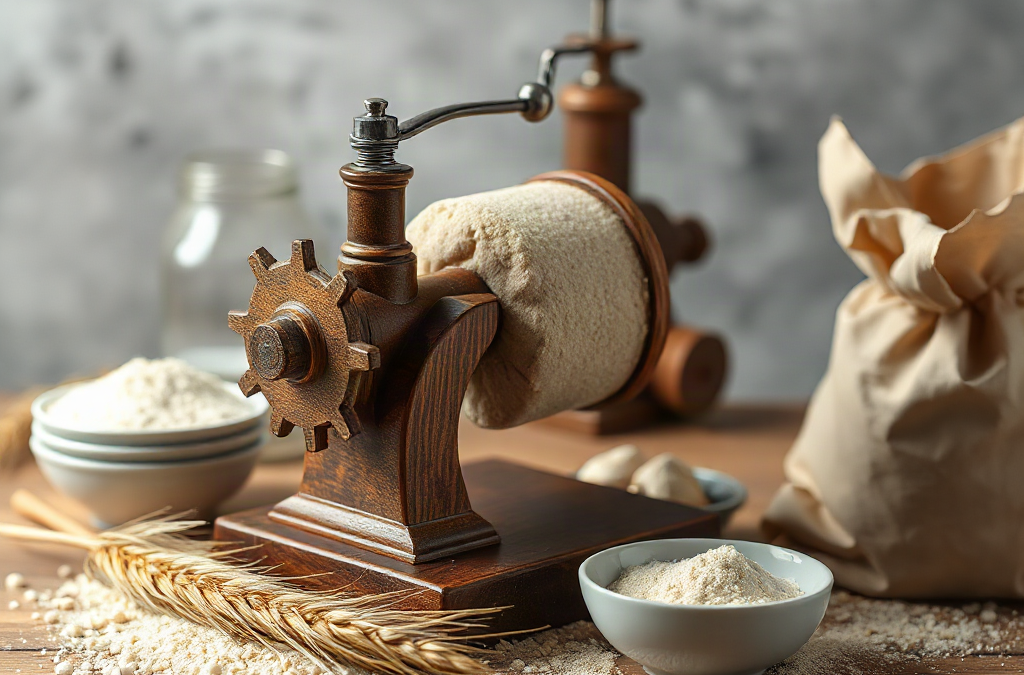
Home grain mills produce fresh whole wheat flour most effectively when the mill matches the household’s batch size, preferred texture, noise tolerance, and available power. Impact mills grind quickly and finely but are loud, while stone or steel burr mills offer adjustable texture and often better control at slower rates. Wheat berries should be clean and dry, and flour should be milled shortly before mixing because the exposed germ oils lose quality faster than intact kernels. Consistent bread results also require weighing flour, controlling dough hydration, and avoiding overheated or excessively coarse grinds.
Which Type of Home Grain Mill Works Best?
The best milling mechanism depends on how much wheat you expect to grind, how fine the flour must be, and whether speed matters more than quiet operation. Home models generally use impact heads, stone burrs, or steel burrs. Each can turn sound wheat berries into useful flour, but they differ noticeably in noise, output, texture control, and suitability for non-wheat ingredients.
Impact mills propel grain through rapidly moving metal components. They are commonly chosen for bread flour because they process wheat quickly and can produce a fine, uniform result in one pass. Their main compromises are high-pitched noise and limited texture adjustment. An impact mill is practical for someone who bakes several loaves at once and wants flour ready quickly, but it is less appealing in an apartment or for early-morning use. These machines are also not intended for oily materials unless the manufacturer explicitly permits them.
Stone-burr mills crush kernels between stationary and rotating stones. The gap between the stones can usually be adjusted, allowing a baker to move from relatively fine flour to a coarser meal. They tend to process grain more slowly than impact machines, and flour fineness may depend on feed rate and adjustment. A stone mill suits a cook who values texture control for breads, crackers, and hot cereals. Stones can glaze or become contaminated if damp, oily, or unsuitable ingredients are fed through them, so the approved-grain list matters.
Steel-burr mills also provide adjustable texture and are often more tolerant of varied dry grains than stone models. Some are hand-powered; others use electric motors. A manual steel-burr mill avoids dependence on electricity and provides precise control for small quantities, but producing several cups of fine bread flour can require sustained effort. It may serve well as a backup or for occasional batches rather than daily family-scale bread production.
| Mill type | Strongest use | Main tradeoff |
|---|---|---|
| Impact | Fast, fine wheat flour | Loud with limited texture control |
| Stone burr | Adjustable flour and meal | Slower and sensitive to unsuitable ingredients |
| Steel burr | Flexible dry-grain grinding | Fine flour may take longer |
| Manual burr | Small batches and power outages | Requires time and physical effort |
A common buying mistake is assuming that every machine labeled a grain mill will make equally fine bread flour. Some inexpensive mills excel at cracked grain but require repeated passes for a fine grind. Check the manufacturer’s stated capabilities, permitted ingredients, expected output, and duty cycle rather than relying on appearance or motor wattage alone.
What Features Matter Before Buying?
Capacity, flour texture, and serviceability matter more than an unusually long feature list. Start by estimating one normal milling session. A household making a single loaf may need only a few cups of flour, while a baker preparing multiple loaves needs a hopper, collection container, and motor designed for larger uninterrupted runs.
Fineness adjustment deserves close attention because “fine” is not standardized across manufacturers. Whole wheat sandwich bread generally benefits from a reasonably fine, consistent grind; coarse bran fragments can interfere with gluten development and produce a denser crumb. Coarser settings remain useful for porridge, polenta-style grain dishes, or adding texture to crackers. If possible, inspect a flour sample or look for clear manufacturer descriptions of the available range.
Consider the complete workflow rather than the mill alone. Measure the available counter height with the hopper and collection bowl installed. Determine where grain will be poured, where flour dust may settle, and whether the machine must be moved after every use. A heavy mill may remain stable during operation but become inconvenient if it must be lifted from a cabinet weekly. Noise duration matters as much as the published sound level: a fast, loud unit may be easier to tolerate than a quieter mill that runs for much longer.
Cleaning requirements should fit the materials you intend to grind. Many mills are cleaned by brushing or by running a small amount of an approved dry grain through the mechanism; their grinding chambers should not be washed with water. Removable hoppers and flour bins are easier to inspect for trapped material. Follow the model’s instructions because moisture left near burrs or stones can encourage residue buildup and damage components.
Use this buying priority list to avoid paying for capabilities you will not use:
- Approved ingredients: Confirm that the mill handles hard and soft wheat, plus any other dry grains you actually use.
- Required fineness: Favor a demonstrated bread-flour setting if yeast loaves are the main goal.
- Batch output: Match hopper and motor capacity to a normal baking day, not an imagined maximum.
- Operating constraints: Account for noise, counter space, electrical supply, and lifting weight.
- Parts and support: Check warranty terms and the availability of replacement burrs, stones, filters, or collection containers.
Do not treat a manual mill as automatically cheaper over its useful life or an electric model as automatically more capable. A robust hand mill can cost more than a basic electric unit, while some compact electric mills offer little adjustment. The sound decision is the machine that performs your recurring task without adding enough setup, labor, or cleanup to discourage use.
How Do You Mill Wheat Berries Consistently?
Consistent flour begins with clean, dry wheat berries and a mill set up exactly as its manufacturer specifies. Inspect the grain under good light before it enters the hopper. Remove stones, metal fragments, damaged kernels, or foreign plant material; a hard contaminant can damage grinding surfaces, while damp grain may smear, clog, or produce flour that stores poorly.
Choose wheat according to the intended bake. Hard red or hard white wheat is commonly used where stronger dough structure is desired, such as yeast bread. Soft wheat generally produces lower-protein flour suited to tender baked goods. Milling cannot give soft wheat the dough strength of hard wheat, so changing the grind setting will not correct a grain-selection mismatch.
Before a full batch, run a small test quantity. Set adjustable burrs slightly coarser than the final target, start the machine according to its instructions, and examine the output. Flour intended for bread should feel relatively even rather than containing abundant intact grit. Tighten the setting gradually if the model permits adjustment while operating. Forcing burrs together or feeding grain faster than the mill can clear it may increase heat, strain the motor, and create inconsistent flour.
Temperature is best judged as an operating signal rather than a reason for alarm. Grinding creates friction, so freshly milled flour may feel warm. Flour that becomes uncomfortably hot, develops a scorched odor, or appears discolored indicates that the setting, feed rate, ventilation, or duty cycle needs attention. Stop the mill, allow it to cool, check for blocked airflow, and consult the operating manual before continuing. Never reach into a hopper or grinding chamber while the machine is connected to power.
Get Whole Wheat Flour, Grains and Milling Supplies – CLICK HERE 
Weigh the wheat berries when repeatability matters. The mass entering the mill will be close to the flour recovered, apart from small amounts retained in the machine or collection path. Weight therefore provides a more dependable baking baseline than cups, which vary with flour aeration and grind. Record the wheat variety, mill setting, berry weight, and resulting dough hydration for the first few batches.
The most frequent process error is milling far more flour than the immediate recipe requires. Intact wheat berries generally protect the germ and its oils better than flour does because milling greatly increases exposed surface area. Grind a recipe-sized amount when practical, let any warm flour cool before sealing it, and keep surplus flour in a tightly closed container. For longer holding periods, refrigeration or freezing may slow quality loss, but flour should be protected from moisture and strong odors.
How Does Fresh Flour Change Baking?
Freshly milled whole wheat flour often behaves differently from commercial flour because it contains the bran, germ, and endosperm in the proportions produced from the whole kernel, with particle size determined by the home mill. A recipe written for white flour cannot be converted reliably by making a straight volume-for-volume substitution. Whole grain components bind water, and sharp or coarse bran particles can weaken the continuous gluten network needed to retain gas.
Use weight-based recipes and hold back a small portion of the liquid at first. Mix the dough until no dry pockets remain, then allow it to rest before deciding whether it needs more water. During that rest, bran and other flour particles hydrate, often changing a stiff-looking dough into a more extensible one. Add reserved water in small increments rather than compensating immediately with extra flour, which can produce a dry, heavy loaf.
For example, a baker replacing commercial whole wheat flour with home-milled hard white wheat may find the dough rough after initial mixing. A short hydration rest followed by kneading can improve handling without changing the grain. If the dough still tears quickly, the flour may be unusually coarse, the wheat may not have enough protein for the selected loaf, or the recipe may contain too little water. Milling more finely is one option, but switching wheat varieties or blending with bread flour may be more effective.
Sifting changes both texture and composition. Removing the largest bran particles can make dough easier to develop, but the result is no longer the same whole-kernel flour that left the mill. Some bakers soak the sifted bran and return it to the dough; others reserve it for cereal or toppings. Neither approach is inherently required. The choice depends on whether the priority is a lighter loaf, full inclusion of every fraction, or predictable handling.
Fresh flour aroma is easiest to evaluate before strong ingredients are added. It should smell clean, mildly wheaty, or nutty rather than musty, sour, paint-like, or rancid. An unpleasant odor can originate in old berries, flour residue trapped in the mill, or poor storage. Do not assume milling makes questionable grain usable. Discard grain or flour showing insects, visible mold, persistent off-odors, or moisture damage, and clean the equipment according to its manual.
A dense first loaf does not necessarily mean the mill failed. Diagnose one variable at a time: confirm hard wheat was used, inspect fineness, weigh ingredients, allow hydration time, and observe fermentation rather than relying only on a fixed clock. Keeping the same wheat and mill setting for several bakes makes it much easier to identify whether water, mixing, fermentation, or grind size needs adjustment.
Frequently Asked Questions
Is freshly milled whole wheat flour better than store-bought flour?
Fresh milling offers control over the wheat variety, grind, and batch timing. It does not automatically produce better bread; grain quality, flour fineness, hydration, and baking technique still determine the result.
Can a home grain mill grind beans, corn, or oats?
Only if the manufacturer approves those ingredients. Dry corn and beans can be harder than wheat, while oily or moist materials may clog certain stones, burrs, or impact chambers.
Should wheat berries be washed before milling?
Do not put wet grain into a mill. Buy food-grade, cleaned wheat berries and inspect them before use. If grain is washed for a specific reason, it must be dried thoroughly and safely before milling.
How much flour should be milled at one time?
Mill the amount required for the planned recipe when convenient. Small, recipe-sized batches limit leftover flour and make it easier to track wheat weight, mill setting, and baking results.
Why is home-milled whole wheat bread dense?
Common causes include coarse flour, soft wheat, inadequate hydration, weak gluten development, or fermentation that ended too early or continued too long. Change one factor per bake so the cause becomes clear.
Conclusion
A useful home milling setup is defined by repeatable flour, manageable operation, and compatibility with the grains you intend to use. Choose impact, stone-burr, steel-burr, or manual equipment according to actual batch size, texture needs, noise limits, and power availability. Before buying, verify approved ingredients, flour fineness, cleaning instructions, replacement parts, and the space required for normal operation.
Once the mill is in place, inspect dry wheat berries, test a small batch, monitor grind quality and temperature, and weigh both grain and recipe ingredients. Expect fresh flour to alter hydration and dough strength rather than behaving exactly like white or packaged flour. Start with one dependable wheat variety and one familiar bread formula, document each batch, and adjust grind, water, or fermentation separately. That controlled process reveals whether the machine and flour are performing as intended.
Get Whole Wheat Flour, Grains and Milling Supplies – CLICK HERE
Auto Amazon Links: No products found.





