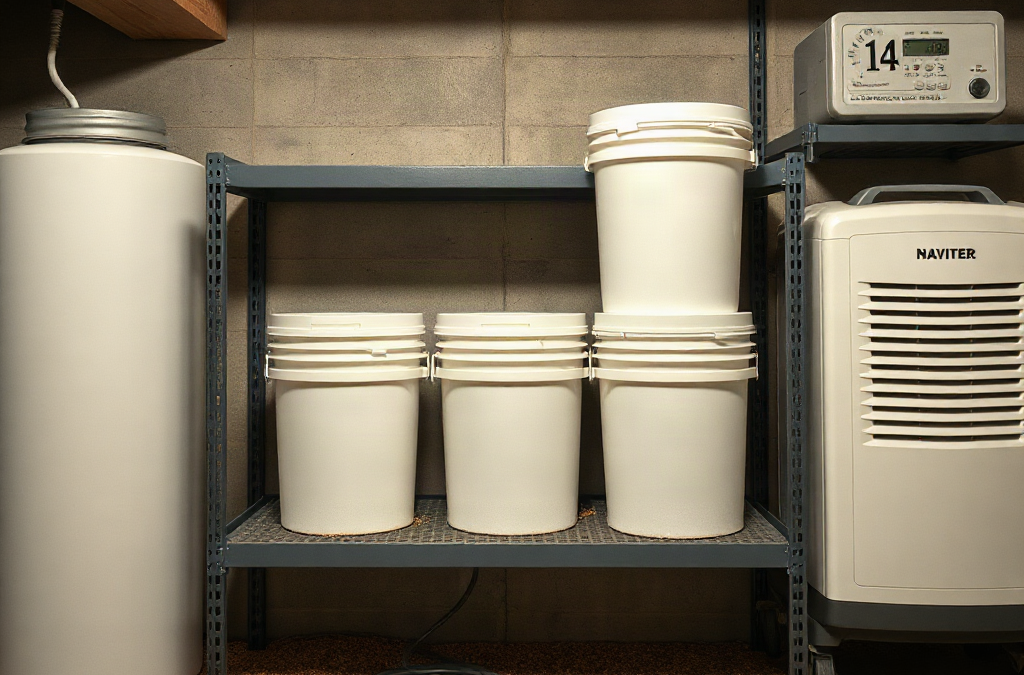
Basement grain storage moisture control keeps kernels dry by addressing water entry, humid air, and condensation before they damage a stored batch. Repair leaks first, then use a hygrometer and, where needed, a dehumidifier to keep the storage area near 40–50% relative humidity. That room reading does not establish grain moisture, so confirm that the grain meets crop-specific storage guidance before sealing it. Use food-grade containers with effective moisture barriers, raised shelving, and enough wall clearance to spot dampness. If droplets, clumping, or musty odors appear, isolate the affected batch and investigate rather than expecting oxygen absorbers or room drying to repair it.
What you’ll learn
This guide covers the following practical points:
- Identify Leaks, Humidity, and Condensation — Water entering through a basement wall needs a different fix from moisture forming on a cold container.
- Verify Grain Dryness Before Packing — Grain must be suitable for its intended storage period before it goes into a moisture-resistant package.
- Choose Moisture Barriers and Raised Storage — A useful basement container must limit water-vapor entry as well as protect grain from spills and handling damage.
- Control Humidity and Track Warning Signs — A practical room-humidity target is roughly 40–50%, used as an operating goal rather than proof that the grain is safe or dry.
Identify Leaks, Humidity, and Condensation
Water entering through a basement wall needs a different fix from moisture forming on a cold container. Before buying equipment, inspect the proposed storage area during or shortly after rain. Look for wet floor edges, plumbing drips, damp patches behind shelving, and water tracks beneath windows. Old staining shows where water has traveled, but it does not establish whether a leak is still active.
Recurring seepage should be addressed before that space becomes your main grain reserve. Check accessible gutters, downspout discharge, and visible plumbing first; persistent foundation or drainage problems may need a qualified contractor. A dehumidifier can remove water vapor from the air, but it cannot keep incoming water away from your food.
Condensation can appear even when the basement has no leak. It forms when a surface is colder than the surrounding air’s dew point—the temperature at which that air begins shedding moisture. As an illustrative example, air at 68°F and 70% relative humidity has a dew point near 58°F. A container surface at 55°F could collect droplets.
Place a temperature-and-humidity meter near the grain, away from the dehumidifier’s exhaust. Compare that location with a cold exterior-wall corner. A comfortable reading near the stairs may hide a much damper pocket behind the lowest shelf.
Verify Grain Dryness Before Packing
Grain must be suitable for its intended storage period before it goes into a moisture-resistant package. Dry basement air will not reliably dry kernels inside a sealed bucket. Closing damp grain in a good barrier simply traps its existing water.
Ask the supplier whether the grain was prepared for food storage and whether a recent moisture measurement is available. For home-grown grain or an uncertain bulk purchase, use a grain moisture meter calibrated for that crop, following its sampling and temperature instructions. A wood moisture meter is not a substitute. Samples from several parts of a batch are more informative than one handful from the surface.
Room relative humidity and grain moisture content are different measurements. The first describes the air; the second describes water within the grain. Wheat, corn, and oats do not share one universal storage limit, and acceptable moisture also changes with temperature and storage duration. Seek crop-specific guidance rather than treating a single percentage as suitable for every grain and packaging method.
Oxygen absorbers are not drying agents and should not be used as a workaround for uncertain dryness. Follow the moisture requirements of the chosen storage method. Label each batch with its grain type, supplier, packing date, and any measured moisture result so a later problem can be traced without opening every container.
Choose Moisture Barriers and Raised Storage
A useful basement container must limit water-vapor entry as well as protect grain from spills and handling damage. Paper sacks and ordinary woven bags are not dependable moisture barriers. An apparently closed package may still admit humid air through a loose lid, damaged seam, or poorly made seal.
A food-grade bucket with an intact gasket can provide sturdy outer protection. For extended storage, a properly heat-sealed, food-contact foil-laminate liner adds a stronger vapor barrier than many ordinary plastic bags. Keep grain dust out of the sealing area, inspect the full seam, and follow the packaging manufacturer’s instructions. A liner with a folded opening is not equivalent to a sealed liner.
Pack in a dry area rather than beside a damp basement wall. When moving a cold, sealed package into warmer, humid air, let it warm while still closed before opening it. This reduces the opportunity for moisture to collect on cold kernels or inside the package.
Use shelving rated for the full loaded weight, with clearance beneath containers for cleaning and inspection. Leave room between shelving and foundation walls to spot seepage. Elevation makes dampness easier to detect, but neither a raised shelf nor a sealed bucket should be treated as flood protection. A basement with recurring water on the floor may be a poor choice regardless of packaging quality.
Get Whole Wheat Flour, Grains and Milling Supplies – CLICK HERE 
Control Humidity and Track Warning Signs
A practical room-humidity target is roughly 40–50%, used as an operating goal rather than proof that the grain is safe or dry. Watch whether the storage area stays reasonably steady through rain and seasonal changes. Persistent high readings, wet surfaces, or damp packaging call for investigation even when the dehumidifier appears to be running normally.
Choose equipment rated to operate at the basement’s actual temperature. Some units lose effectiveness or frost in cool conditions. Follow the manufacturer’s placement, filter, and drainage instructions; a full collection tank or blocked drain can stop moisture removal unnoticed. Confirm results with the separate meter near the grain, not only the appliance display.
Opening basement windows is not automatically a drying measure. Warm summer air can bring in more water vapor and condense against cool surfaces. Ventilation is more useful when incoming air has a lower dew point than basement air. A fan moves air but does not remove its moisture.
Keep a short inspection record so you can tell whether a repair or equipment change is working:
- Check readings daily while adjusting the setup, then establish a routine suited to how quickly conditions change.
- Inspect after heavy rain, plumbing trouble, and dehumidifier shutdowns.
- Look beneath containers and behind shelves for dampness, damaged seals, or corrosion.
- Investigate new droplets, clumps, unusual warmth, or musty odors rather than simply resetting the humidity control.
Where droplets appear matters. Moisture only on a container’s exterior points toward a cold-surface problem; moisture inside raises questions about the packed grain, seal, or packing conditions. Set a suspect batch aside and stop using it while seeking guidance from a local extension food-safety service. Lowering room humidity afterward does not establish that affected grain is suitable to eat.
Frequently Asked Questions
Can I leave unopened grain sacks in the basement?
Only if the packaging and location are suitable for the intended storage period. An unopened paper or woven sack is not necessarily a moisture barrier. Check whether it has a sealed protective liner, keep it off the floor, and avoid placing it against a foundation wall.
Will desiccant packets dry grain that is already damp?
Small packets should not be relied on to dry a bulk grain batch. Their capacity is limited, and they cannot establish that the kernels meet storage requirements. Use only products intended for the relevant food-packaging application, and address uncertain grain moisture before sealing.
Do sealed grain containers make a basement dehumidifier unnecessary?
Not always. Good packaging limits moisture reaching the grain, but damp room conditions can still cause exterior condensation, corrosion, and damage to labels or shelving. Base the need for a dehumidifier on measured conditions and surface dampness rather than container seals alone.
Can a humidity sensor inside a grain jar replace a moisture meter?
A household humidity sensor does not directly measure kernel moisture. Converting enclosed-air readings into grain moisture requires crop-specific information, stable temperature, and a suitable method. For packing decisions, use a correctly calibrated grain meter or ask an extension service about testing options.
What should I do if the dehumidifier stops during a power outage?
Keep sound containers closed and check for leaks or rising water. Once power returns, record the room conditions and confirm that the unit drains and removes moisture normally. If water threatens the storage area, prioritize personal safety and seek food-safety guidance for any exposed packages.
Conclusion
Choose the driest reliable basement location before investing in more containers. Check it after rain, confirm the grain’s condition, and make the packaging match the length of storage you intend. Then use humidity records and accessible shelving to catch changes early. If water keeps returning or a batch shows internal dampness, pause expansion of the reserve and resolve that problem first. A smaller, inspectable supply is easier to protect than a large stack hiding a wet corner.
Your state cooperative extension’s grain-storage guidance is a useful next stop for crop-specific moisture limits and measurement methods. When requesting advice, provide the grain type, intended storage duration, expected basement temperature, and packaging method; those details matter more than a general recommendation to keep grain dry.
Get Whole Wheat Flour, Grains and Milling Supplies – CLICK HERE
Auto Amazon Links: No products found.