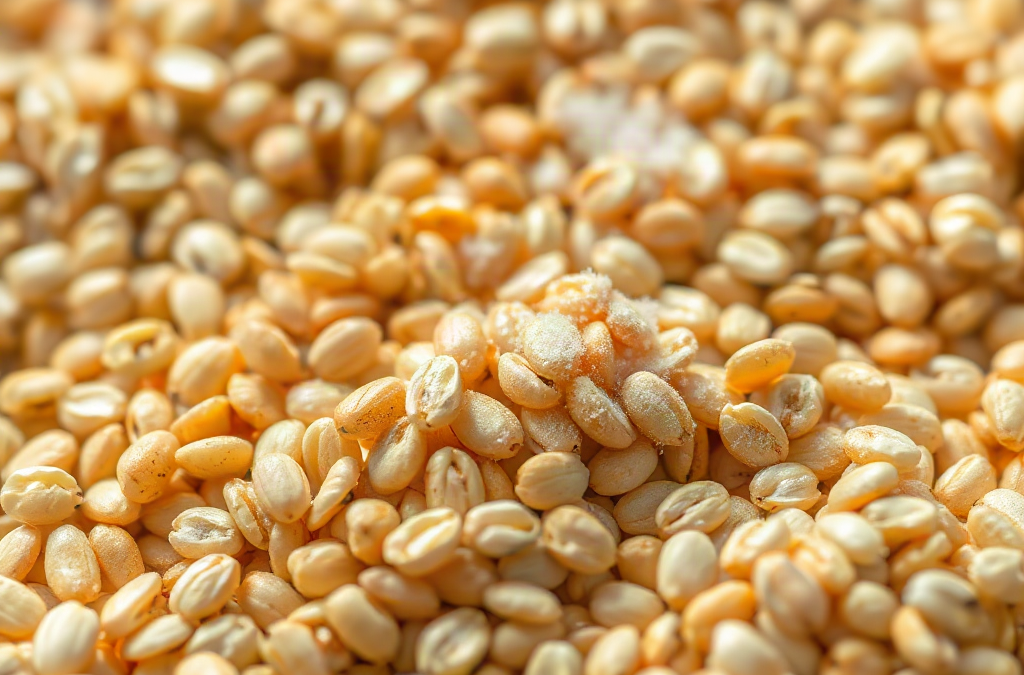
Grain storage mold versus harmless discoloration is distinguished by examining growth pattern, odor, texture, moisture exposure, and whether the marking spreads across kernels. Mold may appear fuzzy, powdery, web-like, or clustered and often accompanies musty odors, dampness, caking, or insect activity; harmless variation is usually dry, fixed, and confined to the seed coat. Do not taste questionable grain or rely on color alone, because mold can be present without dramatic visible growth. Isolate the container, inspect grain from several depths, and discard affected food when mold, unexplained moisture, or a persistent musty smell is present.
Why Grain Changes Color During Storage
Color differences in stored grain can originate in the field, during harvest, or after the grain enters a container. Wheat, oats, barley, rice, corn, and other intact grains are biological materials rather than uniformly manufactured pieces. Seed coats naturally vary in shade, and individual kernels may carry darker tips, pale patches, surface scuffs, or staining caused by soil and plant material. These stable markings can look suspicious when someone expects every kernel to have the same color.
Mechanical handling creates another source of harmless variation. A scratched bran layer may reveal a lighter interior, while pressure against other kernels can polish one side. Old grain can also lose brightness gradually. A uniform shift from a vivid natural color to a duller tone is different from isolated colonies, spreading patches, or damp clusters. Age-related fading does not by itself establish that the food is safe, but it is less concerning when the grain remains dry, loose, normally scented, and structurally intact.
Mold-related color develops through fungal growth supported by available moisture. Grain may have been packaged before it was sufficiently dry, exposed to a leak, or subjected to condensation when warm humid air met a cool container or cool grain. Moisture may collect in one zone rather than affecting the entire batch. For example, kernels near a container wall can deteriorate while the dry material sampled from the top still appears normal.
The weak assumption is that dark kernels are moldy while pale kernels are safe. Fungal growth can be white, gray, green, blue-green, brown, or nearly black, and some contamination produces little obvious surface color. Conversely, a naturally dark crease or germ end may be part of the kernel itself. Color therefore works as one observation, not a final test.
A useful first comparison is consistency. Natural pigmentation usually repeats in a recognizable anatomical location and remains attached to a firm, dry kernel. Suspicious growth tends to cross normal kernel boundaries, collect where moisture accumulated, or appear as material sitting on the surface. Readers assessing Grain storage mold versus harmless discoloration should first ask whether the mark is part of the seed coat or a new deposit extending over it.
Visible Differences Between Mold and Natural Variation
Surface structure carries more diagnostic value than hue alone. Examine a small sample under bright neutral light and, if available, with a hand magnifier. Turn several kernels rather than judging a single exposed face. A harmless stain generally follows the contours of the seed coat, has crisp or naturally irregular boundaries, and does not bridge adjacent kernels. Bran flecks and darker germ areas also tend to occupy comparable locations on multiple kernels.
Active or established fungal growth more often looks raised, dusty, fuzzy, filamentous, or web-like. Fine strands may connect kernels, while powder may settle in creases or transfer to nearby surfaces. Mold can also form compact spots rather than obvious fuzz. Kernels may become shriveled, softened, swollen, cracked, or stuck together after moisture exposure. A discolored area accompanied by structural damage deserves more concern than an equally dark but hard and intact seed coat.
Distribution provides practical context. Suppose a bucket contains scattered red wheat kernels with similar dark lines along their creases, and every kernel remains hard and free-flowing. That pattern is more consistent with normal variation than a gray-white patch concentrated beneath the lid beside condensation droplets. Likewise, several kernels fused into a damp clump indicate a local storage failure even if the surrounding grain looks acceptable.
Do not conduct a rub test that disperses visible dust into the air. Disturbing suspect grain can release fungal spores and fine grain dust, both of which may irritate the respiratory system. Avoid leaning directly over the opening or taking a deep smell from inside the container. People with asthma, mold allergies, or compromised immune systems should not handle visibly moldy grain.
Photographs can help document whether a patch changes, but waiting to see if questionable food becomes visibly worse is not a safety test. Conditions may have dried after fungal growth occurred, leaving residues without ongoing fuzz. Home visual inspection also cannot identify fungal species or determine whether toxins are present. The practical distinction is therefore conservative: stable seed-coat markings may justify closer inspection, while surface growth, clumping, or unexplained residue should move the decision toward rejection rather than salvage.
Odor, Texture, and Container Clues
Odor and physical condition can confirm that a color change belongs to a broader spoilage pattern. Sound dry grain usually has a mild, characteristic cereal smell. A musty, moldy, earthy, sour, fermented, or cellar-like odor indicates that storage conditions changed, even when the kernels show little visible growth. Smell should be checked by gently wafting air from a distance, not by placing the face inside a barrel, bag, or bucket.
Texture reveals where moisture may have moved. Dry kernels should pour freely and feel firm for their grain type. Caking, unusual softness, tackiness, swelling, or damp dust suggests water exposure. Warm spots inside a large mass can accompany biological activity, including insects and microorganisms, although a home user may not be able to determine the cause. Grain that feels warm only because it was kept in a hot room must be interpreted alongside odor, moisture, and distribution.
The package often preserves evidence that the grain itself does not show clearly. Look for condensation, water tracks, rust around a metal seam, a loose lid, punctures, damaged gaskets, or moisture beneath a liner. Insects, larvae, webbing, shed skins, and excess broken material can create heat and moisture or signal that the barrier failed. A sound outer bucket does not rule out a problem if the inner bag was sealed around grain containing too much moisture.
Sampling only the top layer is a common failure. Moisture can settle near a cool floor, migrate toward a lid during temperature changes, or enter through one damaged side. Without plunging bare hands into questionable material, inspect representative portions from the upper, middle, and lower zones when this can be done without spreading dust. If one area is moldy, separating the apparently clean portion is not a dependable household remedy. Invisible fungal structures or contaminants may extend beyond the visible boundary.
Get Whole Wheat Flour, Grains and Milling Supplies – CLICK HERE 
Packaging components can sometimes create non-biological marks. A dark abrasion where kernels repeatedly rubbed against a liner differs from patches associated with dampness and odor. Oxygen absorbers may become firm after activation, but their condition does not prove that grain stayed dry or safe. They remove oxygen from suitable sealed packaging; they do not remove water or reverse deterioration. The best reading of Grain storage mold versus harmless discoloration combines the kernel pattern with the history and condition of the entire package.
A Safe Inspection and Disposal Checklist
A controlled inspection should protect both the stored supply and the person examining it. Move the suspect container away from unaffected food before opening it. Choose a well-ventilated location that is protected from wind, children, pets, and food-preparation surfaces. Do not pour questionable grain from one container to another merely to inspect it; pouring creates dust and can spread insects or spores.
Use this compact decision checklist:
- Review the storage history. Note leaks, flooding, temperature swings, torn packaging, or grain that may have been packed damp.
- Inspect the package. Check the lid, seams, liner, gasket, walls, and bottom for moisture or pest evidence.
- Compare multiple kernels. Look for raised growth, dust, filaments, clumps, damage, and markings that cross natural seed structures.
- Assess odor and flow. Mustiness, sourness, caking, warmth, or softness strengthens the case for spoilage.
- Choose conservatively. Discard food with visible mold, persistent off-odors, unexplained dampness, or widespread deterioration.
Do not taste grain to decide whether it is moldy, and do not assume that washing, sifting, heating, milling, or baking makes a compromised batch suitable for people or animals. Removing visible growth does not establish that the remainder is unaffected. Feeding suspect grain to livestock or wildlife can also transfer the risk rather than solve the disposal problem; local agricultural or waste authorities can advise on larger quantities.
If the marks appear fixed in the seed coat, the grain is dry and free-flowing, the odor is normal, and the container shows no moisture or pest failure, compare the sample with grain from the original lot or a known sound reference. A supplier may be able to identify expected varietal markings or field staining. Laboratory analysis is the more appropriate option when a large or valuable lot makes uncertainty consequential, but testing may cost more than replacing a household container.
After disposal, clean the surrounding storage area without creating airborne dust. Follow the container manufacturer’s cleaning directions if reuse is being considered, and allow all components to dry completely. Replace damaged liners, seals, or lids rather than trusting a visibly compromised barrier. Before refilling, correct the source of moisture and avoid moving cold containers directly into warm, humid air while open.
A sound replacement batch should remain loose, dry, normally scented, and stable during periodic checks. Recurring condensation, new clumps, a returning musty odor, or changes concentrated along the same wall show that the environment or packaging problem continues. Inspection can distinguish many ordinary markings from obvious spoilage, but uncertainty involving dampness or odor should be treated as a food-safety decision rather than a cosmetic one.
Frequently Asked Questions
Can stored grain have black spots without being moldy?
Yes. Natural seed-coat pigmentation, dark creases, field staining, or mechanical scuffs can create black or brown marks. A fixed mark on a dry, firm kernel is less concerning than raised growth, residue, musty odor, or moisture damage.
Is white powder on grain always mold?
No, because flour-like dust and broken starch can accumulate during handling. Treat powder as suspicious if it appears in localized colonies, forms filaments, returns after movement, or occurs with clumping, dampness, damaged kernels, or an off-odor.
Can moldy kernels be removed from an otherwise good batch?
Picking out visible kernels is not a reliable safety measure. Growth or contamination may extend beyond what can be seen, especially after moisture moved through the grain mass. For household food, rejecting the affected batch is the conservative choice.
Does cooking make moldy grain safe?
Cooking should not be used to rescue visibly moldy, musty, or moisture-damaged grain. Heat may kill some living organisms, but it does not provide a dependable household method for addressing every contaminant associated with fungal spoilage.
Should questionable grain be opened indoors?
Avoid opening visibly moldy or dusty grain in living areas or near other food. Minimize disturbance, use a controlled ventilated location, and keep vulnerable people away. Large affected quantities may require disposal guidance from local authorities.
Conclusion
Reliable judgment comes from combining appearance with structure, smell, moisture evidence, package condition, and the distribution of the change. Dry markings that follow the anatomy of firm kernels may reflect natural pigmentation or handling, while fuzzy deposits, transferable powder, webbing, caking, mustiness, and damp zones point toward deterioration.
Isolate a questionable container before examining it, sample more than the top layer, and avoid tasting or aggressively pouring suspect grain. Visible mold, persistent off-odors, or unexplained moisture justify discarding the affected food rather than attempting to wash, sift, or cook away the problem. If a clean-looking batch passes inspection, correct any packaging or environmental weakness and monitor it for renewed condensation, clumping, warmth, or odor. When the evidence remains ambiguous and the lot matters enough to preserve, seek qualified laboratory or agricultural guidance instead of relying on color alone.
Get Whole Wheat Flour, Grains and Milling Supplies – CLICK HERE
Related Content
- Prepping Storage Ideas: Practical Solutions for Efficient Space Management
- Top 10 Food Storage Ideas for Preppers in 2025 (Ultimate Guide)
- Home Storage for Prepping Grains: Effective Containers, Techniques, and Maintenance
- The Ultimate Guide to the Best airtight containers for grain storage in 2025
- The Ultimate Guide to 10 Effective Bulk Food Storage Systems for 2025
Auto Amazon Links: No products found.