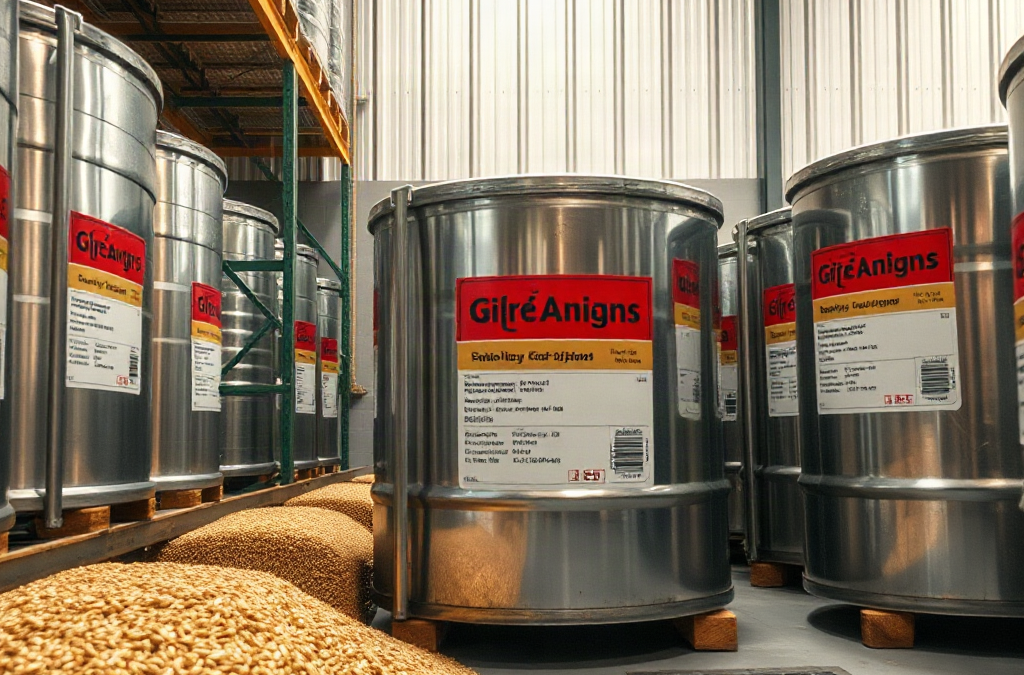
Effective grain storage labels prevent inventory errors by giving every container a unique lot code, grain identity, packing date, quantity, and inspection status in a consistent format. Place the same identifier on the container lid and side so it remains visible when buckets, bags, or bins are stacked. Record moisture or condition notes when known, but never substitute an unverified estimate for measured information. Durable labels paired with a matching inventory log make stock rotation, partial-quantity updates, and problem-lot isolation far more reliable.
Information Every Grain Label Should Carry
A useful label identifies one physical lot without requiring anyone to open the container or consult several unrelated notes. At minimum, it should state the grain, variety or form when relevant, unique lot code, packing date, current quantity, and storage status. A bucket marked only “wheat” cannot distinguish hard red wheat from soft white wheat, an older purchase from a recent one, or inspected stock from a container awaiting review.
The lot code is the link between the physical grain and its inventory history. It should be unique, short, and assigned once. A practical code might combine a grain abbreviation, packing year, and sequence number, such as HRW-26-03 for the third hard red wheat lot packed in 2026. The code does not need to carry every fact; its job is to identify the lot consistently. Overloaded codes become difficult to read and are more likely to be copied incorrectly.
Dates need explicit labels. “09/10/26” can be interpreted differently depending on local date conventions, and an unlabeled date could mean purchase, packaging, inspection, or expected rotation. Write dates in an unambiguous form such as “Packed: 10 Sep 2026.” If the purchase date matters for receipts or supplier tracing, give it a separate field rather than combining it with the packing date.
Quantity should include both a number and unit. “25” is incomplete; “25 lb at packing” is usable. When grain is removed, record the revised quantity or mark the container as opened and update the associated log. For household inventory, an approximate remaining amount may be acceptable if it is clearly identified as an estimate. Commercial or regulated operations may require calibrated measurements and procedures beyond a household labeling system.
Condition fields should report observations rather than unsupported conclusions. “Packaging intact; inspected 18 Sep 2026” is more defensible than “perfect condition.” If moisture was actually measured, note the result, instrument or method where appropriate, and measurement date. Do not invent a moisture value based on how dry the kernels feel. Readers building grain storage labels that prevent inventory errors should prioritize traceable facts over decorative detail.
A Label Format That Reduces Reading and Entry Errors
Consistent field order reduces the mental work involved in identifying and recording stored grain. Put the grain name in the largest type, followed by the lot code, packed date, quantity, and status. Reserve a lower section for inspections, opening dates, or quantity changes. When every label follows the same layout, a person can find the needed value quickly instead of scanning an improvised paragraph.
Visual hierarchy should communicate meaning without relying on color alone. Large black text for the grain and lot code remains useful under poor lighting and for users who cannot distinguish certain colors. Color bands may supplement the text—for example, one color for wheat and another for rice—but a faded band must not be the only way to identify the contents. Handwriting should be printed clearly with a permanent, surface-compatible marker; cursive notes and unexplained abbreviations invite transcription mistakes.
A compact household label can use the following order:
- Contents: Hard red wheat berries
- Lot: HRW-26-03
- Packed: 10 Sep 2026
- Quantity: 25 lb at packing
- Status: Sealed; next inspection Mar 2027
- Location: Shelf B2
Location is helpful when similar containers occupy more than one room, rack, or storage area. It should describe the assigned position, not replace the lot code. Shelves change; lot identity should not. If bucket HRW-26-03 moves from B2 to C1, update the location in the inventory record while retaining the original lot identifier.
Status language must be standardized. If one person writes “OK,” another writes “checked,” and a third writes “good,” the labels do not show whether the same inspection occurred. Choose a small set of explicit terms such as “sealed,” “opened,” “hold for inspection,” and “remove from food inventory.” A hold status is especially useful when a container shows condensation, damaged packaging, pest evidence, or an unexplained odor. It prevents uncertain stock from being used or combined with another lot before assessment.
Barcodes or QR codes can speed data entry, but they should supplement readable text. Phones fail, files move, and printed codes can become damaged. The grain, lot code, and status should remain legible without a scanner. For a small pantry, a standardized handwritten or printed label often outperforms a complex digital system that no one maintains.
Materials and Placement for Buckets, Bags, and Bins
Label material must match the container surface and storage environment. Paper labels may work on clean, dry buckets in a climate-controlled room, but they can curl or release when exposed to dust, abrasion, humidity, or temperature changes. Synthetic labels and suitable permanent markers generally tolerate handling better, although adhesive compatibility should be tested before an entire inventory is labeled.
Rigid buckets should carry duplicate identification on the side and lid. The side label can be read on a shelf, while the lid label remains available when the bucket is moved or viewed from above. Both locations should show at least the grain and lot code. Never put the only identifier on a removable lid: lids can be swapped during inspection or repacking, leaving the wrong identity attached to the grain.
Flexible grain bags present different constraints. A label attached loosely to string or a closure can separate from the bag. Place a durable tag at the closure and, where the bag material permits, add matching identification directly to the bag. Avoid writing where folds, abrasion, or repeated handling will obscure the text. If grain is transferred from a bag into smaller containers, assign sub-lot identifiers such as HRW-26-03-A and HRW-26-03-B rather than treating the new containers as unrelated stock.
Large bins need identification at normal viewing height and near the access or discharge point when safe to do so. Labels should not require climbing, reaching around equipment, or entering a hazardous area to read them. The bin identifier and contents record should agree with any intake, transfer, or cleaning documentation used by the operation. Site-specific safety procedures take priority over convenient label placement.
Clear tape over a paper label can protect writing from smears, but it is not automatically archival. Tape edges can lift, and some inks may fade or react with adhesives. Test a sample under actual storage conditions and inspect it after several weeks. Direct marking is similarly imperfect because containers may later be reused. A removable durable label can support reuse, provided old identifiers are fully removed or permanently canceled.
A label is working when it remains attached, readable, and visible without moving several heavy containers. It is failing when corners lift, ink transfers to hands, dates fade, or the label faces the wall after normal stacking. Correct placement and duplicate identifiers are cheaper than reconstructing a container’s history after its only tag disappears.
Keeping Labels and Inventory Records Synchronized
The label and inventory log should function as two views of the same lot. The container supplies immediate identity and status; the log preserves details such as supplier, purchase quantity, inspections, transfers, and remaining balance. Errors appear when either record changes without the other. A bucket may say 25 pounds even though half has been used, or a spreadsheet may show a lot that was discarded months earlier.
Get Whole Wheat Flour, Grains and Milling Supplies – CLICK HERE 
Choose one source for each changing field. The inventory log is usually the better source for detailed transaction history, while the physical label should show the current status and enough information to verify that the correct lot was selected. If exact remaining weights are not measured after every use, mark the package “opened” and use a clearly labeled estimate in the log. False precision is more misleading than an honest range.
Stock rotation should be based on lot identity and condition, not appearance alone. Two identical buckets may contain grain packed years apart. Selecting the nearest bucket repeatedly can leave older lots untouched. A location map or shelf code allows older suitable stock to be chosen without opening containers to investigate. First-in, first-out is a useful starting method, but damaged or suspect packaging requires separate assessment rather than automatic priority for consumption.
Transfers deserve immediate documentation. Suppose a 40-pound rice lot is divided between two 20-pound containers. The original lot record should show the split, and each new container should carry a linked sub-lot code. If the containers later develop different conditions—one seal fails while the other remains intact—the shared origin is preserved without implying that both now have the same status.
Digital records offer sorting, search, and easier quantity totals. Paper records remain accessible during a power outage and may be simpler for a small store. A hybrid system can work well if one version is designated as authoritative and updates are reconciled on a fixed schedule. Two independent logs that are assumed to match will eventually diverge.
Use the same spelling, units, and lot code in every record. Searching a spreadsheet for “HRW-26-03” may not find an entry mistyped as “HWR-26-03.” Data validation, drop-down status choices, and periodic comparison against physical labels can catch these small discrepancies before they affect purchasing or rotation decisions.
A Practical Labeling Workflow and Error Audit
A controlled workflow prevents identification mistakes at the moment they are easiest to create: packing and transfer. Prepare the label before filling when possible, but do not mark the container as sealed until sealing is complete. Keep only one unlabeled open lot in the work area at a time. Multiple open bags of similar-looking grain make it easy to attach a correct label to the wrong container.
Start by confirming the product name and any meaningful form or variety, then assign a unique lot code. Record the packing date and measured quantity, attach side and top identification, seal the container, and enter the lot in the inventory log. Finish by reading the physical label against the record rather than checking from memory. For shared storage, a second-person check may be worthwhile for large transfers or easily confused grains.
A short audit should examine both readability and agreement:
- Locate every container listed in the inventory record.
- Match the lot code, grain, quantity status, and location.
- Check labels for fading, detachment, obstruction, or altered handwriting.
- Identify opened, transferred, empty, quarantined, or removed containers.
- Correct discrepancies with a dated note rather than silently guessing.
Do not erase uncertainty by inventing missing information. If an unlabeled container cannot be identified confidently, mark it “identity unconfirmed” and isolate it from known inventory. Appearance alone is not a dependable identifier because many wheat, rice, oat, and other grain lots look similar. The proper next action depends on intended use, storage history, and applicable safety procedures; a new label cannot restore missing provenance.
Audit frequency should reflect activity and conditions. Frequently opened pantry stock needs review when quantities change, while sealed reserve containers may be checked on a planned inspection cycle. A move, leak, pest incident, container failure, or inventory handoff warrants an additional reconciliation. Signs of success include quick lot retrieval, matching counts, legible labels, and no containers with unexplained status.
Build revisions into the system. If users repeatedly confuse the packed date with the inspection date, separate those fields more clearly. If location codes are too similar, change their format. The best template is not the one with the most fields; it is the one that preserves necessary facts and is completed correctly every time. A periodic review of grain storage labels that prevent inventory errors should therefore examine human use as closely as label durability.
Frequently Asked Questions
What is the most important item on a grain storage label?
A unique lot code is the strongest control because it connects the physical container to its packing, inspection, quantity, and transfer history. The grain name should still appear prominently for immediate identification.
Should the purchase date or packing date be used?
Use the packing date on the container because it describes the current storage package. Record the purchase date separately when supplier tracing or time before repacking matters.
Can color-coded labels replace written grain names?
No. Color is a useful secondary cue, but fading, poor lighting, printing differences, and color-vision limitations make text necessary. Always print the grain and lot code.
How should an opened grain container be relabeled?
Retain the original lot code, add the opening date, mark the status as opened, and update the remaining quantity in the inventory log. Do not assign a new lot merely because the seal was broken.
What should be done with an unlabeled container of grain?
Separate it from identified stock and mark its identity as unconfirmed. Do not guess from kernel appearance or combine it with a known lot; follow suitable assessment and disposal procedures for its intended use.
Conclusion
Reliable grain identification comes from a small set of well-controlled details: a unique lot code, explicit grain name, unambiguous dates, quantity with units, current status, and a matching inventory entry. Use the same field order on every container, place identification where stacking cannot hide it, and duplicate critical information on removable lids or closures only when the main container also remains marked.
Begin by auditing existing stock for unreadable, missing, or conflicting labels. Isolate any container whose identity cannot be verified, then standardize new labels before the next packing session. Reconcile transfers, openings, and removals as they occur rather than postponing updates. A simple system maintained consistently provides more dependable inventory control than elaborate codes, scanners, or spreadsheets that drift away from the grain on the shelf.
Get Whole Wheat Flour, Grains and Milling Supplies – CLICK HERE
Auto Amazon Links: No products found.