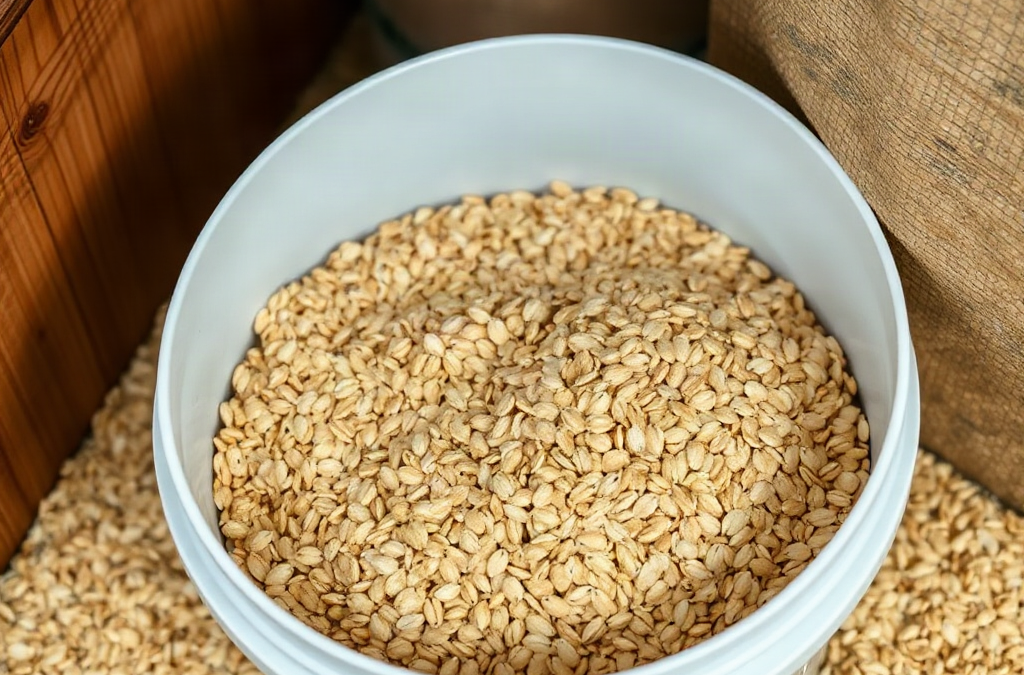
A storage bucket holds grain according to its usable volume and the grain’s bulk density, so a nominal 5-gallon bucket typically accommodates roughly 25 to 37 pounds of dry grain. Dense grains such as wheat and white rice usually approach the upper end, while rolled oats may fill the same bucket at less than half that weight. Kernel size, settling, headspace, and liner thickness change the final amount. For a reliable figure, weigh the empty bucket, fill it without compressing the contents, leave room for the lid or oxygen absorber, and subtract the container’s weight.
Typical Capacity of a 5-Gallon Bucket
A nominal 5-gallon bucket provides a useful planning unit, but the label does not guarantee that all five gallons are available for grain. The bucket may hold five gallons only when filled near the rim, while the lid, gasket, liner, or oxygen absorber requires some of that space. For practical storage, the usable capacity is often slightly below the container’s maximum liquid volume.
Whole wheat commonly weighs about 33 to 37 pounds in a filled 5-gallon bucket. White rice often falls near 30 to 36 pounds, depending on grain length and how much it settles. Dry corn may land around 30 to 35 pounds. Rolled oats are much lighter and may weigh only about 15 to 20 pounds in the same container. These are planning ranges rather than guaranteed package weights because grain moisture, shape, broken kernels, and filling technique all affect bulk density.
Volume and weight answer different questions. Bucket size determines how much physical space is available, while pounds determine how much food has actually been stored. Two buckets can look equally full yet contain sharply different weights. A bucket of rolled oats contains more air between flakes than a bucket of compact wheat kernels, so using one universal “pounds per bucket” figure creates purchasing and inventory errors.
Container design introduces another source of variation. Some utility buckets taper noticeably toward the bottom, and heavy-duty food buckets may have thicker walls. A square container advertised by gallon capacity can also have a different fill line than a round bucket. Never assume that an exterior size or marketing label reveals the working volume available below the lid.
For rough purchasing, use a range for the specific grain and plan conservatively. If exact inventory matters, use a scale after filling each container. The page on How much grain fits in a storage bucket can serve as a planning reference, but the measured net weight of the actual contents should control labels and records.
Why Grain Type Changes the Weight
Bulk density explains why equal bucket volumes produce unequal grain weights. It measures the mass of loose material occupying a given volume, including the air spaces between kernels or flakes. Dense, regularly shaped kernels settle closely together. Large, irregular, or flattened pieces leave more empty space and therefore weigh less per bucket.
Wheat berries pack efficiently because their kernels are relatively small and firm. Rice also settles readily, although long-grain and short-grain varieties may occupy space differently. Whole kernel corn is larger and can leave wider gaps. Rolled oats behave differently from intact kernels: the flakes bridge across one another, trap air, and may break if pressed. Steel-cut oats are denser than rolled oats because their smaller pieces settle more closely.
Processing changes capacity even when the food began as the same crop. Whole wheat berries, cracked wheat, and flour should not be treated as interchangeable. Flour can settle heavily, create airborne dust during filling, and has different storage considerations from intact grain. Grinding also exposes more surface area, so a bucket measurement does not address shelf life or packaging suitability. The capacity calculation should describe the product in its stored form, not merely the crop from which it came.
Moisture affects weight as well. Grain containing more water weighs more, but extra weight does not mean more dry food. Grain intended for storage should already be appropriately dry; a bucket and oxygen absorber cannot correct unsuitable moisture. Damp grain can support mold or other deterioration even when the container seals correctly. Do not add questionable grain to a sound batch simply to fill the remaining space.
A common mistake is converting a commercial bushel weight directly into bucket capacity without accounting for volume and condition. Bushel weights are commodity-specific reference measures, while a household bucket may not contain an exact fraction of a bushel at its safe fill level. Such conversions are adequate for estimates, but a household scale provides a better answer for the grain and container in front of you.
Use separate assumptions for each stored product. For example, planning 35 pounds for wheat and the same amount for rolled oats would substantially underestimate the number of oat buckets required. Labels should identify the grain, processing form, packing date, and net weight so later meal or supply calculations are based on actual food rather than bucket count alone.
How to Measure Your Bucket Accurately
Direct weighing is the most dependable way to determine bucket capacity because it captures the container, grain, liner, and fill level actually being used. A basic platform or shipping scale is generally easier to read than a small kitchen scale when the filled bucket approaches several dozen pounds. Confirm that the scale’s rated capacity exceeds the expected total weight.
Begin by placing the empty bucket, liner, and any components that will remain with the package on the scale. Record that tare weight or use the scale’s tare function. Fill the liner gradually with clean, dry grain. A wide scoop reduces spills, while pouring from excessive height can release dust and sort small particles toward the bottom.
- Check the container: Confirm that it is clean, dry, food-contact appropriate, and free from cracks or damaged lid surfaces.
- Record the tare: Weigh the bucket with its liner before adding grain.
- Fill consistently: Add grain in stages and gently settle it without forceful compression.
- Allow working space: Reserve enough room to close the liner and fully seat the lid.
- Calculate net weight: Subtract the tare weight from the final filled weight and write the result on the label.
Gentle settling can make measurements more repeatable. Lightly rocking the bucket or tapping its sides allows kernels to find natural spaces. Forceful tamping is a poor comparison method because it can split grains, stress the liner, distort the bucket, and leave insufficient room for closure. Rolled oats are particularly vulnerable to crushing, so their natural loose fill is more useful than a compressed measurement.
If a scale is unavailable, measure a smaller known volume and weigh it on a kitchen scale. For example, weigh several level quarts of grain, calculate the average weight per quart, and multiply by the usable quart capacity of the bucket. Multiple samples are better than one because scooping and settling vary. This method remains an estimate, but it is more defensible than applying a figure taken from a different grain or container.
A water-volume test can identify a bucket’s capacity, but only before it is placed into dry-food service and only if it can be dried completely afterward. Water weighs about 8.3 pounds per U.S. gallon, making it possible to verify approximate volume by weight. Moisture trapped under a rim or gasket is unacceptable around grain, so a purpose-marked measuring vessel is often the safer option. Once filled, check that the lid seats evenly and that the bucket wall is not bulging.
Headspace, Liners, and Packing Mistakes
Filling to the rim does not produce the best storage package. A liner must gather or seal without grain contaminating the closure, and a lid needs a clear rim to seat correctly. If oxygen absorbers are part of the chosen method, they also require physical space, although their size is not the main reason to leave headroom. The practical target is a full container that closes without forcing either the liner or lid.
A food-grade bucket and an inner barrier liner perform different jobs. The bucket protects against impact and offers structural support. A suitable high-barrier liner can reduce oxygen and moisture transmission when sealed correctly. Bucket plastic alone should not automatically be assumed to provide the same long-term barrier as purpose-made packaging. Packaging choices should match the intended duration, environment, grain condition, and expected frequency of opening.
Get Whole Wheat Flour, Grains and Milling Supplies – CLICK HERE 
Oxygen absorbers are not a remedy for wet grain, an unsealed liner, or a compromised bucket. Their required size relates to residual oxygen in the package, including air between kernels, rather than grain weight alone. Manufacturer instructions for the absorber and liner should control the packaging procedure. Opening a large pack of absorbers before all buckets are ready can reduce their useful capacity as they react with room air.
Three failures are especially easy to spot. Grain caught on the sealing surface can create a channel through the liner seal. A lid that rises, rocks, or will not snap uniformly may indicate overfilling. Condensation, clumping, musty odor, insect activity, or liner damage during later inspection signals a problem that capacity calculations cannot solve. Suspect grain should be isolated rather than blended with unaffected stock.
Leaving excessive empty space has tradeoffs too. It wastes container capacity and increases the amount of air inside the package. For grains suited to sealed dry storage, a modest working gap is preferable to either a half-empty bucket or a rim-level fill. If the remaining quantity is too small for the bucket, use a smaller compatible container instead of treating every bucket as mandatory.
Storage location remains part of the calculation. A bucket that fits by weight may be awkward to lift, stack, or rotate. Thirty-five pounds plus the container is manageable for some households but not others. Smaller buckets cost more per pound of capacity yet may reduce handling strain and limit how much food is exposed each time a package is opened. Packaging should fit the user as well as the grain.
Planning the Number of Buckets You Need
Bucket planning should begin with pounds of each grain, not a desired number of matching containers. Divide the total dry weight by a conservative capacity for that specific product, then round up. If 100 pounds of wheat is expected to fit at about 34 pounds per bucket, three buckets leave almost no margin; four provide room for variation and any partial package.
Use net weight from a test bucket when purchasing many identical containers. Fill one bucket exactly as intended, including the same liner, headspace, and closure method. If that test holds 33 pounds of wheat, divide the total wheat supply by 33 rather than using an optimistic published estimate. Repeat the test for rice, oats, corn, or any other product because the wheat result does not transfer reliably.
Package size should also reflect use rate. A household that consumes rice frequently may empty a large bucket soon after opening it. A less frequently used grain may be better divided among smaller packages so most of the supply remains sealed. Multiple packages also limit the amount affected by one puncture, spill, or closure failure, although they require more lids, liners, labels, and storage space.
Floor loading, shelving strength, and stacking height deserve attention before containers are filled. A row of grain buckets concentrates considerable weight in a small area. Place containers on a stable, level surface and follow the bucket manufacturer’s stacking guidance rather than building a tall stack based only on apparent strength. Keep labels visible so older stock can be used first without dismantling the entire arrangement.
A practical inventory records product name, net weight, package date, and any packaging treatment used. “One bucket of oats” is too vague for meal calculations; “17 pounds of rolled oats” is actionable. Recheck inventory when a bucket is opened rather than continuing to count it as full. For repeated calculations, the internal reference on How much grain fits in a storage bucket can be paired with actual scale readings from the household’s containers.
The sign that the plan is working is consistency: comparable buckets of the same grain have similar net weights, close without strain, and can be moved safely. Large weight differences suggest inconsistent fill levels, mixed grain conditions, or measurement errors. Resolve those discrepancies before buying the remaining buckets because a small error multiplied across a large supply can leave either unused containers or unpackaged grain.
Frequently Asked Questions
How many pounds of wheat fit in a 5-gallon bucket?
A practical estimate is about 33 to 37 pounds of whole wheat berries. The exact amount varies with kernel condition, settling, liner thickness, and the headspace needed to close the package.
How much rice fits in a 5-gallon bucket?
Many 5-gallon buckets hold roughly 30 to 36 pounds of dry white rice. Long-grain, medium-grain, and broken rice can settle differently, so weigh a completed test bucket before planning a large batch.
Why do rolled oats weigh less than wheat in the same bucket?
Rolled oat flakes trap more air and do not pack as closely as compact wheat kernels. A full 5-gallon bucket may therefore contain only about 15 to 20 pounds of rolled oats.
Should grain be packed tightly into a bucket?
Settle whole kernels gently, but do not forcefully compress them. Heavy tamping can damage grain or the liner and may leave too little room to seal the package and seat the lid.
Does a 5-gallon label mean five gallons of usable grain space?
Not necessarily. The stated capacity may extend close to the rim, while a liner, closure, and working headspace reduce usable volume. Bucket shape and wall thickness also vary by manufacturer.
Conclusion
Plan grain storage by combining a grain-specific estimate with one measured test bucket. Wheat, rice, corn, and rolled oats cannot share a single pounds-per-bucket assumption because their shapes and bulk densities differ. Account for the liner, closure, natural settling, and enough headspace to seal the package without strain.
Before filling an entire supply, weigh the empty setup, complete one package, and record its net contents. Use that result to calculate container count, then consider whether the filled weight is safe to lift and whether the package size matches normal consumption. Clear labels and conservative capacity estimates prevent more inventory errors than squeezing an extra pound into each bucket. Dry grain, sound packaging, secure closure, and a suitable storage location should take priority over maximizing volume.
Get Whole Wheat Flour, Grains and Milling Supplies – CLICK HERE
Auto Amazon Links: No products found.