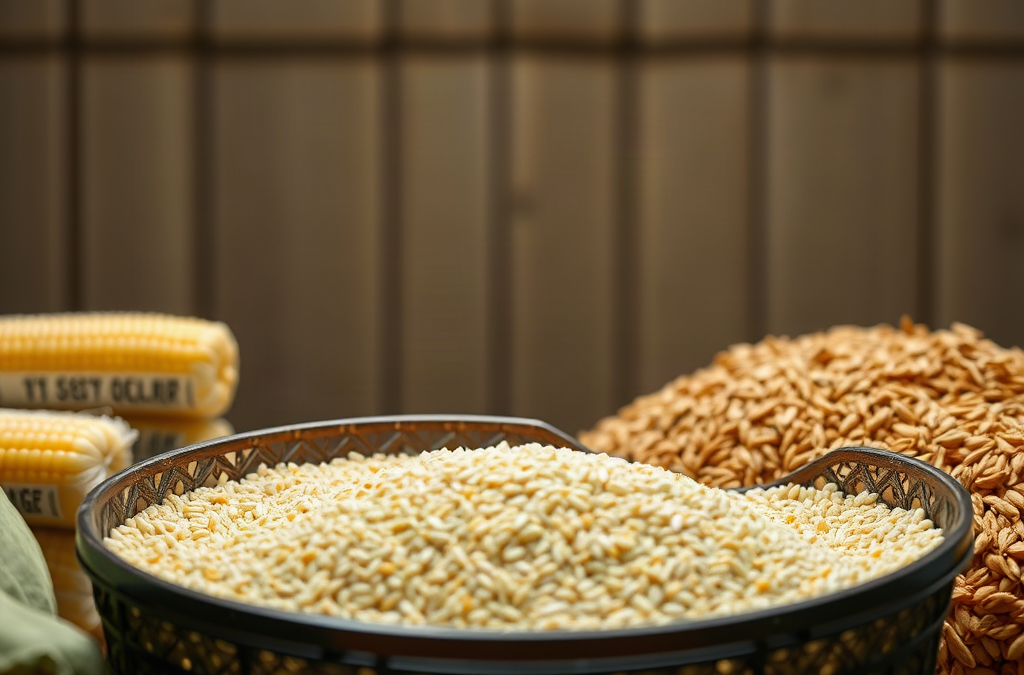
Corn and wheat separation during shared storage works best when each crop remains in a dedicated, sealed compartment rather than being divided by a loose sheet or assumed to stay layered. Corn kernels and wheat berries differ in size, shape, bulk behavior, moisture condition, and airflow resistance, so leakage or mixing can interfere with cleaning, drying, aeration, milling, and sale. Use sound partitions, close conveyor gates fully, clean handling equipment between crops, and label every inlet and outlet. If the grains have already mixed, screen separation may recover usable fractions, but kernel size overlap, broken grain, and fines can prevent complete recovery.
Why Do Corn and Wheat Not Stay Separated on Their Own?
A visible boundary between poured corn and wheat is not a dependable storage partition. Grain moves while a bin is filled, aerated, vibrated, partially unloaded, or disturbed by an auger. Kernels roll down the surface of the grain mass at different rates, while smaller wheat kernels and broken material can enter spaces between larger corn kernels. A neat layer observed through an access opening may therefore conceal a broad transition zone below the surface.
The two crops also create different storage conditions. Kernel size and the amount of fine material affect resistance to airflow. A fan pushing air through a mixed mass may encounter irregular paths rather than the relatively predictable resistance expected from one clean commodity. Air can follow easier routes, leaving compacted or fine-rich pockets with less ventilation. Mixing grain does not automatically make it unsafe, but it makes moisture and temperature management less uniform and inspection results harder to interpret.
Moisture content requires particular attention. A reading from one crop cannot be treated as a reliable reading for the other, and samples taken from the transition between crops may not represent either lot. If wetter corn is placed beside or above drier wheat, the arrangement should not be viewed as a way to average their condition. Moisture migration responds to temperature gradients and local conditions within the stored mass; it does not reliably produce a stable, uniformly conditioned mixture.
Consider a small bin filled first with wheat and then with corn. The operator may expect wheat to leave first because it entered first. A center sump, however, draws material into a funnel-shaped flow pattern. Corn above the outlet can descend while wheat remains near the wall, creating mixed discharge much earlier than expected. Funnel flow is one reason layering cannot replace a structural divider.
The practical assumption should be that uncontained crops will mix. Even when mixing does not damage the kernels, it can reduce their usefulness. Wheat intended for flour preparation may need corn fragments removed, while corn intended for a specific ration, processor, or buyer may fail that recipient’s cleanliness requirements. Keep identity, moisture records, and intended use attached to distinct lots from the moment they enter storage.
Physical Separation Inside a Shared Storage Space
A shared building can hold both crops successfully when it provides genuinely independent containment. Separate bins, sealed food-grade bulk containers, or engineered compartments are more reliable than tarps, plywood leaned against a wall, or grain bags placed where loaders can puncture them. The separator must withstand the lateral pressure of the stored material as well as impact during filling. A divider that looks rigid while empty may bow, shift, or leak once grain accumulates against it.
Purpose-built compartments need continuous boundaries at the floor, walls, and discharge points. Small openings matter because wheat can pass through gaps that retain intact corn. Check seams around posts, floor joints, cleanout doors, aeration ducts, and gates before loading. Light visible through a seam, loose fasteners, old sealant, corrosion, or kernels remaining from a previous fill indicate that the compartment is not ready.
Aeration adds a design constraint. Two commodities should not merely be divided above a shared plenum without confirming that airflow can be controlled for each side. Corn and wheat may enter storage at different temperatures or moisture conditions and may not need the same fan schedule. A partition that ends at a perforated floor can still allow air to cross beneath it. Independent fan control and monitoring points are preferable where the storage design supports them. Modifying a bin, floor, or structural wall should be evaluated by the equipment manufacturer or a qualified grain-storage professional rather than improvised under load.
For household-scale storage, multiple smaller containers usually offer better control than one large box split with a temporary panel. Containers should be clean, dry, suitable for food contact, closable against pests, and positioned off damp floors where they can be inspected. Smaller units cost more per unit of capacity and require more labels, but a damaged seal or questionable lot affects less inventory. Large fixed compartments reduce container handling but demand more attention to structural integrity and cleanout access.
Use a prefill check focused on the actual routes by which grain can cross:
- Boundary: Inspect the divider, corners, roofline, floor, and penetrations.
- Discharge: Confirm that each compartment has an identifiable outlet and a gate that closes fully.
- Air: Verify where fan air enters, exits, and can pass beneath a partition.
- Access: Preserve a safe way to sample and inspect each crop independently.
- Identification: Mark the crop, source lot, loading date, and known condition at every relevant control point.
A successful arrangement remains verifiable after filling. If there is no practical way to sample each side, detect leakage, or determine which outlet serves which crop, the apparent space savings have introduced an operational blind spot.
How Can Mixing Be Prevented During Grain Handling?
Handling equipment is often the transfer point where carefully separated lots become contaminated. Augers, conveyors, elevators, pits, spouts, vacuums, and receiving hoppers retain kernels after they appear empty. Wheat is especially able to remain in ledges and corners, while cracked corn and fines collect in boots, transitions, and low sections. Sending the next crop through without a cleanout carries the retained material directly into its compartment.
Plan the crop change as a distinct operation rather than an interruption between loads. Stop and isolate the equipment according to its operating instructions before opening access points. Remove residual grain from reachable collection areas, inspect the receiving path, and dispose of or separately identify the cleanout material. Never enter a grain bin or place a hand near moving equipment to retrieve kernels. Stored grain can engulf a person, and conveying machinery can start or retain hazardous energy; equipment-specific safety procedures take priority over recovering a small quantity.
The sequence of operations also affects purity. Suppose wheat is unloaded through a shared auger after corn. If the auger contains a modest heel of corn, the first wheat leaving it may carry concentrated corn kernels. Capturing the initial discharge in a separate container provides a practical check and keeps that transition material out of the main wheat lot. The necessary amount cannot be set universally because auger length, angle, internal design, and previous shutdown conditions vary. Continue the transition collection until visual inspection shows the expected commodity consistently, then retain a sample if lot identity matters.
Get Whole Wheat Flour, Grains and Milling Supplies – CLICK HERE 
Labeling should extend beyond the bin wall. Mark valves, electrical controls, removable spouts, and temporary hoses so an operator does not select the wrong route. Before starting, trace the intended path from receiving point to destination and verify gate positions. A second-person check is useful in systems with several branches, but it does not replace clear markings. An unlabeled gate is an invitation to rely on memory, especially during night work or a hurried weather window.
Signs that the procedure is working include clean transition samples, no kernels appearing along partition seams, consistent commodity at the intended outlet, and records that reconcile incoming loads with compartment use. Repeated foreign kernels, unexplained inventory differences, grain beneath closed gates, or mixed material at startup indicate leakage, retained grain, or incorrect routing. Pause before adding another load; every additional movement spreads the problem and makes recovery more difficult.
Can Corn and Wheat Be Separated After They Mix?
Mixed corn and wheat can often be separated by size, but the achievable result depends on kernel condition and the purity required. Intact corn kernels are generally larger than wheat kernels, allowing a screen cleaner to retain one fraction while smaller material passes through. That simple size difference is useful, yet it is not absolute. Broken corn may be similar in size to wheat, and unusually large wheat, cob pieces, chaff, and foreign material can report to the wrong fraction.
Begin by defining the intended outcome. Grain being separated for immediate, compatible use may tolerate a small amount of the other crop. Seed, food processing, milling, or sale under a specification can demand much tighter control and may justify professional cleaning or laboratory assessment. Visual cleanliness alone does not establish that a lot satisfies a buyer’s contract or a processor’s acceptance standard.
A staged screening process is usually more effective than trying to make one screen perform every task. First remove material larger than sound corn, if present. Then use a screen opening that separates intact corn from wheat, followed by a smaller screen or aspiration step for fines where suitable equipment is available. Test a small sample before processing the full lot. Examine both resulting streams, because a clean-looking wheat fraction may have captured broken corn while the corn fraction still contains clumps or oversized wheat-related material.
| Condition | Likely Approach | Main Limitation |
|---|---|---|
| Mostly intact kernels | Screening by size | Some kernels may overlap in size |
| Many broken kernels and fines | Multiple screens with air cleaning | Greater loss and more passes may occur |
| Small household quantity | Hand sorting plus a suitable sieve | Slow and difficult to verify at scale |
| High-purity or contract lot | Commercial cleaning and representative testing | Added handling, transport, and service cost |
Density separation or gravity equipment may improve a difficult separation when size screening leaves overlapping material, but such equipment requires adjustment and a steady feed. It is not a guaranteed correction for heavily damaged grain. Running grain repeatedly can also create more breakage, so cleaner aggressiveness and handling time should be balanced against the value of the recovered fractions.
Before choosing recovery over alternate use, inspect the mixture for odor, heating, insects, mold-like growth, excess dust, or caking. Separation does not correct spoilage or make questionable grain suitable for people or animals. Stop moving suspect material, avoid breathing concentrated dust, and seek advice from an appropriate grain-testing service, extension office, buyer, or feed professional based on the intended use. The most economical answer may be to redirect a sound mixed lot to a compatible use rather than pursue purity that the available equipment cannot verify.
Frequently Asked Questions
Can corn be stored directly on top of wheat?
Layering is not reliable separation. Filling and unloading create sloped flow and funneling that blend the boundary, while smaller kernels and broken material migrate into openings between larger kernels.
Will a plywood divider keep the crops apart?
Only if it is structurally designed for grain pressure and sealed continuously at the floor, walls, and discharge system. A loose or improvised sheet can bow, leak, or fail under load.
What type of screen separates wheat from corn?
A screen selected to pass wheat while retaining sound corn is a common starting point, but the correct opening depends on the actual kernels and breakage. Test a representative sample before cleaning the full lot.
Does mixed corn and wheat spoil faster?
Mixing does not automatically cause spoilage, but uneven airflow, differing moisture conditions, fines, and poor sampling can hide problem areas. Monitor temperature, condition, and each crop's moisture separately whenever possible.
Can separated grain still be sold as pure corn or wheat?
Do not assume screening restores contractual purity. Ask the intended buyer about its specifications and sampling requirements, especially when the mixture contains broken kernels that are difficult to separate by size.
Conclusion
Reliable separation is established before either crop enters the shared facility. Give corn and wheat independent, sealed containment; verify structural boundaries, airflow paths, gates, and outlets; and treat every equipment changeover as a possible source of carryover. Labels and loading records provide little protection unless operators can trace the physical route from receiving point to compartment.
If mixing occurs, sample the lot before committing time and grain to recovery. Intact kernels may respond well to staged screening, while broken material and fines can require air or density cleaning and still leave an uncertain result. Match the cleanup effort to the final use and any buyer specification. The next practical step is to inspect empty storage and conveying equipment, document every crossover point, and correct leaks or ambiguous controls before the next load arrives.
Get Whole Wheat Flour, Grains and Milling Supplies – CLICK HERE
Auto Amazon Links: No products found.